What are accidentals in music? Accidentals are musical symbols that temporarily change the pitch of a note.
When beginning piano students learn to read sheet music, they eventually encounter three important musical symbols: the sharp (♯), flat (♭), and natural (♮) signs.
These symbols are called accidentals.
At first, students may understand what each symbol means. However, remembering how accidentals work throughout a measure can be much more challenging.
As a piano teacher with 25 years of teaching experience, I have noticed that many beginners make the same mistake: they play the first accidental correctly but forget to apply it when the same note appears again.
That is why I always remind my students:
“It’s a rule! You have to remember it!”
Let’s look at what accidentals mean and how to use them correctly when playing piano.
What Are Accidentals in Music?
An accidental is a musical symbol written next to a note in sheet music that changes its pitch or cancels a previous alteration.
The three most common accidentals are:
- Sharp (♯): Raises a note by one half step.
- Flat (♭): Lowers a note by one half step.
- Natural (♮): Cancels a sharp or flat, returning the note to its natural pitch.
Accidentals appear directly before the notes they affect.
Unlike a key signature, which establishes the notes normally used throughout a piece or section, an accidental makes a temporary change.
To learn more about accidentals and how they appear in sheet music, visit this music theory lesson.
What Are Accidentals in Music? Understanding the Sharp Sign
A sharp sign (♯) raises a note by one half step.
For example, when you see G♯, you play G-sharp instead of G.
On the piano, G♯ is the black key immediately to the right of G.
But understanding the sharp sign is only the beginning.
Students must also understand how long that sharp remains in effect.
The Important Rule: Remember the Sharp Until the End of the Measure
Imagine that you are playing a measure and encounter G♯.
You play G-sharp correctly.
Later in the same measure, another G appears at the same octave, but there is no sharp sign written next to it.
What should you play?
G-sharp again!
The sharp sign does not need to be written every time.
Once G♯ appears, it normally applies to every following G in the same octave for the remainder of that measure, unless another accidental changes it.
This is one of the most important rules beginners need to remember.
My Teaching Tip: Don’t Forget the Accidental!
In my piano lessons, I often notice that students play the first sharp correctly and then forget about it.
They see the next G without a sharp sign and automatically play G-natural.
When that happens, I remind them:
“It’s a rule! You must remember the sharp until the end of the measure!”
I also explain something important.
You do not know whether another G will appear later in that measure.
Maybe it will. Maybe it won’t.
But once you encounter G♯, you need to keep that information in your memory until the measure ends.
If another G appears at the same octave, you are ready to play G♯ confidently.
Playing the accidental is easy. Remembering it is the real challenge.
When learning what are accidentals in music, the sharp sign is one of the first symbols beginners should recognize.
For a more detailed explanation, read my guide on What Does a Sharp Mean in Music?
Understanding Accidentals in Music : The Flat Sign
A flat sign (♭) lowers a note by one half step.
For example, A♭ means you play A-flat instead of A.
On the piano, A♭ is the black key immediately to the left of A.
The same rule applies to flats.
If A♭ appears in a measure, another A in the same octave later in that measure must also be played as A-flat, unless another accidental changes it.
Even if the flat sign is not written again, you must remember it.
Sharp or flat, the rule is the same: remember the accidental until the end of the measure.
To learn more, check out my beginner-friendly guide on What Does a Flat Mean in Music?
Accidentals in Music : How the Natural Sign Works
A natural sign (♮) cancels a sharp or flat.
For example, imagine the key signature contains F♯.
Normally, every F is played as F-sharp.
But if an F♮ appears in the music, you must play F-natural instead.
The natural sign temporarily cancels the F-sharp from the key signature.
Like other accidentals, its effect normally continues for the remainder of the measure for that same note and octave, unless another accidental changes it.
One important detail: a natural sign does not simply mean “play a white key.” It means to play the natural version of that note.
Understanding what are accidentals in music also means knowing how a natural sign cancels a sharp or a flat.
Do Accidental in Music Carry Over to the Next Measure?
This is another rule I emphasize during piano lessons.
Accidentals normally stop applying when the measure ends.
Imagine that you play A♭ in one measure.
When you cross the bar line and begin the next measure, that A-flat no longer applies automatically.
If there is no A-flat in the key signature and no new accidental, you return to A-natural.
I like to tell my students:
“New measure, fresh start!”
The previous accidental is gone.
Sometimes the Music Gives You a Friendly Reminder
Occasionally, you may see a natural sign written in the next measure, even though the previous flat has already expired.
For example, after a measure containing A♭, the next measure might show A♮.
Technically, the natural sign may not be necessary because the previous accidental ended at the bar line.
However, the composer or music editor may include it as a helpful reminder.
This is called a courtesy accidental.
When I see this in a student’s music, I sometimes say:
“Oh, that’s very kind! They reminded us!”
But remember, even if the natural sign is not written, the previous accidental has already expired.
One exception to keep in mind is that a key signature still applies in the new measure. A bar line resets ordinary accidentals, not the key signature.
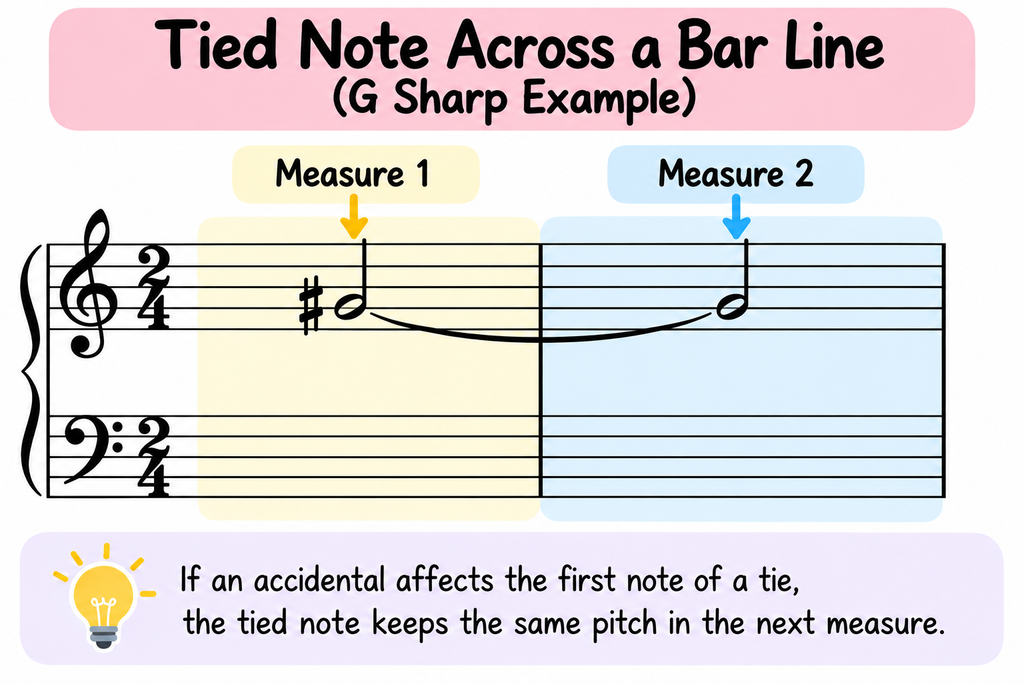
One important exception is a tied note across a bar line, If an accidental affects the first note of a tie, the tied note keeps the same pitch even in the next measure. After the tie ends, the accidental no longer applies unless the key signature or a new accidental requires it.
Do Accidentals Apply to Both Hands?
In piano music, the right and left hands usually read separate staves.
An accidental written on the treble staff does not automatically change notes on the bass staff.
Accidentals generally apply only to the same note name at the same octave within the same measure and staff.
For example, if G♯ appears on the treble staff, you should not automatically play G-sharp on the bass staff unless the key signature or another accidental requires it.
This is another reason students need to pay attention to the music in each hand.
What Are Accidentals in Music Compared to Key Signatures?
Students sometimes confuse accidentals with key signatures because both use sharp and flat signs.
However, they have different purposes.
Key Signature = Forever!
A key signature appears at the beginning of the music, after the clef, and indicates which notes are normally sharp or flat.
For example, a key signature containing F♯ and C♯ is used for D major and B minor.
This means that F and C are normally played as F-sharp and C-sharp throughout the piece, in every octave, unless the music tells you otherwise.
The composer does not need to write a sharp sign next to every F or C.
Students must remember the key signature and apply it while playing.
I sometimes tell my students:
“Key signature means forever!”
Of course, a key signature can change during a piece, and individual notes can be temporarily altered by accidentals.
But for beginners, “forever” is a simple way to remember that the key signature continues beyond a single measure.
Accidental = Temporary!
Now imagine that your key signature contains F♯ and C♯, but you suddenly see A♯ written in the music.
A-sharp is not part of that key signature.
The sharp sign next to A is an accidental that temporarily changes the note.
It normally remains in effect for the rest of that measure for the same A at the same octave.
Then, when the next measure begins, the temporary accidental expires.
I explain the difference to my students this way:
“Key signature is forever. Accidental is temporary!”
This simple comparison helps beginners understand why they must remember the key signature throughout the piece while keeping track of accidentals within individual measures.
Should Students Write Every Sharp or Flat on Their Music?
When students repeatedly forget the key signature, some try to write a sharp or flat next to every affected note.
I discourage this habit.
If the key signature tells you to play F♯ and C♯, you should learn to recognize and remember those notes without writing the symbols everywhere.
Sometimes, if a student keeps making the same mistake in one particular place, I allow a small reminder.
But the goal is to become an independent music reader.
Read the key signature, remember it, and apply it.
Why Learning Accidentals Takes Practice
Music theory gives us important rules, but every piece of music is different.
Sometimes an accidental introduces a note outside the key signature.
A natural sign temporarily cancels a sharp or flat.
In other case, a courtesy accidental appears simply to help the player remember the correct note.
There are many different situations in sheet music, and it is impossible to cover every example in one beginner lesson.
That is why I believe students should first understand the basic rules and then learn to apply them through actual piano practice.
Instead of memorizing every possible situation, focus on understanding what the symbols mean and how they work.
Final Thoughts: Learn the Rule, Remember the Rule, Apply the Rule
Accidentals are an essential part of reading piano music.
Remember these important points:
- A sharp raises a note by one half step.
- A flat lowers a note by one half step.
- A natural cancels a sharp or flat.
- An accidental normally applies to the same note and octave for the remainder of the measure.
- A new measure normally resets the previous accidentals, but the key signature continues to apply.
- A key signature generally applies throughout the piece or until it changes.
Most importantly, do not forget an accidental immediately after playing the note.
Keep it in your memory until the measure ends.
As I often remind my piano students:
“Learn the rule, remember the rule, and apply the rule to the music!”
With consistent practice, recognizing and remembering accidentals will gradually become a natural part of reading sheet music.
So, what are accidentals in music? They are sharp, flat, and natural signs that help musicians read and play the correct notes.