Can you teach yourself piano without taking lessons?
The short answer is yes. You can absolutely learn piano on your own.
With YouTube tutorials, beginner piano books, and online resources, learning piano at home has become easier than ever.
But after teaching piano for 25 years, I believe there is an important difference between being able to teach yourself piano and knowing when self-teaching is the right choice.
I have seen both the benefits and challenges of self-learning, and I have experienced them myself.
Here are my five recommendations for anyone considering learning piano without a teacher.
Can You Teach Yourself Piano? My Personal Experience
I grew up surrounded by music.
My mother was a piano teacher who owned and operated a piano academy in South Korea. I naturally began learning piano from her when I was around five or six years old.
Because I received formal instruction from an early age, I developed a foundation in music reading, rhythm, technique, and proper playing habits.
However, years later, I became interested in learning something different.
Around 2018 or 2019, I started exploring contemporary piano accompaniment, jazz-style chords, and chord variations to use while playing piano at church.
Although I was already an experienced pianist and teacher, I had never taken formal jazz piano lessons.
Instead, I taught myself using YouTube videos, books, and independent practice.
And yes, I consider that self-learning.
My previous piano education gave me the musical knowledge I needed to understand and apply new concepts.
That experience taught me something important:
Self-learning can be very effective when you already have a strong musical foundation.
But starting piano completely from scratch is a different situation.
1. Build a Strong Foundation Before Teaching Yourself Piano
If you are a complete beginner, my first recommendation is to take lessons with a qualified piano teacher.
Why?
Because learning piano involves much more than pressing the correct keys.
Beginning students need to understand:
- Proper sitting posture and bench distance
- Correct hand position and finger technique
- Piano finger numbers
- How to read sheet music
- Basic rhythm and note values
- How to practice effectively
- When to look at the music and when to look at the keyboard
These may seem like small details, but they can make a significant difference in your progress.
For students who want to build a stronger musical foundation, ABRSM offers structured music education and assessment resources.
Why Proper Piano Posture Matters When You Teach Yourself Piano
Some beginners sit too close to the keyboard, while others sit too far away.
Some develop unnecessary tension in their wrists, shoulders, or fingers.
A YouTube video can demonstrate proper posture, but it cannot observe your individual playing position and immediately correct a problem.
A teacher can watch your movements, adjust your technique, and help you develop more comfortable playing habits.
Why Bad Piano Habits Are Difficult to Correct
Over my teaching career, many students have come to me after trying to learn piano independently.
One of the biggest challenges has been correcting habits they had already developed.
Some had learned incorrect techniques, accompaniment patterns, or musical concepts.
Because they had practiced these habits repeatedly, those habits felt natural to them.
When I introduced a different technique, some students found it difficult to change their familiar way of playing.
In my experience, correcting an established habit can take considerably more time and effort than learning the correct technique from the beginning.
Learning correctly from the beginning is often easier than correcting a bad habit later.
If you are just starting, you may also find my guide on 7 Common Piano Beginner Mistakes and How to Fix Them helpful.
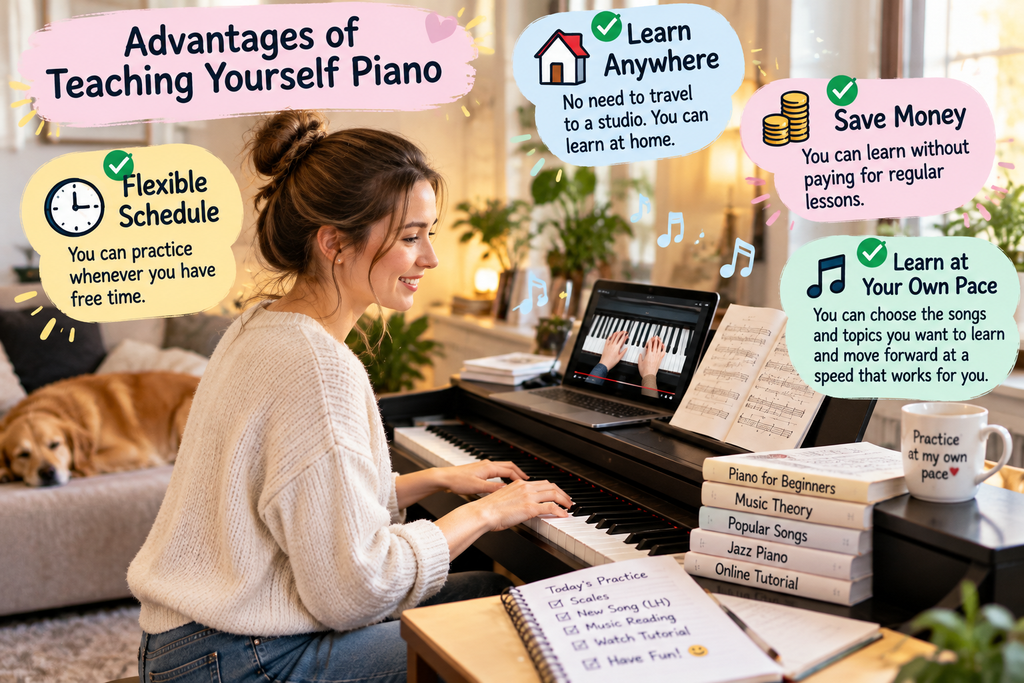
2. Understand the Advantages and Disadvantages of Learning Piano on Your Own

There are real advantages to teaching yourself piano.
The biggest advantage is flexibility.
You can decide when to practice, what to study, and how quickly to move through your materials.
There is no need to arrange a weekly appointment with a teacher or travel to a piano studio.
Whenever you have free time, you can simply sit at your piano and start learning.
Self-learning can also reduce the cost of formal lessons.
For adults with busy work schedules or family responsibilities, these benefits can be especially appealing.
The Biggest Challenge: No Immediate Feedback
However, there is one major disadvantage that I want beginners to understand.
When you have a question, there may be nobody available to answer it immediately.
During my piano lessons, students frequently ask:
“Is this right?”
“Am I playing this correctly?”
“Why doesn’t this sound right?”
I can listen, identify the problem, and explain what needs to change.
But when you are teaching yourself piano, you may have to stop practicing, search for another tutorial, read additional explanations, and try to solve the problem independently.
Sometimes you may not even realize that you are practicing something incorrectly.
This can slow your progress and make learning frustrating.
Online Piano Lessons Can Be Another Option
If your main reason for choosing self-learning is a busy schedule or difficulty traveling, consider online piano lessons.
Online lessons allow you to receive personalized instruction without leaving home.
You still need to arrange a lesson time, but you can avoid traveling and may have more scheduling options.
For some students, this provides a useful balance between convenience and professional guidance.
3. Stay Motivated When You Teach Yourself Piano
Another major challenge of self-learning is motivation.
When you take regular piano lessons, your teacher helps establish goals, assigns practice material, and monitors your progress.
When you teach yourself piano, you become responsible for all of those things.
You must decide what to learn, when to practice, and how to overcome difficulties.
And sometimes, it is very easy to give up.
My Experience Trying to Teach Myself Guitar
Even as an experienced piano teacher, I have experienced this challenge.
At one point, I wanted to learn guitar.
I started studying guitar chords independently and practiced a few times.
But eventually, I lost interest and stopped.
There was no teacher expecting me to practice, no scheduled lesson, and no clear plan keeping me accountable.
That experience reminded me that having access to learning materials does not automatically mean we will continue learning.
How to Stay Consistent With Self-Learning
If you want to teach yourself piano, try these strategies:
- Set a realistic weekly practice schedule.
- Choose one specific skill to work on at a time.
- Keep track of what you have learned.
- Practice small sections instead of constantly starting new songs.
- Set short-term goals that you can realistically achieve.
- Record yourself occasionally to evaluate your progress.
You do not need to practice for hours every day.
What matters more is consistency and having a clear direction.
If you are learning to read music, start with my How to Read Sheet Music for Beginners guide.
4. Combine Piano Lessons With Independent Practice
You do not necessarily have to choose between weekly piano lessons and complete self-learning.
There is another option.
You can combine occasional professional lessons with independent practice at home.
For students who cannot commit to weekly lessons because of financial limitations or busy schedules, this can be a practical solution.
For example, you might consider:
- Taking piano lessons every other week
- Scheduling one to three lessons per month
- Practicing independently between lessons
- Asking your teacher for specific assignments and practice goals
This approach gives you some flexibility while still providing professional feedback.
Why Personalized Piano Lessons Can Improve Your Progress
One of the greatest advantages of working with a piano teacher is individualized instruction.
Every student learns differently.
Some students understand new musical concepts quickly and are ready for more challenging material.
Others need additional explanations, slower demonstrations, or more repetition.
As a teacher, I adjust my lessons according to each student’s ability, understanding, and progress.
A prerecorded tutorial generally presents the same lesson to everyone.
A piano teacher can change the lesson immediately based on what the student needs.
If you are considering private instruction, my article on How Much Do Piano Lessons Cost? explains what can affect lesson prices.
5. Know When You Are Ready to Teach Yourself Piano
So, when should you begin learning piano independently?
In my opinion, self-learning becomes more effective after you have developed a solid understanding of fundamental piano skills.
There is no exact number of months or years that applies to everyone.
Some students progress quickly, while others need more time to become comfortable with the basics.
Instead of focusing only on how long you have taken lessons, I recommend evaluating what you can actually do.
Piano Skills to Learn Before Studying Independently
Before relying primarily on self-learning, I recommend becoming comfortable with:
- Reading notes in both treble and bass clefs
- Understanding basic finger numbers and hand positions
- Maintaining comfortable posture and playing technique
- Reading common time signatures
- Understanding note values and rests, including sixteenth notes
- Recognizing key signatures with multiple sharps or flats
- Counting rhythms accurately
- Practicing a new piece in small, manageable sections
For example, if you understand sixteenth-note rhythms and can recognize key signatures containing two or three sharps, you have developed some useful music-reading skills.
These skills alone do not automatically make someone an intermediate pianist, but they can help prepare you for more independent learning.
You should also be able to recognize when a piece is beyond your current level and when you need additional guidance.
Who Is a Good Candidate for Self-Taught Piano?
I believe independent piano study works best for someone who:
- Already understands fundamental music concepts
- Has developed reasonable playing habits
- Wants to explore a new musical style
- Enjoys solving problems independently
- Has enough motivation to practice consistently
For example, someone with a classical piano background may want to explore jazz, pop accompaniment, or chord improvisation independently.
That was my own experience when I began studying jazz-style chords for church accompaniment.
My existing musical knowledge made it easier to understand what I was learning.
Self-Taught Piano vs. Piano Lessons: Which Is Better?
Both approaches can help you develop musical skills, but they offer different benefits.
| Self-Taught Piano | Piano Lessons |
|---|---|
| Flexible practice schedule | Scheduled instruction and guidance |
| Lower direct learning costs | Professional feedback |
| Freedom to choose learning materials | Personalized learning plan |
| Requires strong self-motivation | Teacher provides accountability |
| Mistakes may go unnoticed | Mistakes can be corrected immediately |
| Progress depends heavily on independent problem-solving | Instruction adapts to student progress |
If you already have a strong foundation and enjoy independent learning, self-study can be an excellent way to expand your musical knowledge.
However, if you are a complete beginner, I strongly recommend starting with a qualified piano teacher.
Frequently Asked Questions About Teaching Yourself Piano
Can You Teach Yourself Piano Without Any Musical Experience?
Yes, it is possible. However, complete beginners may struggle to recognize incorrect techniques, understand music notation, or identify mistakes without guidance.
I recommend professional instruction during the early stages whenever possible.
How Long Should You Take Piano Lessons Before Learning Independently?
There is no universal timeline.
Rather than counting months, focus on developing comfortable technique, reliable music-reading skills, rhythm knowledge, and effective practice habits.
Can Adults Teach Themselves Piano?
Yes. Adults can learn piano independently, especially when they have clear goals and consistent practice habits.
However, adult beginners can also benefit greatly from personalized instruction.
If you are thinking about starting later in life, read my guide on Adult Piano Lessons: Am I Too Old to Learn Piano?.
Is Learning Piano From YouTube Enough?
YouTube can be a valuable learning resource.
However, watching someone play does not always help you identify mistakes in your own technique.
For beginners, I recommend using YouTube as a supplement to professional instruction rather than relying on it as the only source of guidance.
Final Thoughts: Can You Teach Yourself Piano Successfully?
Yes, you can teach yourself piano.
I know this because I have experienced independent learning myself.
However, after 25 years of teaching students of different ages and abilities, I believe that a strong foundation makes independent learning much more effective.
If you are a complete beginner, consider taking lessons with a qualified teacher to develop proper technique, music-reading skills, and effective practice habits.
If you already have a solid foundation, independent study can be a wonderful way to explore new musical styles and continue growing as a musician.
And if weekly lessons are not practical, occasional lessons combined with consistent home practice may be a useful alternative.
Remember, even students who take regular piano lessons do most of their practicing independently.
The difference is that they have a teacher helping guide their progress.
My recommendation is simple: Learn the fundamentals correctly, develop good habits, and then use independent learning to expand your musical abilities.
Grace Piano Notebook — Practical piano advice from a teacher with 25 years of experience.