Learning how to read sheet music for beginners can feel challenging at first, but it is one the the most important skills a beginning piano student can help.
When students can truly read notes, they are not limited to memorizing one song or copying someone else’s fingers. They can open a new piece of music, understand what they see, find the correct keys on the piano, and gradually learn the music for themselves.
That is why I believe note reading should be taught carefully from the very beginning.
When my students look at a note, I want them to ask two questions:
“What note is this?”
and
“Where is this note on the piano?”
Knowing the name of a note is not enough. A student should also be able to connect that note to the correct key on an 88-key piano.
The goal is not to guess. The goal is to understand exactly what you are reading.
Step 1: How to Read Sheet Music for Beginners – Start With Middle C
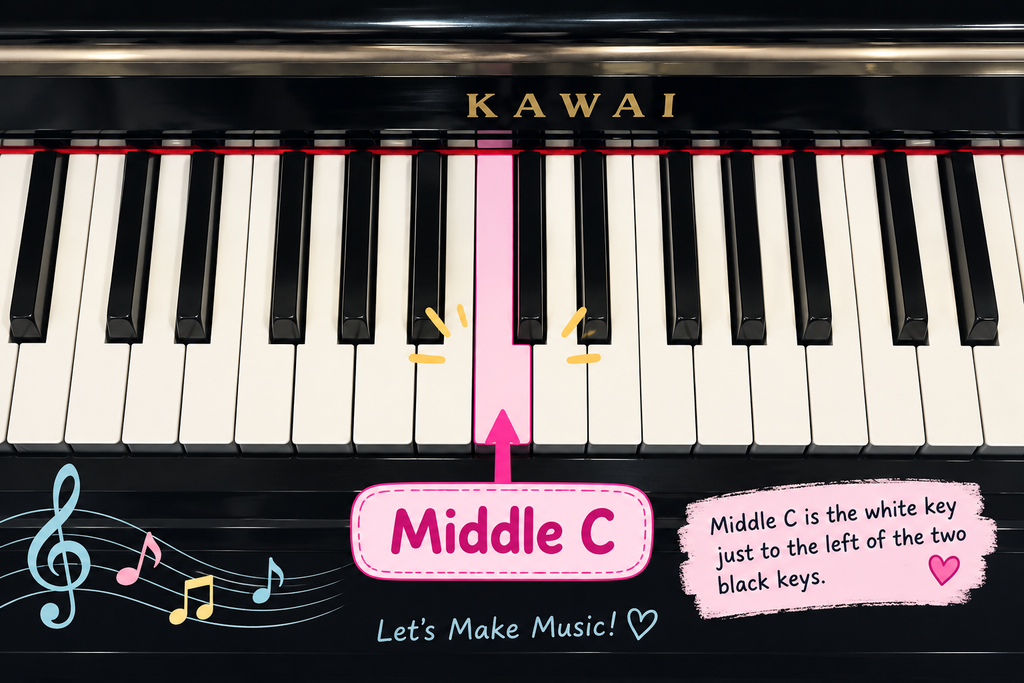
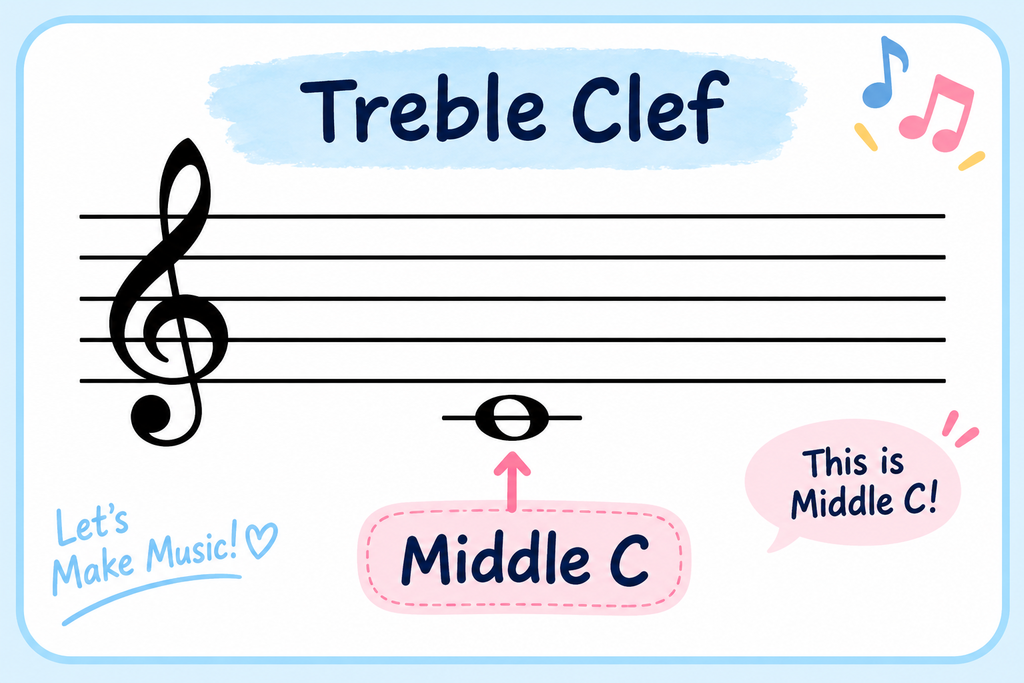
For beginning piano students, Middle C is one of the most useful notes to learn first.
Middle C gives students a clear reference point between the treble clef and bass clef.
I teach students to recognize Middle C on the music and then immediately find the same Middle C on the piano.
This connection is very important.
A student should not simply memorize what Middle C looks like on the page. The student should understand where that note belongs on the keyboard.
Once Middle C becomes familiar, we can begin reading notes that move away from it.
Step 2: Understand Line and Space Notes When Reading Sheet Music
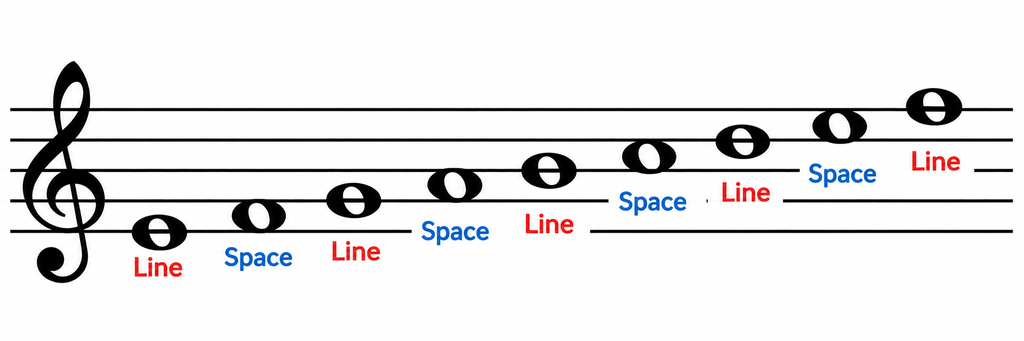
When teaching how to read sheet music for beginners, I first help students notice whether a note is on a line or in a space.
This is one of the most important concepts in reading music.
Look carefully at the staff.
A note can sit directly on a line, or it can sit between two lines in a space.
As notes move up the staff, they alternate:
Line – Space – Line – Space
As notes move down the staff, the same pattern continues:
Line – Space – Line – Space
Once students understand this pattern, reading music becomes much more logical.
Instead of seeing each note as a completely separate symbol that must be memorized, they begin to see how notes are connected.
Step 3: Read Sheet Music by Recognizing Going Up and Going Down
For beginners, one of the most important reading skills is recognizing whether the music is going up or going down.
When the notes move higher on the staff, we move to the right on the piano and the sound becomes higher.
When the notes move lower on the staff, we move to the left on the piano and the sound becomes lower.
I want my students to see this relationship clearly:
Notes going up → move right on the piano → higher sound
Notes going down → move left on the piano → lower sound
This is much more useful than simply memorizing individual note names.
If a student knows the starting note and can recognize whether the next note moves up or down, the student already has an important tool for reading unfamiliar music.
Step 4: Count From a Note You Already Know
Beginning students do not need to memorize every note immediately.
Instead, I teach them to begin with a note they already recognize and count from there.
For example, if a student knows that the first note is C and the next note moves one step higher, the student can count:
C → D
If the music continues upward:
C → D → E → F → G
The same idea works when the music moves downward.
For example:
G → F → E → D → C
This is why knowing the musical alphabet forward and backward is so important.
Students should become comfortable saying:
A – B – C – D – E – F – G
and also:
G – F – E – D – C – B – A
When students can do this easily, counting notes becomes much faster.
Step 5: Connect Every Written Note to the Piano
A key part of learning how to read sheet music for beginners is connecting every written note to the correct key on the piano.
Reading a note on the page is only half of the job.
The student must also know where that note is on the piano.
This is something I emphasize constantly in my lessons.
If I point to a note and ask, “What note is this?” a student may correctly answer, “C.”
But then I may ask:
“Which C?”
There are several C keys on an 88-key piano.
The student needs to understand which C the written note represents.
This is why I do not want students to think of sheet music and the keyboard as two separate things.
They must be connected.
See the note → identify the note → find the correct key → play it.
That connection should gradually become automatic.
Step 6: Read Sheet Music With Treble and Bass Clef
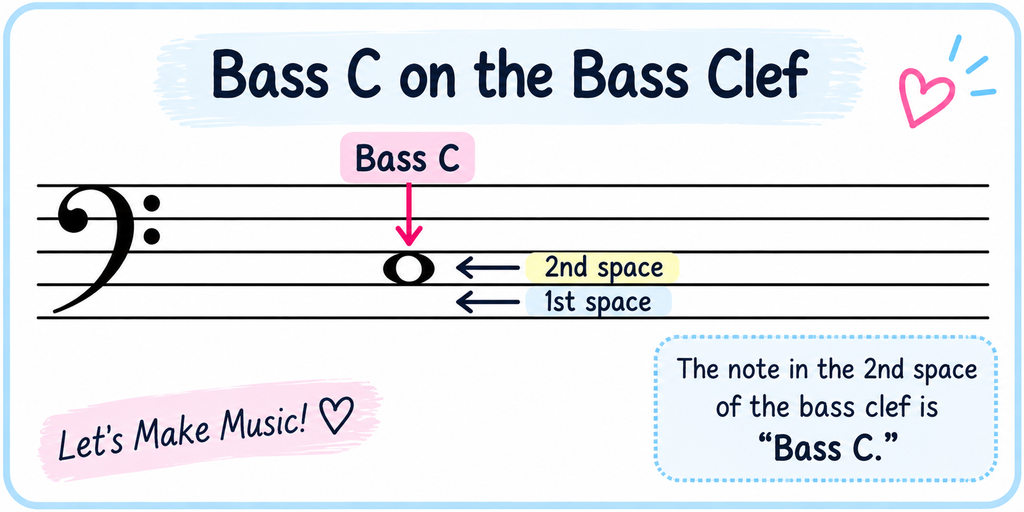
Another important part of how to read sheet music for beginners is learning to read both the treble clef and bass clef.
Piano music normally uses both the treble clef and bass clef.
The right hand commonly begins with notes in the treble clef, while the left hand commonly begins with notes in the bass clef.
Many beginners become more comfortable with treble clef first and then feel that bass clef is much harder.
That is normal, but I do not want students to avoid the bass clef.
Both clefs are important for piano playing.
The same basic reading method works for both.
Find a note you know.
Then ask:
Is the next note going up or going down?
Next, look at whether it moves from a line to a space, from a space to a line, or farther away.
Then count carefully.
This gives students a method they can use instead of guessing.
If bass clef feels more difficult, you may also enjoy my guide on why the left hand is harder when learning piano.
Step 7: Don’t Rely Only on Note-Reading Tricks
Many students come to piano lessons already knowing note-reading sayings they learned at school.
One of the most common examples is:
“Every Good Boy Does Fine”
This is used to remember the treble clef line notes:
E – G – B – D – F
These memory tricks can be helpful at first, but I do not like my students to depend on them when they read music.
Why?
Because imagine what happens every time a student sees a note.
First, the student has to remember the saying. Then the student has to figure out which word matches the note. Then they have to remember the letter, find that note on the piano, and finally play it.
That is too many steps.
Instead, I teach my students to understand how notes are connected.
Start with a note you already know. Then look at the next note.
Is it going up or going down?
Is it moving from a line to a space?
Or from a space to a line?
Then count from the note you already know.
For example, if you know Middle C and the next note moves one step up, you do not need a special saying to figure it out. You can simply see the direction and count:
C → D
This is the kind of reading skill I want my students to develop.
Note-reading tricks may help students remember a few note names, but they should not replace understanding how music actually moves on the staff.
My goal is for students to look at the music and read it, not solve a memory puzzle every time they see a note.
Step 8: Do Not Learn Music Only by Watching Fingers
Today, beginners can easily find videos showing exactly which piano keys to press.
These videos can sometimes be useful, but there is a danger if students depend on them too much.
A student may learn to play one song by copying someone’s fingers without actually learning how to read music.
Then when a new piece is placed in front of them, they may not know what to do.
That is why I encourage beginners to look at the music first.
Ask:
What note is this?
Where is it on the piano?
Is the next note going up or down?
The goal is to become an independent reader, not simply a good imitator.
Step 9: Later, Learn to Read Intervals
After students become comfortable recognizing notes moving up and down, they can begin learning intervals.
An interval tells us the distance between two notes.
Students gradually learn to recognize:
2nd, 3rd, 4th, 5th, 6th, 7th, and octave
This makes reading even faster.
Instead of counting every note individually, an experienced reader begins to recognize the distance and shape between notes.
But I do not rush this with very young beginners.
First, I want them to understand the basic movement of music:
Going up.
Going down.
Line to space.
Space to line.
That foundation makes interval reading much easier later.
Step 10: Practice Reading New Music Regularly
Students become better readers by reading.
Playing the same piece repeatedly is useful for improving technique and polishing music, but it does not provide enough new reading practice.
Beginners should regularly look at short, unfamiliar pieces that are slightly easier than their current performance level.
The goal is not to play them perfectly.
The goal is to practice looking at the page, understanding what the notes are doing, and finding those notes on the piano.
Even a few minutes of this kind of practice can help build stronger reading skills.
How to Read Sheet Music for Beginners: Understand the Direction of Music
After many years of teaching piano, I believe beginners do not need to begin by memorizing every note on the grand staff.
They need to understand how music moves.
Start with a note you know.
Then look at the next note.
Is it going up?
Does the next note move down?
Does it move from a line to a space?
From a space to a line?
How far did it move?
If a student can answer these questions and count carefully, the student can begin to figure out unfamiliar notes independently.
Later, interval reading makes this process even faster.
This is the foundation I want my students to develop.
Final Thoughts
The best approach to how to read sheet music for beginners is to build these skills gradually rather than trying to memorize every note at once.
Learning to read sheet music takes time, but it does not have to feel like memorizing hundreds of unrelated symbols.
Start with Middle C and other familiar reference notes.
Understand line notes and space notes.
Learn the musical alphabet forward and backward.
Recognize when the music is going up or going down.
Connect every written note to its correct location on the piano.
Then, as your reading improves, begin recognizing intervals and larger patterns.
Most importantly, do not guess.
When you understand where you are starting and how the music moves from one note to the next, sheet music begins to make sense.
And once students truly understand how to read music, they gain something much more valuable than the ability to play one song:
They gain the ability to learn new music for themselves.