One of the first questions parents ask when considering piano lessons is, “How much do piano lessons cost?”
It is an important question because piano lessons are usually not a short-term expense. Learning an instrument requires consistency, and many students continue lessons for several years.
The cost of private piano lessons can vary considerably depending on location, the teacher’s education and experience, lesson length, and whether lessons are offered at a studio, in the student’s home, or online.
As a piano teacher in Northern Virginia, I have seen a wide range of tuition rates. In the Northern Virginia and Washington, D.C. area, private music instruction can be relatively expensive because students are receiving individualized instruction from a professional teacher.
So, how much do piano lessons cost, and how much should parents realistically expect to budget?
How Much Do Piano Lessons Cost for 30, 45, or 60 Minutes?
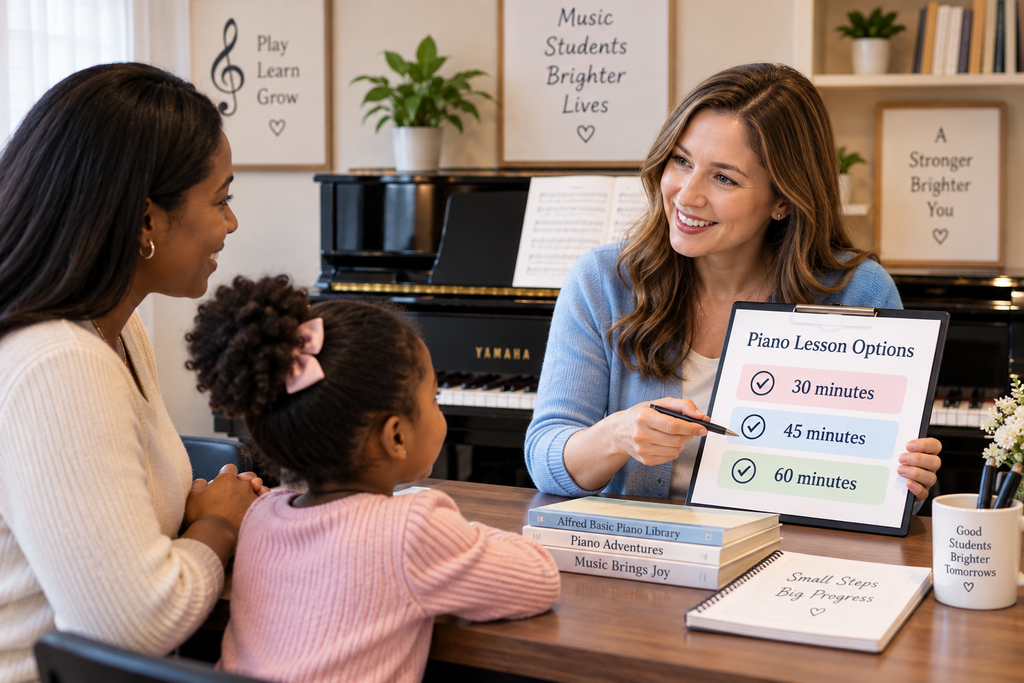
There is no single standard tuition rate for private piano lessons.
Rates vary by teacher and location, but families in the Northern Virginia and Washington, D.C. area may encounter private piano lesson prices approximately within these general ranges:
30-minute lesson: $40–$60+
45-minute lesson: $60–$80+
60-minute lesson: $80–$100+
These figures should be considered general reference ranges rather than fixed prices. Highly experienced teachers, specialized instructors, and high-demand studios may charge more.
The important thing for parents to understand is that piano lesson tuition reflects much more than the number of minutes a student spends sitting at the piano.
How Much Do Weekly Piano Lessons Cost Per Month?
When parents compare piano lesson prices, it is helpful to consider the ongoing cost rather than looking only at the price of one lesson.
For a simple four-lesson example, imagine that lessons cost:
30 minutes: $50 per lesson — about $200 for four lessons
45 minutes: $70 per lesson — about $280 for four lessons
60 minutes: $90 per lesson — about $360 for four lessons
Of course, actual monthly tuition varies.
Some teachers charge per lesson, while others use monthly, semester, or annual tuition structures. Some studios may also include recitals, studio classes, or other benefits in their tuition.
Parents should always ask for the complete tuition policy before comparing teachers based solely on price.
Why Do Piano Lesson Prices Vary So Much?
Private piano instruction is highly individualized.
When parents pay for a private piano lesson, they are not simply paying for 30, 45, or 60 minutes of someone sitting next to their child at the piano.
An experienced teacher is constantly evaluating the student’s technique, note reading, rhythm, hand position, musical interpretation, practice habits, and overall progress.
The teacher must also determine what the student should learn next and how quickly the student should advance.
Several factors can influence piano lesson tuition, including:
Teacher education and professional training
Years of teaching experience
Geographic location
Studio demand
Student level
Preparation for examinations, auditions, competitions, or performances
Lesson format
In-home, studio, and online instruction can also involve different costs and scheduling considerations.
This is why comparing piano teachers based only on the hourly rate can sometimes be misleading.
Are 30-Minute Piano Lessons Enough for Beginners?
For many young beginners, a 30-minute piano lesson is an excellent place to start.
Beginning students have many new concepts to absorb. They may be learning keyboard geography, finger numbers, note reading, rhythm, hand position, basic technique, and their first pieces.
At the same time, young children may not yet have the concentration necessary for a full hour of focused private instruction.
A well-organized 30-minute lesson can accomplish a great deal.
The important question is not:
“Is a longer lesson automatically better?”
Instead, parents and teachers should ask:
“Can this student remain focused and productive for the entire lesson?”
For many young beginners, 30 minutes is enough.
When Should a Student Move to a 45-Minute Piano Lesson?
As students advance, 30 minutes can begin to feel very short.
There may be scales and technical exercises to review, several repertoire pieces, sight-reading, theory, rhythm work, and corrections from the previous lesson.
At this stage, a 45-minute piano lesson can be an excellent transition between a beginner lesson and a full 60-minute lesson.
Those additional 15 minutes can make a surprisingly significant difference.
The teacher has more time to address technique and musical details without rushing through every assignment.
For many developing students, 45 minutes provides a comfortable balance between concentration and instructional depth.
Who Benefits From 60-Minute Piano Lessons?
A 60-minute piano lesson becomes particularly useful as students reach the intermediate and advanced levels.
More advanced students may be studying longer classical repertoire, technical exercises, scales, interpretation, music theory, sight-reading, examinations, auditions, or recital programs.
An hour gives the teacher enough time to work in greater depth rather than rushing from one assignment to another.
Adult students may also enjoy longer lessons because they often arrive with specific questions, repertoire, and personal musical goals they want to explore.
However, a 60-minute lesson is not automatically better simply because it is longer.
The appropriate lesson length should reflect the student’s age, attention span, level, goals, and repertoire.
Do In-Home Piano Lessons Cost More?
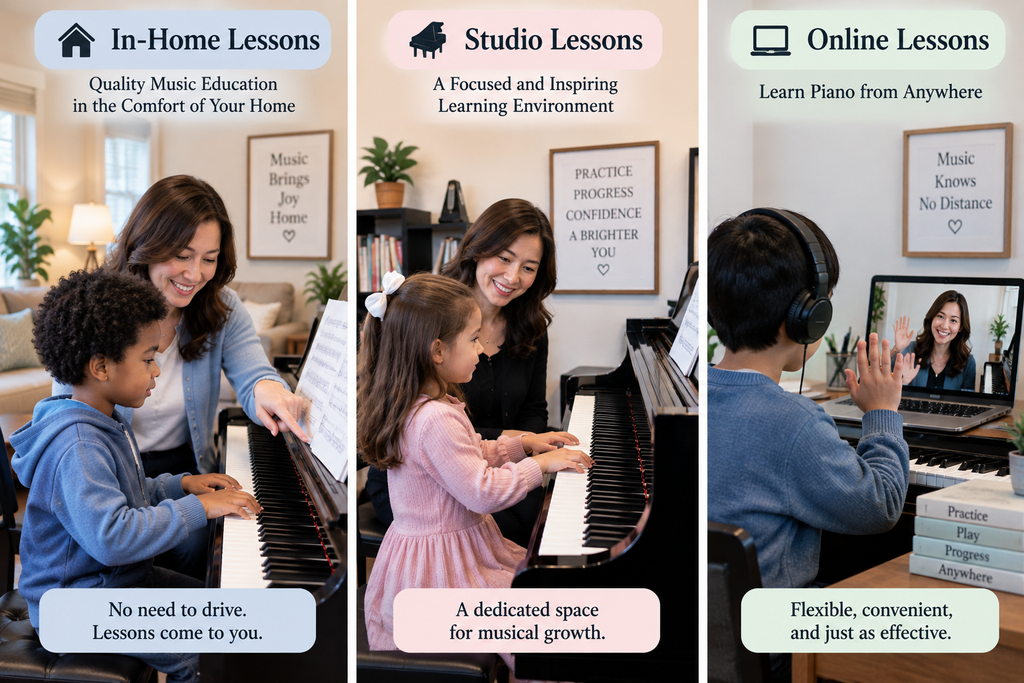
In-home piano lessons can sometimes cost more than studio lessons.
When a piano teacher travels to a student’s home, the teacher is providing more than the lesson itself.
For example, a 45-minute in-home lesson may also require driving time before and after the appointment. Transportation costs, traffic, distance, and scheduling limitations can all affect how much time the teacher must reserve for one student.
For this reason, some teachers charge a higher tuition rate or an additional travel fee for in-home piano lessons.
However, in-home lessons can provide considerable convenience for families.
Parents do not have to drive to the studio, wait during the lesson, and drive home again.
For families with busy schedules, that convenience can be extremely valuable.
Are Online Piano Lessons Less Expensive?
Online piano lessons may sometimes be less expensive, but not always.
Online instruction eliminates travel time for both the teacher and the student, but the student is still receiving individualized professional instruction.
Therefore, parents should not automatically expect online lessons to cost dramatically less than in-person lessons.
Online piano lessons can work particularly well for adults, older children, and students who are already comfortable at the keyboard.
For very young beginners, however, in-person instruction can have advantages because the teacher can more easily observe posture, hand position, finger movement, and other physical aspects of piano technique.
Is an Expensive Piano Teacher Always Better?
Not necessarily.
Price is only one factor when choosing a piano teacher. If you are still deciding what to look for in a teacher, read my guide on How to Choose the Right Piano Teacher for your Child.
A teacher can have impressive credentials and still not be the right match for a particular student. At the same time, a teacher with more affordable tuition may have extensive experience teaching beginners and an exceptional ability to communicate with children.
Parents should consider the teacher’s:
Experience
Teaching style
Communication
Expectations
Reliability
Ability to establish a strong musical foundation
The relationship between the teacher and student is also important.
The most expensive teacher is not automatically the best teacher for every student, just as the least expensive teacher is not necessarily the best value.
What Are You Really Paying for in a Piano Lesson?
Parents are ultimately paying for professional guidance.
A good piano teacher does much more than tell a student which notes to play.
The teacher identifies problems the student may not recognize independently, corrects inefficient habits before they become established, selects appropriate repertoire, introduces musical concepts in a logical sequence, and teaches the student how to practice effectively.
That professional guidance becomes increasingly important as the music becomes more difficult.
The objective should not simply be to finish more pages in a method book.
The goal is to develop an independent musician with strong note-reading skills, healthy technique, rhythmic accuracy, musical understanding, and confidence at the piano.
How Much Should You Budget for Piano Lessons?
Families should think about piano lessons as an ongoing educational commitment rather than a one-time purchase.
Using the general price ranges above, a simple four-lesson month might look approximately like this:
30-minute weekly lessons: $160–$240+ for four lessons
45-minute weekly lessons: $240–$320+ for four lessons
60-minute weekly lessons: $320–$400+ for four lessons
Families should also remember that piano education may involve additional expenses.
These can include method books, sheet music, recital fees, examination fees, registration fees, and, of course, purchasing or maintaining an appropriate instrument.
Before beginning lessons, parents should ask the teacher or studio for a complete tuition and cancellation policy so there are no surprises later.
Final Thoughts: Choosing Value, Not Just Price
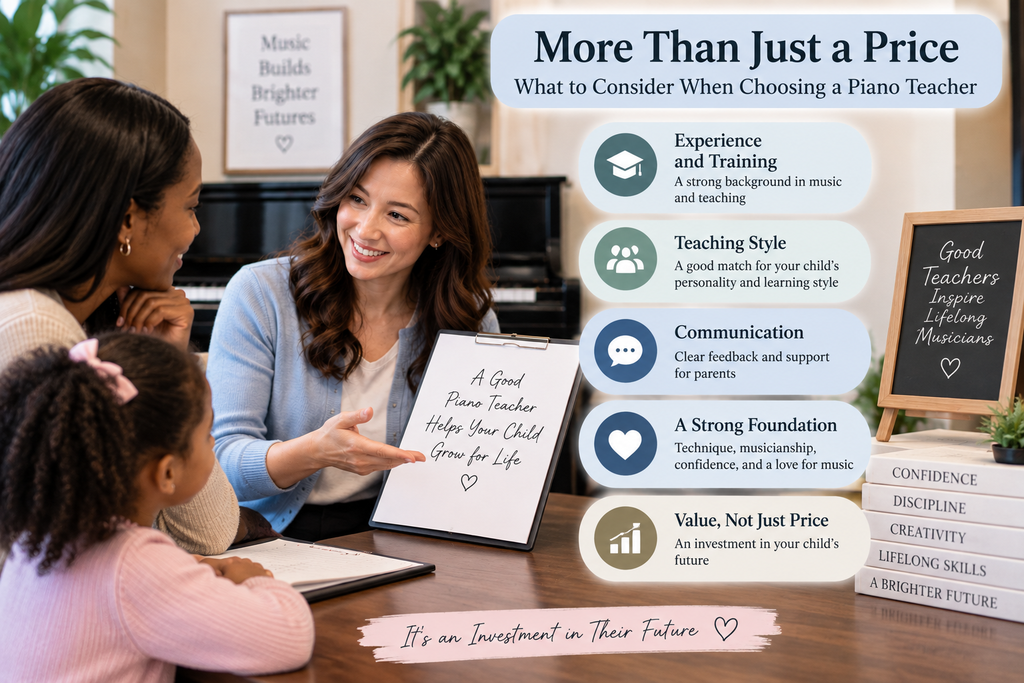
Piano lessons are an investment of both money and time.
For a young beginner, a 30-minute weekly lesson is often an appropriate and economical place to start. As the student matures and the repertoire becomes more demanding, moving to 45 or 60 minutes may provide the additional instructional time needed for continued development.
When comparing piano teachers, I would not recommend choosing solely according to who charges the lowest tuition—or assuming that the highest-priced teacher must automatically be the best.
Instead, look for a qualified teacher whose experience, teaching philosophy, expectations, and personality are appropriate for the student.
The best value in piano education is not necessarily the cheapest lesson.
It is instruction that helps the student build a strong foundation, develop independence, enjoy making music, and continue progressing year after year.
The prices in this article are general reference ranges for private piano lessons in the Northern Virginia and Washington, D.C. area. Actual tuition varies by teacher, studio, location, lesson format, and individual studio policies.
Families can also visit the Music Teachers National Association (MTNA) for additional information about music teachers and music education.