When beginning piano students first see a sharp sign (♯) in their music, they often recognize the shape.
I usually draw a sharp sign and ask:
“Have you seen this sign before?”
Some students say it looks like a hashtag. Others say it looks like a number sign or even a tic-tac-toe board.
They are right — it does look familiar.
But in music, this symbol has a special name.
It is called a sharp.
I always teach my students the spelling, too:
S-H-A-R-P. Sharp.
But recognizing the sharp sign is only the beginning.
Students also need to know how to draw it, where to place it next to a note, and most importantly, what a sharp means when they play the piano.
Let’s look at the sharp sign step by step.
What Does a Sharp Mean in Music? Understanding Half Steps
A sharp in music raises a note by one half step.
The sharp symbol looks like this:
♯
For beginning piano students, I explain it very simply:
Sharp means go one half step up.
On the piano, going “up” means moving to the right.
But there is another important word in that definition:
half step.
A half step does not mean skipping a key.
A half step means moving to the very next key on the piano.
That next key may be black.
It may also be white.
That distinction is very important.
How to Recognize a Sharp Sign in Music
Before we even play a sharp on the piano, I want students to become comfortable with the symbol itself.
I draw ♯ on paper and ask:
“Have you seen this before?”
Students may answer:
“Hashtag!”
“Number sign!”
“Tik-tac-toe!”
Then I explain:
“In music, we call this a sharp.”
I also have them say and spell the word:
S-H-A-R-P.
Learning the name and spelling helps students become comfortable with music vocabulary instead of simply recognizing the symbol by its shape.
How to Draw a Sharp Sign in Music
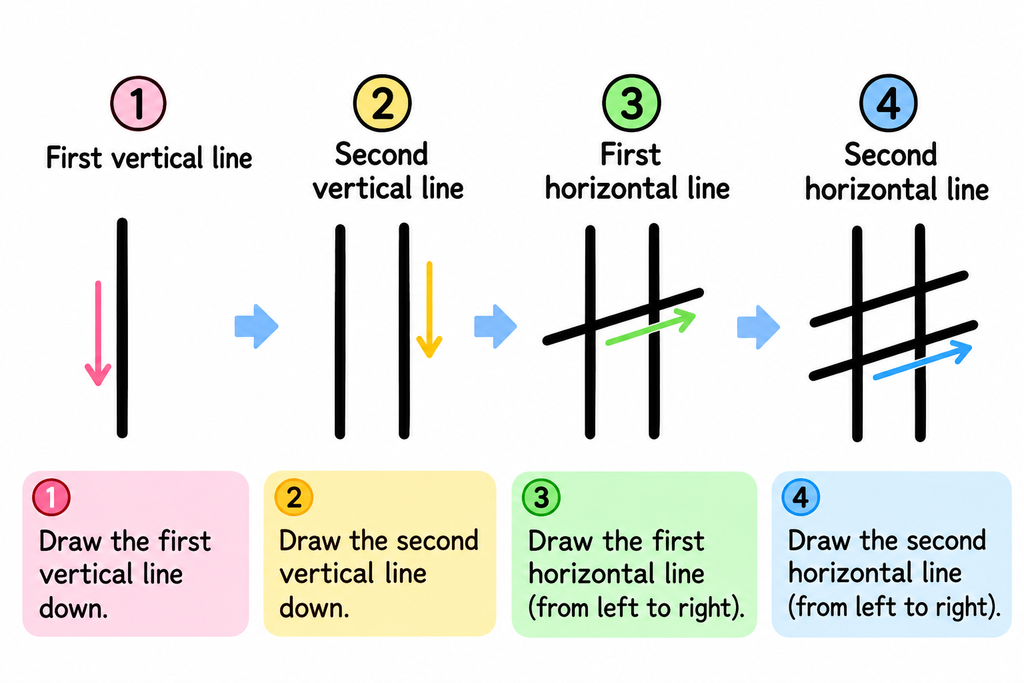
Seeing a sharp sign and drawing one yourself are two different skills.
That is why I have beginning students practice drawing the sharp sign on blank paper or music paper.
Sometimes I ask them to draw it 10 times.
If necessary, we practice even more.
As they draw, I look carefully at each symbol.
Is one line too long?
Is another line too short?
Does the symbol actually look like a sharp sign?
These may seem like small details, but I have found that physically drawing music symbols helps beginning students recognize them much more quickly when they appear in real music.
Where to Place a Sharp Sign in Sheet Music
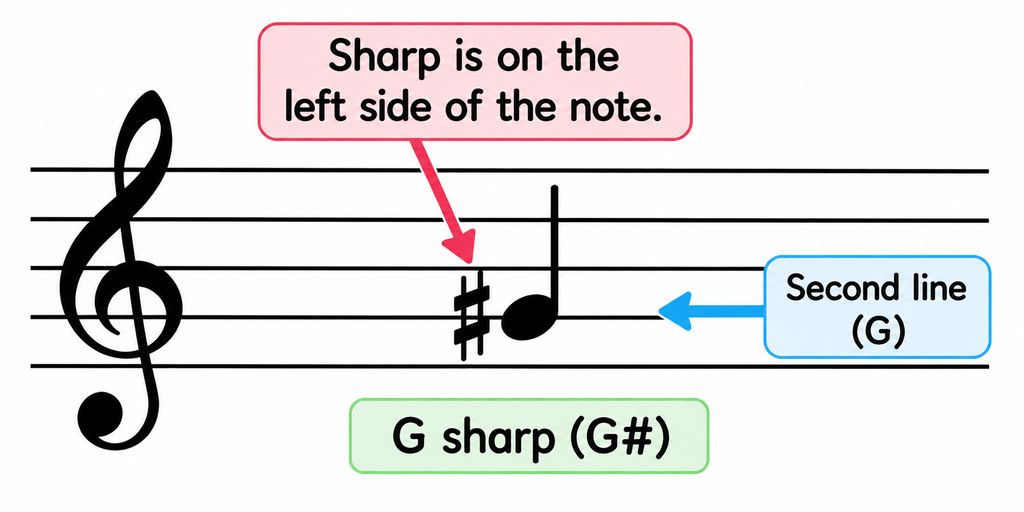
This is something beginning students often get wrong.
A sharp sign is written on the left side of the note.
Not on the right.
For example, if a G has a sharp sign, the ♯ appears before the G note.
It is called G sharp, or G♯.
Students should practice placing the sharp on the correct side because it is surprisingly common for beginners to draw it on the right side of the note.
The Sharp Must Match the Height of the Note
There is another important detail.
The sharp sign must be placed at the same staff position as the note it belongs to.
For example, treble-clef G is on the second line.
If that G is sharp, the sharp sign should also be centered on that second line.
Do not draw the sharp at the top or bottom of the staff and expect the student to know which note it belongs to.
The position matters.
When students practice drawing sharps on staff paper, I make sure they learn both rules:
Put the sharp on the left side of the note.
Put the sharp at the same line or space as the note.
Before learning sharp notes, it is important to recognize the basic piano keys. If you need a little practice, read my guide on How to Find Any Note on the Piano.
What Does a Sharp Sign Mean on the Piano?
Now we can move to the keyboard.
Remember:
A sharp raises a note by one half step.
On the piano, that means:
Move one key to the right.
The words one key are important.
Some students accidentally move a whole step because they think they need to skip a key.
They do not.
A half step is the distance from one piano key to the very next piano key, whether that key is black or white.
How to Play Sharp Notes on the Piano
Let’s start with G.
First, play G.
Now find the very next key to the right.
That key is G♯.
So I might ask a student:
“Can you play G?”
Then:
“Can you play G sharp?”
The student moves from G to the very next key on the right.
That is a half step higher.
How to Play C Sharp and D Sharp
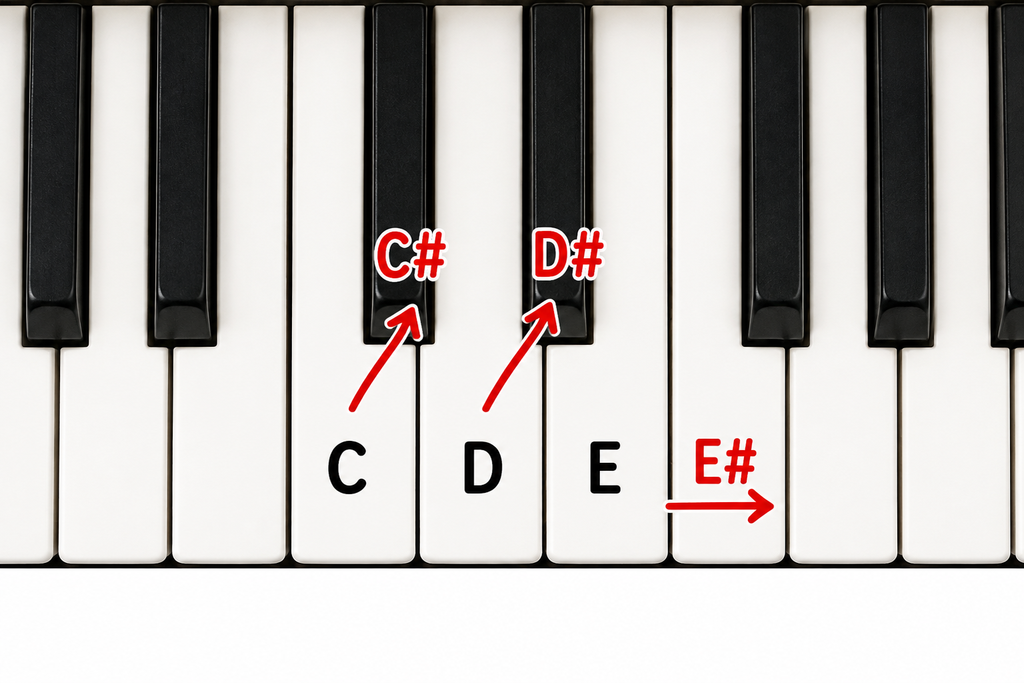
We can practice the same idea with other notes.
Play C.
Move one half step to the right.
That is C♯.
Now play D.
Move one half step to the right.
That is D♯.
In these examples, the sharp note happens to be played on a black key.
And this is where beginners can develop a very common misunderstanding.
They begin to think:
Sharp means black key.
But that is not the rule.
Does a Sharp Sign Always Mean a Black Key?
No.
This is one of the most important things I teach beginners about sharps.
A sharp does not mean “play a black key.”
A sharp means:
Move one half step higher.
Sometimes the next key is black.
Sometimes the next key is white.
To understand this, look at E and F.
There is no black key between E and F.
The two white keys are directly next to each other.
This gives us one of my favorite questions to ask students.
If you would like to learn more about sharp sign in music, you can read this helpful guide to sharps and flats in music.
How Do You Play E Sharp?
I ask:
“Can you play E?”
The student plays E.
Then I ask:
“Can you play E sharp?”
This is where many students stop.
They look for a black key to the right of E, but there isn’t one.
That is because they have started thinking that a sharp must be a black key.
So I remind them:
What does sharp actually mean?
One half step higher.
What is a half step?
The very next key.
The very next key to the right of E is the white F key.
Therefore:
E♯ is played on the F key.
The student may immediately say:
“But this is F!”
Yes. It is the F key.
But that same piano key can also be used to play E♯.
This is an important lesson because it helps students stop associating sharps only with black keys.
How Do You Play B Sharp?
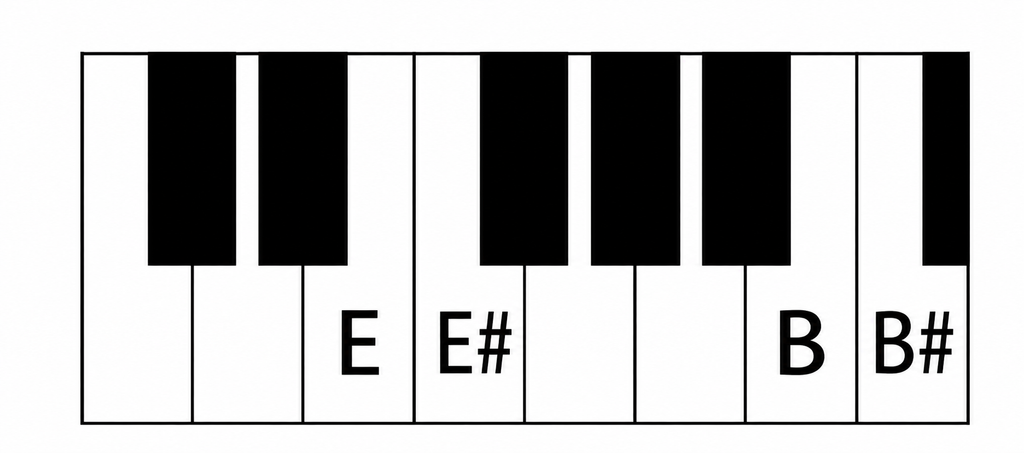
B♯ works the same way.
There is no black key between B and C.
First, play B.
Then move one half step higher — to the very next key on the right.
You arrive at the C key.
Therefore:
B♯ is played on the C key.
This is another example that shows why students should understand the meaning of a sharp instead of simply memorizing black keys.
“C Is B Sharp” — Is That the Best Way to Say It?
When I teach beginners, I am careful with the language here.
Students sometimes say:
“C is B sharp.”
I prefer not to teach it that way.
C and B♯ are different note names, even though on a standard piano they are played using the same physical key.
So for a beginner, I prefer saying:
“B sharp is played on the C key.”
Similarly:
“E sharp is played on the F key.”
This helps students separate two ideas:
The name of the note written in the music and the physical piano key used to play it.
That distinction becomes increasingly useful as students learn more music theory.
A Simple Sharp Practice Game for Piano Students
Once a student understands the rule, I like to practice it directly at the piano.
I start by asking:
“Can you play G? Now find G sharp.”
Next, we try D and D sharp.
The I ask the student to find E and E sharp.
Finally, we practice B and B sharp.
The goal is not for the student to memorize a list of sharp notes.
The goal is for the student to think:
Sharp → half step higher → next key to the right.
When that idea becomes automatic, finding sharps on the piano becomes much easier.
Sharp Notes in Music: The Most Important Rule
If your child or beginning piano student remembers only one thing from this lesson, remember this:
A sharp does not mean “black key.”
A sharp raises a note by one half step.
And on the piano:
One half step higher means move to the very next key on the right.
Sometimes that key is black.
Sometimes that key is white.
Once students truly understand that rule, notes such as E♯ and B♯ are no longer confusing.
Instead of memorizing individual answers, they can figure them out for themselves.
And that is exactly what I want my piano students to learn to do.