What does a flat mean in music? When beginning piano students first learn about sharps and flats, they often get confused about which direction to move on the keyboard.
Does a sharp go left or right?
What about a flat?
As a piano teacher with over 25 years of teaching experience, I always emphasize one simple rule:
Sharp goes right. Flat goes left.
This is one of the most important things beginners should remember when learning about sharps and flats.
In this guide, I will explain what a flat means in music, how to draw a flat sign, where to place it on sheet music, and how to find flat notes on the piano.
5 Easy Examples of Flat Notes on the Piano
A flat sign (♭) lowers a note by one half step.
On the piano, this means moving one key to the left.
For example:
- B becomes B♭.
- A becomes A♭.
- G becomes G♭.
- E becomes E♭.
- D becomes D♭.
When you see a flat sign next to a note, first find the original note on the keyboard.
Then move one half step to the left.
Remember: A Flat lowers a note by one half step in pitch. On the piano, that means moving one key to the left.
What Is a Flat in Music? Understanding Half Steps
A half step is the distance between two neighboring piano keys, with no key in between.
These neighboring keys can be:
- A white key and a black key.
- A black key and a white key.
- Two white keys.
For example, B and B♭ are one half step apart.
C and B are also one half step apart.
The important thing is to move to the very next key without skipping any keys.
Sharp vs. Flat: Which Direction Do You Move?
This is something I always emphasize during piano lessons.
Sharp (♯): Move one half step to the RIGHT.
Flat (♭): Move one half step to the LEFT.
Students should never confuse these two directions.
A sharp raises a note by one half step, while a flat lowers a note by one half step.
To learn more about sharp, read my guide on What Does a Sharp Mean in Music?
I encourage students to practice moving their fingers in both directions on the keyboard until the difference becomes natural.
For more practice with half steps and musical notes, you can explore the free music theory lessons at Musicca.
What Is a Flat in Music? How to Draw the Flat Sign

A flat sign looks similar to a lowercase letter b, but its shape is slightly different.
When I teach students how to draw a flat sign, I always have them follow two steps.
Step 1: Draw a Vertical Line
Start by drawing a straight vertical line.
This is the first part of the flat sign.
Step 2: Draw a Curved Shape on the Right
Next, draw a curved shape extending from the vertical line toward the right.
The curved part should look somewhat like the right half of a heart.
Instead of making a perfectly round lowercase b, shape the upper part of the curve with a slightly pointed appearance before bringing it back toward the vertical line.
I sometimes describe this to my students as drawing half of a heart.
Always draw the vertical line first, then add the curved part on the right.
Practicing the correct drawing order helps students develop a consistent flat sign.
What Is a Flat in Music? Reading the Flat Sign
A flat sign is written to the left of the note, not the right.
This is an important rule for beginners to remember.
Both sharps and flats are placed before the notes they modify.
However, the exact vertical position of the flat sign is just as important as its placement on the left.
How to Write a Flat in Music on a Line
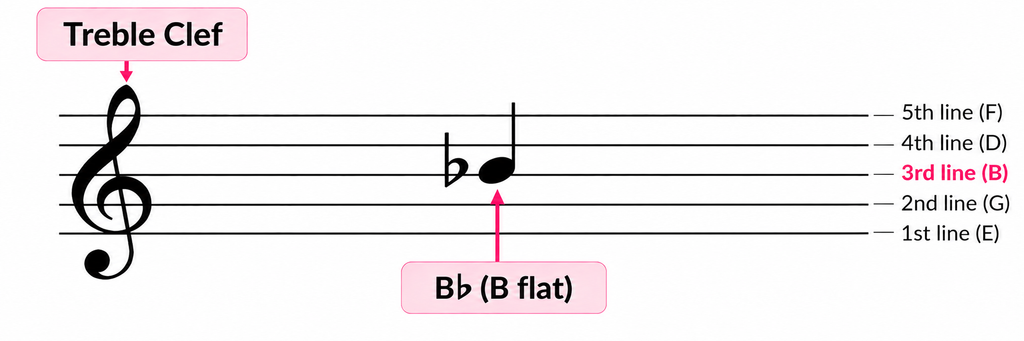
Let’s use B on the treble clef as an example.
B is located on the third line of the treble staff.
When writing B♭:
- Find B on the third line.
- Place the flat sign to the left of the note.
- Make sure the rounded lower part of the flat sign is centered on the third line.
The curved part of the flat sign must align with the same line as the note.
If the B note is on the third line but the curved part of the flat is centered in a space, the flat is incorrectly positioned.
How to Write a Flat in Music in a Space
The same rule applies to space notes.
If the note is in a space, the rounded part of the flat sign must be centered in that same space.
For example, A is in the second space of the treble clef.
To write A♭, place the flat sign to the left of A and align its rounded part with the second space.
Line note = Flat aligned with the same line.
Space note = Flat aligned with the same space.
This simple rule helps students write flats accurately on the staff.
What Is a Flat in Music? 5 Easy Piano Examples
Understanding what a flat means in music helps beginners find the correct keys without guessing.
When teaching flat notes, I don’t want students to guess which black key to play.
Instead, I teach them to find the original note first.
Then they move one half step to the left.
Let’s practice with five common flat notes.
1. How to Find B♭
First, find B on the piano.
B is the white key immediately to the right of the group of three black keys.
Now move one half step to the left.
You will land on a black key.
That is B♭.
2. How to Find A♭
First, find A.
Now move one half step to the left.
The black key immediately to the left of A is A♭.
3. How to Find G♭
Find G on the keyboard.
Move one half step to the left.
The black key immediately to the left of G is G♭.
4. How to Find E♭
Find E.
Move one half step to the left.
The black key immediately to the left of E is E♭.
5. How to Find D♭
Find D.
Move one half step to the left.
The black key immediately to the left of D is D♭.
After practicing these five notes, students usually begin to recognize how flats work on the keyboard.
But there is one more important concept to learn.
What Is a Flat in Music? Black Keys vs. White Keys

No!
This is one of the most common misunderstandings among beginning piano students.
A flat does not always mean playing a black key.
A flat simply means lowering the original note by one half step.
Sometimes that means moving from one white key to another white key.
Let’s look at two examples.
F♭ Is Played on the Same Key as E
First, find F on the piano.
Now move one half step to the left.
Is there a black key between F and E?
No.
The key immediately to the left of F is the white key E.
Therefore, F♭ is played on the same piano key as E.
The two notes have different names, but they share the same piano key.
C♭ Is Played on the Same Key as B
Now find C on the piano.
Move one half step to the left.
Again, there is no black key between C and B.
The key immediately to the left of C is the white key B.
Therefore, C♭ is played on the same piano key as B.
This is why I always tell my students:
Don’t look for a black key just because you see a flat sign. Find the original note first, then move one half step to the left.
If you’re still learning your way around the keyboard, start with my guide on How to Find Any Note on the Piano.
What Is a Flat in Music? 7 Notes to Practice
Now it’s time to practice!
Ask your child or student to find each original note on the piano and then move one half step to the left.
- B → B♭
- A → A♭
- G → G♭
- E → E♭
- D → D♭
- F → F♭
- C → C♭
For each note, encourage the student to say:
“Find the note first. Move one key to the left.”
Students can also practice identifying which flats are played on black keys and which are played on white keys.
The goal is not simply to memorize the locations of flat notes.
It is to understand how to find them independently.
What Is a Flat in Music? Common Beginner Mistakes
Mistake 1: Moving to the Right Instead of the Left
Some students confuse sharps and flats.
Remember:
Sharp goes right.
Flat goes left.
Mistake 2: Assuming Every Flat Is a Black Key
F♭ and C♭ are excellent examples of why this is incorrect.
Always move one half step from the original note, even if the next key is white.
Mistake 3: Drawing the Flat on the Wrong Line or Space
The rounded part of the flat sign must align with the same line or space as the note.
Students should check the position carefully when writing flats on sheet music.
Mistake 4: Skipping a Key
A half step means moving to the immediately neighboring key.
Never skip a key when moving one half step.
Final Thoughts: Remember That Flat Means Left
Learning flat notes becomes much easier when students understand the direction of movement on the piano keyboard.
Rather than memorizing every flat note immediately, I encourage beginners to follow three simple steps:
- Find the original note.
- Move one half step to the left.
- Play the new key.
Remember:
Sharp goes right. Flat goes left.
And most importantly, a flat does not always mean a black key.
Once students understand these basic rules, they can confidently begin recognizing and playing flat notes in their piano music.
Happy practicing!
Grace Piano Notebook — Practical Piano Tips From Over 25 Years of Teaching Experience