Learning how to read ledger lines in music can feel intimidating for beginning piano students.
When students first see notes written above or below the five lines of the staff, they sometimes become nervous.
They may think, “That note looks too high!” or “I don’t know how to read that!”
But ledger lines are not as difficult as they appear.
After teaching piano for 25 years, I have noticed that students often become worried about ledger lines before they even try to read them.
I always remind my students of one important rule:
Ledger lines follow exactly the same note-reading rules as the five lines of the staff.
Students do not need to memorize every note above or below the staff.
Instead, I teach them to memorize five important C notes and use those notes as reference points.
I call this approach the Five Cs Method.
Once students recognize these five C notes, they can identify unfamiliar notes much more confidently.
What Are Ledger Lines in Music?
Ledger lines are short horizontal lines added above or below the musical staff.
A standard musical staff has five lines and four spaces.
However, piano music often includes notes that are higher or lower than the five-line staff.
That is when we use ledger lines.
Why Do We Need Ledger Lines?
Imagine that you are reading music in the treble clef.
The top line of the treble staff is F.
But what happens when the music goes higher than F?
The notes continue:
G – A – B – C – D – E – F – G
Instead of drawing another staff, composers use short ledger lines to extend the range of written notes.
The same idea applies below the bass staff.
Ledger lines allow musicians to read notes beyond the regular staff without changing the musical alphabet.
For additional practice, visit MusicTheory.net to review how notes are placed on the musical staff.
How to Read Ledger Lines in Music Using Lines and Spaces
Here is the first thing I explain to my students:
A ledger line is simply an extra line.
The musical alphabet does not change.
The pattern of lines and spaces does not change either.
When notes move step by step, they follow the same pattern:
Line – Space – Line – Space
This pattern continues above and below the staff.
How to Read Ledger Lines in Music From Middle C
Middle C is written on the first ledger line below the treble staff.
From Middle C, count upward:
C – D – E – F – G – A – B – C
Notice how each note moves to the next line or space.
- Middle C is on the first ledger line below the staff.
- D is in the space below the staff.
- E is on the bottom line of the treble staff.
The pattern continues as notes move higher.
Start With Middle C in the Bass Clef
In the bass clef, Middle C is written on the first ledger line above the staff.
From Middle C, count downward:
C – B – A – G – F – E – D – C
The same line-and-space pattern applies.
Whether students are reading treble clef or bass clef, they can begin with a familiar note and count in the correct direction.
If you are still learning the basics, read my guide on How to Find Middle C on the Piano.
Why Counting From Middle C Is Not Always the Best Method
When students first learn how to read ledger lines in music, counting from Middle C is an excellent starting point.
However, I do not want them to depend on Middle C forever.
Imagine that a student sees a very high G in the treble clef.
This G is written on the fourth ledger line above the treble staff.
Technically, the student could start at Middle C and count upward until reaching that G.
But think about how long that would take!
When students are playing piano music, they cannot spend too much time counting through numerous notes.
That is why I introduce additional reference notes.
Instead of always starting from Middle C, students learn to recognize important C notes in different registers.
How to Read Ledger Lines in Music With the Five Cs Method

The Five Cs Method is the approach I use to help students become more independent music readers.
There are five important C notes I want my students to recognize:
- Low C
- Bass C
- Middle C
- Treble C
- High C
These five notes are arranged from lowest to highest.
Each C serves as a landmark in a different part of the grand staff.
1. Low C
Low C is written on the second ledger line below the bass staff.
This is an important reference point when students begin reading lower notes.
Instead of counting down from a note inside the staff every time, students can learn to recognize Low C immediately.
2. Bass C
Bass C is located in the second space of the bass staff.
Because this note is inside the staff, it does not require a ledger line.
However, it is still an important landmark for reading notes in the lower register.
3. Middle C
Middle C is one of the most familiar notes for beginning piano students.
It is written on the first ledger line below the treble staff or the first ledger line above the bass staff.
These two written positions represent the same piano key.
Middle C helps students understand how the treble and bass staffs connect.
4. Treble C
Treble C is located in the third space of the treble staff.
Students can use this familiar note to identify nearby notes without always counting from Middle C.
It is another important landmark for reading music in the upper register.
5. High C
High C is written on the second ledger line above the treble staff.
This is one of the most important ledger-line notes I want students to memorize.
When students see High C, I want them to recognize it immediately.
They should not need to count all the way from Middle C.
Why High C Helps You Read Ledger Lines in Music
High C is a useful landmark because it allows students to identify nearby high notes more efficiently.
For example, suppose a student sees High G.
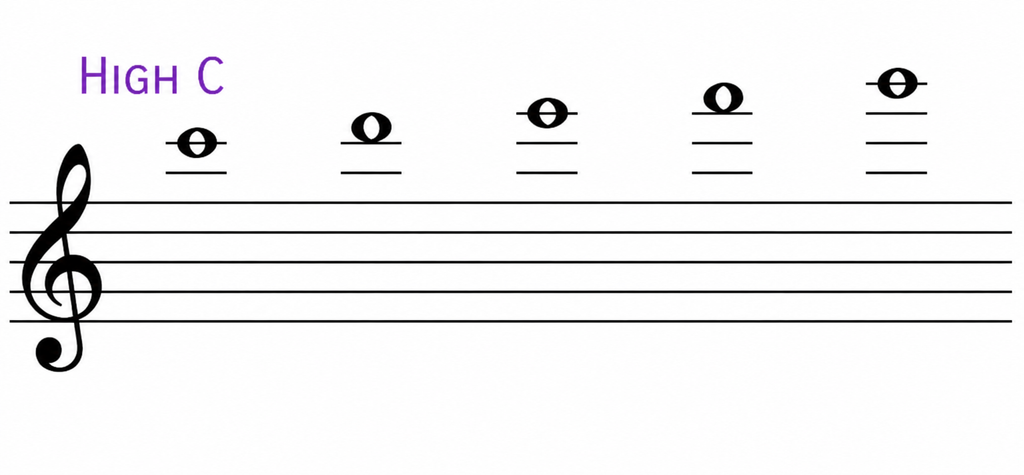
High G is written in the space above the fourth ledger line above the treble staff.
Instead of starting from Middle C, the student can begin with High C:
C – D – E – F – G
Now the student has identified High G.
That is much faster than counting all the way from Middle C.
Do Students Need to Memorize High G Too?
No.
I do not require my students to memorize every ledger-line note individually.
I want them to memorize the important C notes first.
Then they can use those notes to figure out nearby notes.
My teaching philosophy is simple:
“Memorize the Cs. Figure out the rest.”
Of course, with experience, students may begin recognizing many other notes automatically.
But they do not need to memorize every ledger-line note before they can read music successfully.
How to Read Ledger Lines in Music Without Memorizing Every Note
Once students know the Five Cs, I encourage them to find the closest familiar C.
If a note is above High C, students can count upward from that reference point.
When reading below Low C, they can count downward instead.
Notes near Treble C or Bass C can be identified using those familiar landmarks.
Here is the process I teach.
Step 1: Find the Nearest C
Look at the unfamiliar note.
Ask yourself:
“Which C is closest to this note?”
Finding a familiar landmark makes the note easier to identify.
Step 2: Check the Direction
Is the unfamiliar note above or below that C?
Remember:
Higher notes move upward on the staff.
Lower notes move downward.
Step 3: Count Lines and Spaces
Move one step at a time.
Each movement from a line to the next space, or from a space to the next line, advances one letter in the musical alphabet.
Do not skip spaces between ledger lines.
Step 4: Find the Note on the Piano
Once you know the note name, find the correct key in the correct register.
Remember that identifying the letter is only part of reading music.
Students must also know which octave to play.
For more practice connecting written notes with piano keys, read How to Find Any Note on the Piano.
How to Read Ledger Lines in Music With Confidence
One thing I have noticed throughout my teaching career is that some students become nervous as soon as they see ledger lines.
Even students who can read notes comfortably inside the staff may hesitate when notes appear outside it.
Why?
Because the notes look unfamiliar.
A student might see three or four ledger lines and immediately assume the music is too difficult.
But the basic reading rules have not changed.
The notes still move through the same seven letters:
A – B – C – D – E – F – G
Then the pattern repeats.
What I Tell My Students
I remind them that a ledger line is not a new kind of note.
It is simply an extension of the staff.
If they understand line notes and space notes, they already understand the basic system needed to read ledger lines.
Instead of becoming nervous, I encourage them to stop, find a familiar C, and figure out the note.
This approach helps students become more confident and independent music readers.
Common Mistakes When Learning How to Read Ledger Lines in Music
There are several common mistakes beginning students make when reading ledger lines.
Mistake 1: Counting From Middle C Every Time
Middle C is a wonderful starting point.
But it should not become the only starting point.
As students progress, they need additional landmarks.
That is why I teach the Five Cs.
Mistake 2: Trying to Memorize Every Ledger-Line Note
Some students believe they must memorize every note above and below the staff.
That can make music reading feel overwhelming.
Instead, I encourage them to memorize the Five Cs and use those landmarks to identify unfamiliar notes.
Mistake 3: Forgetting to Count Spaces
Students sometimes count only the ledger lines.
But notes can also appear in the spaces between ledger lines.
Remember to count every line and space as one step.
Mistake 4: Finding the Correct Letter in the Wrong Octave
A student might correctly identify a note as C but play the wrong C on the keyboard.
This is why recognizing Low C, Bass C, Middle C, Treble C, and High C is so important.
Students need to understand both the note name and its location on the piano.
For a broader introduction to note reading, see How to Read Sheet Music for Beginners.
Three Exercises to Learn How to Read Ledger Lines in Music
Here are three ways beginners can practice reading ledger lines in music.
Exercise 1: Find the Five Cs
Look at a grand staff and locate:
Low C – Bass C – Middle C – Treble C – High C
Say each note name aloud.
Then find each C on the piano.
Repeat until you can recognize all five without counting from another note.
Exercise 2: Find Notes Near High C
Start with High C on the second ledger line above the treble staff.
Now identify the notes above it:
C – D – E – F – G
Remember:
- High C is on the second ledger line.
- D is in the space above that line.
- E is on the third ledger line.
- F is in the next space.
- G is on the fourth ledger line.
Practice counting upward and downward from High C.
The goal is to recognize how each note moves through the lines and spaces.
Exercise 3: Find Notes Near Low C
Start with Low C on the second ledger line below the bass staff.
Count upward:
C – D – E – F – G
Then practice moving downward:
C – B – A – G
Pay attention to each line and space.
The goal is not to memorize every answer immediately.
The goal is to understand how to find the correct answer independently.
How Parents Can Help Children Practice Ledger Lines
Parents do not need to be experienced musicians to help their children practice note reading.
Instead of giving the answer immediately, ask:
“Can you find a C that you already know?”
Then ask:
“Is this note higher or lower?”
Finally:
“Can you count from that C?”
These questions encourage children to think through the process.
Even five minutes of careful note-reading practice can be useful.
Students do not need to read difficult ledger-line notes quickly on their first attempt.
Accuracy and understanding come first.
Speed develops with practice.
Final Thoughts: How to Read Ledger Lines in Music With Confidence
Learning how to read ledger lines in music does not have to be complicated.
Ledger lines are simply extensions of the five-line staff.
The same musical alphabet and line-and-space patterns continue above and below the staff.
When students first begin, counting from Middle C is a helpful way to understand the system.
But as they advance, they should learn to recognize more reference points.
That is why I emphasize the Five Cs:
Low C – Bass C – Middle C – Treble C – High C
These five notes give students reliable landmarks throughout the grand staff.
I do not expect students to memorize every high or low note they encounter.
Instead, I want them to know their Cs so well that they can recognize them immediately, even many years later.
Then, when they see an unfamiliar note, they have a way to figure it out.
“If you know your Cs, you can figure out any note on the piano.”
That is the confidence I want every piano student to develop.
The goal is not simply to memorize more notes.
The goal is to become an independent music reader.