One of the most common questions parents ask me is, “What is the best age for my child to start piano lessons?”
In my experience, many children are ready to begin piano lessons around age five or six. However, age is not the only thing that matters. A child’s readiness is even more important.
What is the Best Age to Start Piano Lessons?
How Do I Know If My Child Is Ready for Piano Lessons?
Before starting lessons, I like to see whether a child can recognize the letters A through G and understand them in both directions — A, B, C, D, E, F, G and G, F, E, D, C, B, A. This simple skill can make learning the notes on the piano much easier.
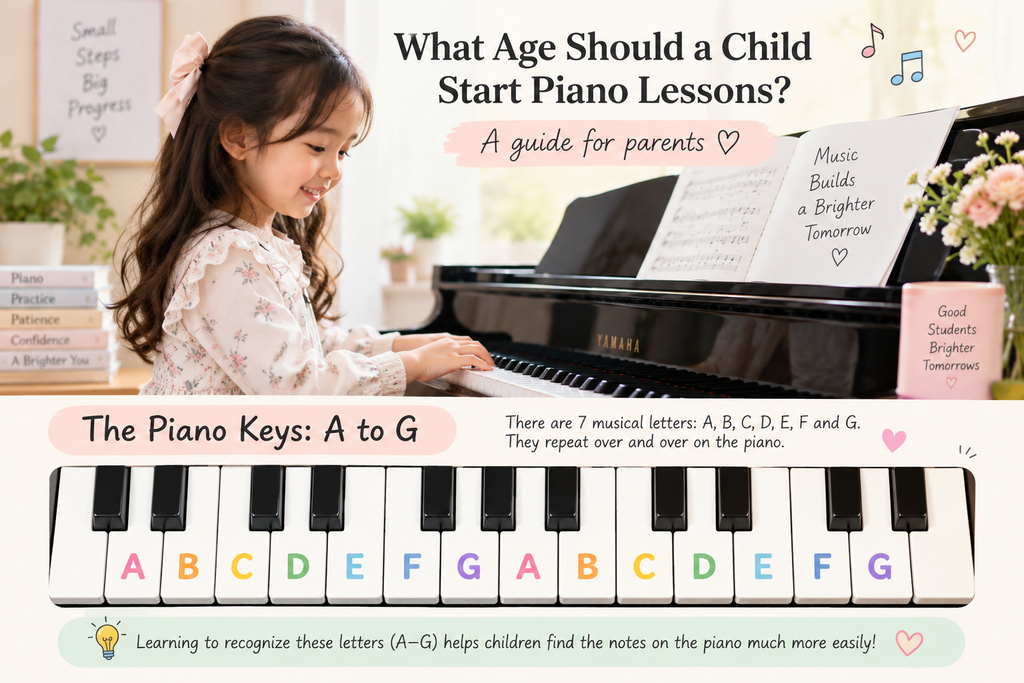
Another important sign of readiness is being able to sit and focus for a short period of time. Young beginners do not need to practice for a long time. Even 10–15 minutes of consistent practice each day can make a big difference.
What Should Parents Expect at the Beginning?
At the beginning, piano lessons should be simple and enjoyable. Young children are learning much more than just how to play songs. They are learning how to sit at the piano, recognize notes, follow directions, and develop good practice habits.
Parents do not need to expect fast progress. What is most important is helping the child build a regular practice routine. Even a few minutes of focused practice every day is better than one long practice session once a week.
How Much Should a Beginner Practice?
For young beginners, I believe consistency is more important than long practice sessions. Practicing for 10–15 minutes each day is often enough in the beginning. The goal is to help the child develop the habit of sitting at the piano regularly.
I usually recommend practicing each assigned piece about five times a day. Repetition helps children become comfortable with the notes and rhythm, but the goal is not simply to memorize the music. Children should continue looking at the music and learning to read the notes as they play.
Too much repetition can sometimes cause a child to play from memory instead of reading the music. I want my students to develop strong music-reading skills from the beginning, so I encourage them to keep their eyes on the music as much as possible while they play.
Keep Practice Positive
Practice should not become a daily battle between parents and children. Encouragement is much more effective than pressure, especially for young beginners. Praise your child for sitting at the piano, trying carefully, and making small improvements.
It is also important to remember that every child learns at a different pace. Some students learn new pieces quickly, while others need more time and repetition. This is completely normal. The goal is not to compare your child with other students, but to help your child make steady progress.
Building a Strong Foundation
In the early years of piano study, building a strong foundation is more important than playing difficult pieces. Students need time to develop note-reading skills, rhythm, proper hand position, and good practice habits.
When these basic skills become comfortable, students can gradually move on to more challenging music. A strong foundation will make learning piano easier and more enjoyable in the future.
Final Thoughts
So, what is the best age to start piano lessons? For many children, ages five or six can be a wonderful time to begin, but readiness is more important than the exact age.
Look for signs that your child can recognize letters A through G, follow simple directions, focus for a short period of time, and show an interest in music.
Most importantly, keep the beginning positive and enjoyable. With regular practice, patience, and encouragement, children can develop not only piano skills but also a lifelong love of music.