What does Op. mean in music? If you have ever opened a classical piano book and noticed something like Op. 9, No. 2 or Op. 27, No. 2 next to a piece’s title, you may have wondered what those numbers mean.
The abbreviation Op. stands for opus, a Latin word meaning “work.” An opus number helps identify a musical composition or a group of compositions.
At first, opus numbers may seem like small details that beginners can ignore. However, understanding them can help students recognize classical music titles, distinguish between pieces, and become more familiar with the composers whose music they play.
After teaching piano for more than 25 years, I believe learning a new piece should begin with more than finding the first note on the keyboard.
Students should also develop the habit of reading the information printed above the music.
Let’s explore what opus numbers mean, how to read them, and why this simple knowledge matters.
What Does Op. Mean in Music? Understanding Opus Numbers
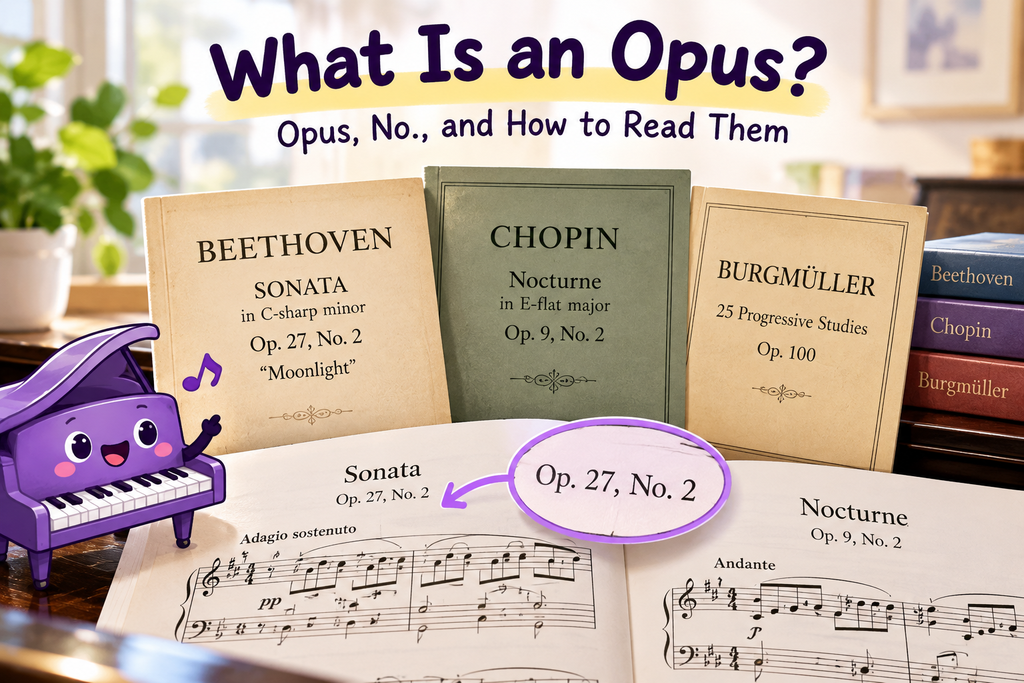
An opus number is a number used to identify a composer’s musical work or collection of works.
In printed music, opus is usually abbreviated as Op.
For example:
- Op. 9
- Op. 27
- Op. 49
- Op. 100
You might see these numbers beside a piano sonata, nocturne, étude, or another classical composition.
What Does Op. Mean in Music? The Latin Origin
Op. is short for the Latin word opus, meaning “work.”
Its plural form is opera, meaning “works.”
In classical music, opus numbers became a useful way to organize and identify compositions, particularly as composers published larger collections of music.
Think of an opus number as an identifying label.
It helps musicians locate the correct piece when several compositions have similar names.
What Does Op. Mean in Music? Is It a Difficulty Level?
No. An opus number is not a difficulty level.
A piece labeled Op. 100 is not automatically harder than a piece labeled Op. 10.
Likewise, a larger opus number does not mean the music is longer, more advanced, or more important.
The number identifies the work; it does not grade the student’s playing ability.
What Does Op. Mean in Music? Understanding Op. 9, No. 2
Many students wonder what Op. means in music when they first see these numbers in a classical piano title.
Sometimes a classical music title contains both an opus number and another number.
For example:
Chopin – Nocturne in E-flat Major, Op. 9, No. 2
Let’s read the title one part at a time.
Step 1: Identify the Composer
Frédéric Chopin is the composer.
Knowing the composer’s name is important because many composers wrote pieces with similar titles, including nocturnes, sonatas, and waltzes.
Step 2: Read the Piece’s Title
Nocturne in E-flat Major tells us the type of composition and its key.
A nocturne is a musical composition often associated with a lyrical, expressive character.
E-flat major identifies the key of the piece.
Step 3: Find the Opus Number
Op. 9 identifies the numbered collection of works.
Chopin’s Op. 9 contains three nocturnes.
Step 4: Understand No. 2
No. 2 identifies the second nocturne in that collection.
Therefore, Chopin’s Nocturne in E-flat Major, Op. 9, No. 2, is the second piece in his Op. 9 set of three nocturnes.
The important distinction is simple:
Op. identifies the work or collection. No. identifies an individual piece within that numbered group.
What Does Op. Mean in Music? Does It Show Composition Order?
When explaining what Op. means in music, I remind students that opus numbers do not always follow the order of composition.
This is one of the most common misunderstandings about opus numbers.
What Does Op. Mean in Music? Is It Composition Order?
A composer may write a piece and publish it several years later.
Another piece may be published earlier even though it was composed later.
In some cases, opus numbers were assigned by publishers rather than directly by the composer.
For these reasons, opus numbers often reflect publication history or a particular numbering system rather than the exact order of composition.
Does Op. Mean a Composer’s Twentieth Piece?
No.
An opus number can refer to an entire collection containing several compositions.
Also, not every piece written by a composer necessarily receives an opus number.
For example, Beethoven’s Op. 2 contains three piano sonatas, not just one composition.
It would be incorrect to assume that Op. 2 means Beethoven’s second-ever composition.
Famous Examples That Explain What Op. Means in Music
Looking at famous compositions is a practical way to understand what Op. means in music.
Example 1: Chopin – Nocturne in E-flat Major, Op. 9, No. 2
This is one of Chopin’s best-known nocturnes.
Its title tells us the composer, the musical form, the key, the opus collection, and the individual piece number.
A student who understands the title can distinguish it from Chopin’s other nocturnes.
Example 2: Beethoven – Piano Sonata No. 14 in C-sharp Minor, Op. 27, No. 2
This famous sonata is commonly known as the Moonlight Sonata.
Notice that the title contains two different numbering systems.
Sonata No. 14 identifies its traditional position in Beethoven’s numbered piano sonatas.
Op. 27, No. 2 identifies the second sonata in the Op. 27 group.
The popular nickname “Moonlight Sonata” is another way listeners recognize the work.
This is a useful example of why reading the complete title matters.
Example 3: Burgmüller – 25 Easy and Progressive Studies, Op. 100
Friedrich Burgmüller’s Op. 100 is a collection of 25 piano studies.
Many developing piano students encounter these pieces as they progress beyond their earliest beginner books.
Each study has its own number and often a descriptive title.
For example, La Candeur, Op. 100, No. 1, is the first study in the collection.
Here, Op. 100 identifies the collection, while No. 1 identifies the particular study.
You do not need to memorize all 25 titles to understand how the numbering works.
Do All Classical Composers Use Opus Numbers?
Once students understand what Op. means in music, they can begin exploring other musical cataloguing systems.
Different composers’ works are identified using different numbering systems.
This is especially important when students begin exploring music by Mozart, Bach, Schubert, and Beethoven.
Mozart: What Does K. Mean in Music?
Mozart’s works are commonly identified with K. or KV numbers.
These refer to the Köchel catalogue, named after Ludwig von Köchel, who organized Mozart’s compositions.
For example:
Mozart – Piano Sonata in C Major, K. 545
The number K. 545 identifies the work in the Köchel catalogue.
It is not an opus number.
Bach: What Does BWV Mean?
Johann Sebastian Bach’s compositions are commonly identified with BWV numbers.
BWV stands for Bach-Werke-Verzeichnis, meaning “Bach Works Catalogue.”
For example:
Bach – Prelude in C Major, BWV 846
The BWV number identifies the composition within the catalogue of Bach’s works.
Unlike a simple chronological numbering system, BWV numbers are largely organized by categories of compositions.
Beethoven: What Does WoO Mean?
Some Beethoven compositions do not have opus numbers.
These works may be identified with WoO, an abbreviation of the German expression Werke ohne Opuszahl, meaning “works without opus number.”
For example:
Beethoven – Für Elise, WoO 59
Although Für Elise is one of Beethoven’s most recognizable piano pieces, it does not have a traditional opus number.
This is an excellent reminder that a piece can be famous and important without having an Op. designation.
Other Catalog Numbers You May See
As students explore more classical music, they may encounter additional abbreviations:
- D. for the Deutsch catalogue of Schubert’s works
- Hob. for the Hoboken catalogue of Haydn’s works
- RV for the Ryom catalogue of Vivaldi’s works
There is no need for beginners to memorize every catalogue system.
The goal is simply to recognize that these letters and numbers help identify musical compositions.
For readers interested in researching classical works more deeply, G. Henle Publishers’ Beethoven Catalogue of Works offers an example of how compositions are organized and documented.
Why Understanding What Op. Means in Music Matters
Knowing what Op. means in music helps students identify the correct piece when searching for sheet music or recordings.
Understanding opus numbers is not just about learning music history.
It is also part of developing good habits when reading sheet music.
1. Recognize the Piece You Are Learning
Imagine that a student says:
“I’m playing a Beethoven sonata.”
Beethoven wrote many piano sonatas.
Which one?
A complete title provides much more information.
When students learn to read the composer’s name, title, key, and opus number, they can identify their music more accurately.
2. Find the Correct Music More Easily
Suppose you are searching for a recording of Chopin’s Nocturne, Op. 9, No. 2.
If you search only for “Chopin Nocturne,” you may find many different compositions.
Including the opus and piece numbers makes it easier to locate the intended work.
The same principle applies when looking for sheet music, recordings, or performances.
3. Become Familiar With Classical Music
Students do not need to memorize hundreds of opus numbers.
However, recognizing a few important titles can gradually build their knowledge of classical repertoire.
A student who regularly reads the titles of new pieces may begin to notice familiar composers, musical forms, and numbering patterns.
Over time, those details become less intimidating.
My Teaching Tip: Read the Title Before Playing the First Note
As a piano teacher with more than 25 years of teaching experience, I encourage my students to develop a simple but valuable habit.
Before playing a new classical piano piece, read the information at the top of the page.
I want students to notice more than the notes written on the staff.
Start With Three Simple Questions
Before beginning a new piece, students can ask:
- Who is the composer?
- What is the title of the piece?
- Is there an opus number or another catalogue number?
If the title also includes a key, movement, or tempo marking, students can begin noticing those details as well.
The goal is not to turn every piano lesson into a music history lecture.
It is to help students understand what they are learning.
Do Students Need to Memorize Every Opus Number?
Absolutely not.
There are thousands of classical compositions, and expecting students to memorize every title and catalogue number would be unrealistic.
Some musicians remember an impressive number of works and their identifying numbers.
Others remember only the pieces they perform or enjoy most.
Both can develop a meaningful understanding of classical music.
I think it is helpful for students to remember the full titles of a few favorite pieces, especially works they have studied or performed.
However, the habit of reading the information is more important than memorizing every number.
Look at the Music Before Touching the Keys
Sometimes students are eager to begin playing immediately.
They open the book, find the first note, and start.
But I want them to develop a more thoughtful approach.
First, look at the title.
Notice the composer.
Read the opus number if there is one.
Then examine the music itself.
What is the time signature? What is the key signature? Are there tempo or dynamic markings?
Only then begin playing.
This habit supports the broader music-reading skills I discuss in How to Read Sheet Music for Beginners.
It also connects with the importance of keeping your attention on the score, which I explain in Should You Look at Your Hands When Playing Piano?.
Practice Exercise: What Does Op. Mean in Music?
This simple exercise reinforces what Op. means in music and helps students become more confident when reading classical music titles.
You can practice reading classical music titles without even sitting at the piano.
Exercise 1: Read the Title
Look at this example:
Chopin – Nocturne in E-flat Major, Op. 9, No. 2
Answer the following questions:
- Who composed the piece?
- What is the title?
- What is the key?
- What is the opus number?
- Which piece is it within the opus collection?
Answers: Chopin; Nocturne; E-flat major; Op. 9; No. 2.
Exercise 2: Recognize a Different Catalog System
Now look at:
Mozart – Piano Sonata in C Major, K. 545
Can you identify the composer and title?
Does this piece have an opus number in the title?
No. It uses a Köchel catalogue number instead.
Exercise 3: Create a New-Music Checklist
The next time you begin learning a piece, check these five items:
- Composer
- Title
- Opus or catalogue number, if present
- Key signature
- Time signature
You can expand the checklist later to include tempo, dynamics, and other musical directions.
For additional beginner foundations, see my Beginner Piano Guide: 10 Essential Tips From a Piano Teacher.
What Does Op. Mean in Music? Common Questions
Is Opus the Same as Op.?
Yes. Op. is the standard abbreviation for opus.
Both refer to the same term.
What Is the Difference Between Op. and No. in Music?
Op. identifies a work or collection, while No. identifies a numbered item within a group.
However, No. can also appear independently in titles, such as “Piano Sonata No. 14.”
Always read the complete title to understand which numbering system is being used.
Are Opus Numbers Always Assigned by the Composer?
No. Depending on the composer and historical circumstances, opus numbers may have been assigned or influenced by publishers, editors, or later cataloguing practices.
Can One Opus Number Include Several Pieces?
Yes.
A collection of études, nocturnes, sonatas, or other works may share one opus number, with individual pieces distinguished by No. 1, No. 2, and so on.
Is a Higher Opus Number More Advanced?
No.
Opus numbers do not indicate the technical difficulty of a composition.
Why Does Für Elise Have WoO 59 Instead of an Opus Number?
Für Elise belongs to Beethoven’s works catalogued without opus numbers.
WoO 59 is its identifying catalogue number.
You can learn more about Beethoven’s works without opus numbers through G. Henle Publishers’ collection of Beethoven piano dances, which also explains the WoO designation.
Final Thoughts: What Does Op. Mean in Music?
Learning what Op. means in music is a small but useful step toward understanding classical piano repertoire.
An opus number is not a difficulty rating, and it does not necessarily reveal when a composition was written.
Instead, it helps identify a musical work or collection.
As students progress, they will encounter other systems, including K., BWV, and WoO.
There is no need to memorize every abbreviation immediately.
Start with a simple habit:
Read the composer’s name. Read the title. Notice the opus or catalogue number. Then begin exploring the music.
Piano playing is not only about pressing the correct keys.
It is also about understanding the music in front of you.
And sometimes, that understanding begins before you play a single note.