Should you look at your hands when playing piano?
This is a question many beginning piano students ask, and my answer is: sometimes—but not most of the time.
During my piano lessons, there is one phrase I probably say more than almost anything else:
“Look at the book.”
I say it again and again because many beginners naturally want to look down at their hands while they play. Sometimes they are checking their fingers. Sometimes they are looking at the keys. And sometimes they have already memorized part of the music and are playing from memory instead of actually reading the notes.
Learning when to look at the music and when to look at your hands is an important part of becoming an independent pianist.
Why Should You Look at the Music When Playing Piano?
When a student is learning a new piece, I want the student’s eyes to follow the music.
Looking at the book does not simply mean that your face is turned toward the music stand.
Your eyes should actually be following the notes and measures as you play.
I sometimes see students whose faces are pointed toward the book, but their eyes are not really following the music. They have memorized what comes next, so their fingers continue playing while their eyes are no longer connected to the notes on the page.
That is not the same as reading music.
Learning how to read sheet music helps students stay connected to the score instead of depending on their hands or memory.
When you are first learning a piece, you need to know exactly where you are in the score.
What measure are you playing?
What note are you playing?
What comes next?
What changes are coming?
Your eyes should stay connected to the music so that you are actually reading and understanding what you are playing.
“I Don’t Want to Make a Mistake”
There is another reason students look at their hands, and I hear it all the time in my lessons.
I will ask:
“Why aren’t you looking at the book?”
“Why are you looking down?”
“Why are you watching your hands?”
Almost every time, I hear the same answer:
“I don’t want to make a mistake.”
Students look down because they want to make sure their fingers are going to the correct keys. They believe that if they keep watching their hands, they will be less likely to play a wrong note.
I understand why they feel that way.
But my response is:
“Trust yourself.”
You have practiced. You know more than you think you know. Give your hands a chance to find the keys without watching every movement.
And if you make a mistake?
That is okay.
Now we have something to learn from.
Maybe you were supposed to play E, but you played F. Look down, check what happened, correct it, and try again.
Making a mistake and correcting it is part of learning.
But if you constantly watch your hands because you are afraid of making a mistake, you never give yourself the opportunity to develop the keyboard awareness that eventually allows you to play without watching every key.
Trust Yourself—and Trust Your Teacher
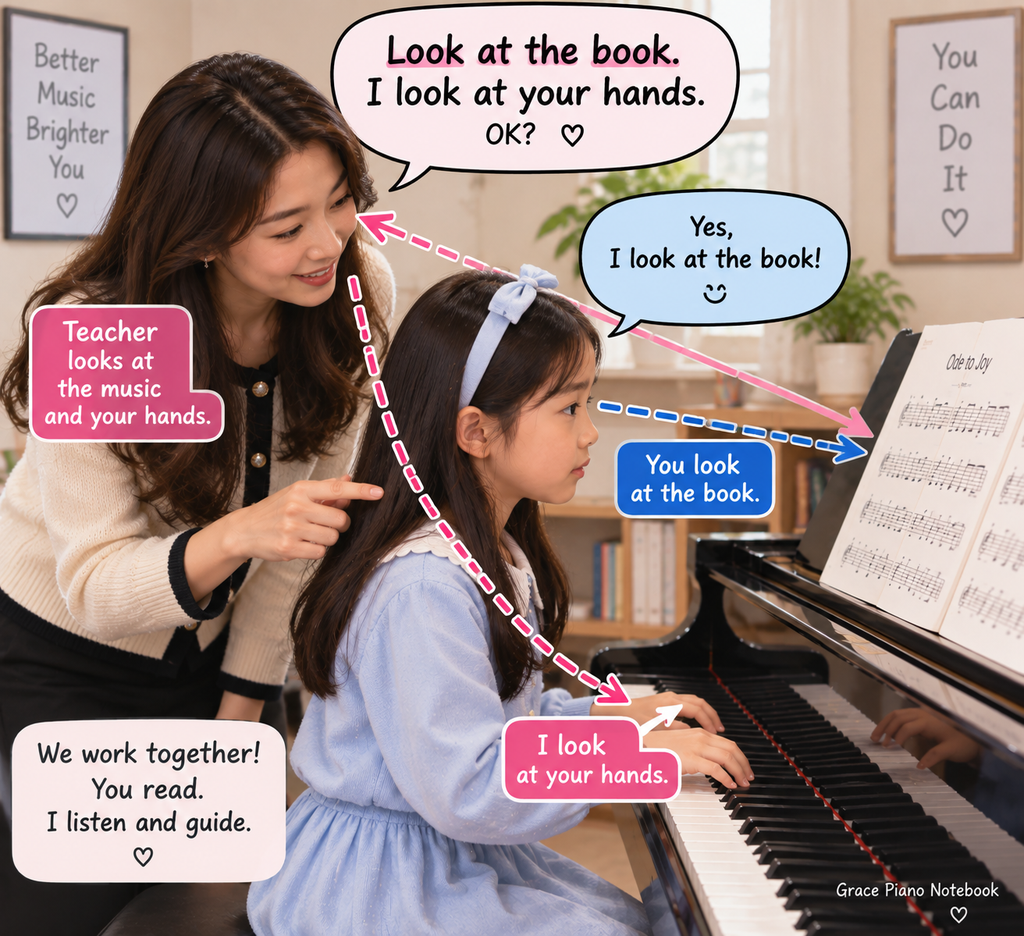
Sometimes I tell my students:
“Trust yourself.”
And sometimes I add:
“Trust me.”
There is a reason.
During a piano lesson, the student and teacher have different jobs.
The student’s job is to read the music.
My job as the teacher is to watch and listen.
While the student follows the score, I can watch the hands. I can see whether the student is using the correct finger number. I can see whether the hand moved to the wrong key. I can hear whether a note is incorrect.
The student does not need to do both jobs at the same time.
If the student keeps looking down to check every finger and every key, the eyes keep leaving the score.
Instead, I want the student to stay with the music and trust that I am watching what is happening at the keyboard.
If something is wrong, I will tell them.
And sometimes something wonderful happens.
The student keeps looking at the music, plays the passage, and nothing happens.
I do not stop them.
The notes sound right.
The music continues.
Then the student realizes:
“I did it without looking at my hands.”
That moment begins to build confidence.
Do Not Depend on Memorization When Learning a New Piece
Memorization is not a bad thing.
In fact, being able to memorize music well is an excellent skill. After a student has learned a piece thoroughly, understands the music, and has practiced it carefully, playing from memory can be wonderful.
But memorization should not replace reading while you are still learning the piece.
There is an important difference between memorizing music after learning it and using memory to avoid reading it.
If a student begins memorizing immediately and stops following the score, mistakes can easily become part of that memorization.
The student may believe the notes are correct simply because the fingers have repeated the same pattern many times.
That is one reason I keep saying:
“Look at the book.”
I want the student to check the music—not just trust what the fingers remember.
Looking at the Music Helps You Prepare for What Comes Next
Another reason to keep your eyes on the music is that good reading is not only about the note you are playing right now.
Your eyes also need to prepare for what is coming next.
As your reading improves, you begin to see the next note, interval, chord, or hand movement before you actually play it.
This is an important part of sight-reading.
Sight-reading is also an important skill in structured piano study and practical music exams such as ABRSM.
If your eyes constantly move from the book to your hands, back to the book, and then back to your hands again, it is much easier to lose your place.
Keeping your eyes on the score helps create a continuous connection between what you see, what you understand, and what your hands play.
Piano Lessons Are Also a Conversation Through the Music
When I teach a student, both of us are looking at the same score.
There is a reason for that.
The student is not simply learning where to put each finger. We are studying the music together.
I may point to a note, a measure, a rhythm, a dynamic marking, or a phrase. The student needs to know exactly where I am talking about.
In that sense, the score becomes part of the communication between teacher and student.
We are both looking at the same musical information and talking about how to understand and play it.
If the student is playing mostly from memory without following the score, that connection can easily be lost.
Is It Ever Okay to Look at Your Hands When Playing Piano?
Yes, it is okay to look at your hands when playing piano sometimes
The goal is not to teach students that they should never look at the keyboard.
There are times when looking down is helpful and necessary, especially when the hands need to make a large jump.
For example, imagine that you are playing near Middle C and suddenly need to move to a much higher G.
Or perhaps your left hand needs to jump far down into the lower register of the piano.
In those situations, I may quickly look at the keyboard to confirm the location before making the jump.
Then my eyes return to the music.
The important difference is this:
Looking at your hands occasionally to confirm a position is very different from watching your hands throughout the entire piece.
For most normal passages, I want students to develop enough keyboard awareness that they do not need to watch every finger movement.
Learn to Feel the Distance Across the Keyboard
This is something I work on regularly with my students.
A pianist should gradually develop a physical sense of where notes are located on the keyboard.
If you are sitting in the middle of the piano and need to play an F, you should begin to develop a sense of where that F is.
If you need an E-flat, your hand should gradually learn approximately how far it needs to move.
The same is true for larger distances.
How far does an octave feel?
What does a two-octave movement feel like?
How far does your arm need to move from the middle register into the high or low register?
You develop this awareness through experience and repetition.
Eventually, the keyboard begins to feel less like 88 separate keys that you must visually search for and more like a physical space that your hands understand.
My Eyes-Closed Piano Exercise for Students
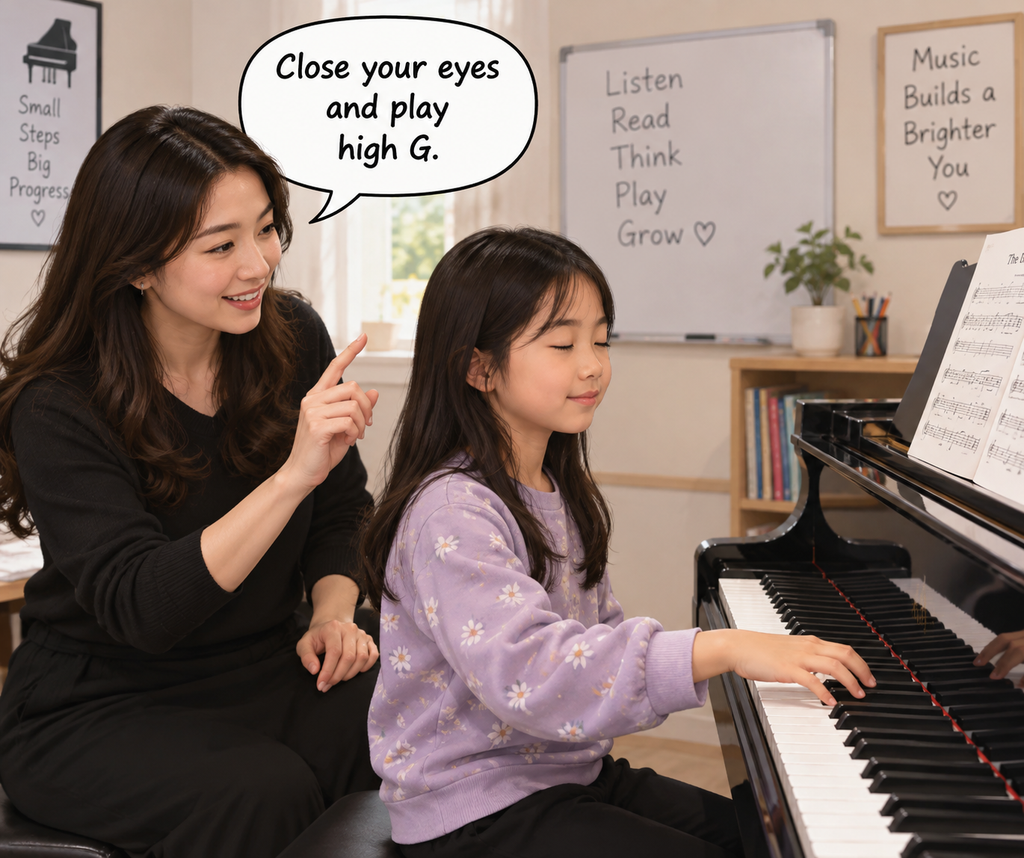
One exercise I use with my students is very simple.
I ask them to close their eyes.
Then I might say:
“Find E-flat.”
Or:
“Play A with your left hand.”
Or:
“Find F-sharp with your right hand.”
The goal is not necessarily to get every note correct immediately.
The goal is to develop keyboard awareness.
Students begin learning how far their hands need to move and where different areas of the keyboard are located without depending completely on their eyes.
After trying the note, they can open their eyes and check.
With practice, their sense of distance becomes more accurate.
This is a very useful skill because it allows the eyes to stay on the music while the hands become more confident moving around the keyboard.
Should Beginners Look at Their Hands When Playing Piano?
Beginners will naturally need to look at their hands more often than experienced pianists.
That is normal.
But from the beginning, I want my students to develop the habit of returning their eyes to the music.
Do not stare at your hands for the entire piece.
Do not play from memory simply because reading the notes feels more difficult.
And do not look down at every note simply because you are afraid of making a mistake.
Instead, keep following the score and gradually learn to feel your way around the keyboard.
Look down briefly when you truly need to check a position or prepare for a large jump, and then bring your eyes back to the music.
When Should You look at Your Hands When Playing Piano?
The goal is balance.
Learning when to look at your hands when playing piano is part of developing good keyboard awareness.
When you are learning a new piece, the score should usually be the main focus of your eyes.
Your hands should gradually learn the geography of the keyboard so that you do not need to watch every movement.
And once you have fully learned and understood a piece, memorizing it can become another valuable musical skill.
So when I tell my students,
“Look at the book.”
I am not simply telling them where to point their eyes.
I am teaching them to read, think ahead, understand the score, trust their hands, and become more independent at the piano.
And when they are afraid they might play a wrong note, I remind them:
“Trust yourself.”
If you make a mistake, we can fix it.
That is what learning is for.