7 Common Piano Beginner Mistakes and How to Fix Them: Advice from a Piano Teacher
Learning piano is exciting, but beginners often develop small habits that can make playing more difficult later.
After teaching piano since 2001, I have seen the same beginner mistakes many times—with both children and adults. Most of these mistakes are completely preventable when they are corrected early.
A strong foundation is not only about learning the right notes. Hand shape, posture, fingering, rhythm, tempo, practice habits, and music-reading skills all matter.
Here are seven common piano beginner mistakes I see in lessons—and how I help my students correct them.
1. Poor Hand Shape and Posture
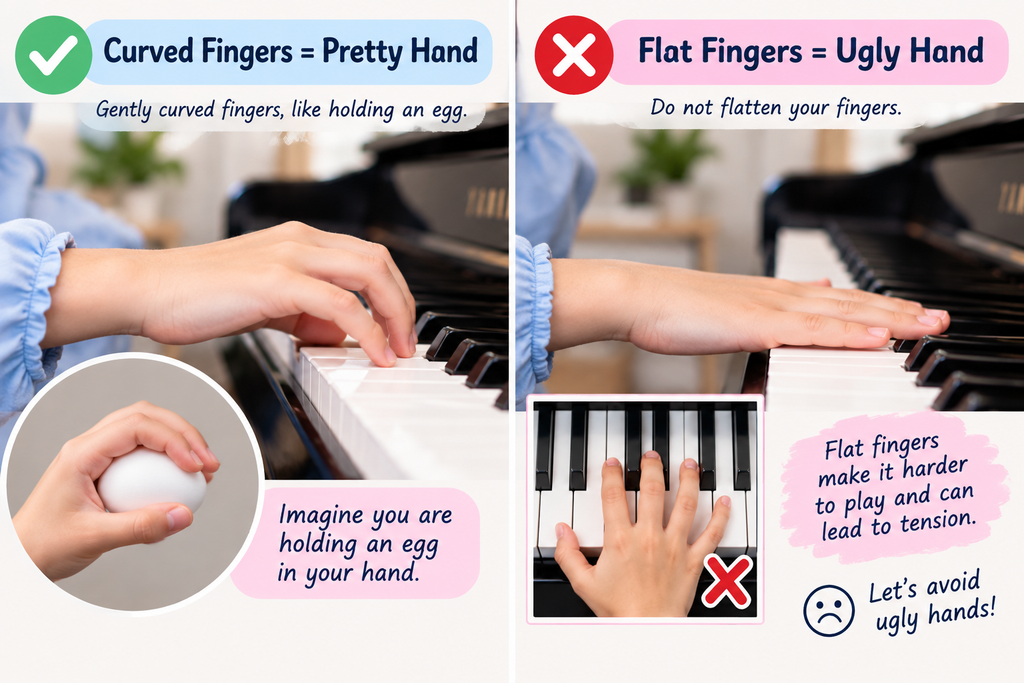
One of the first things I teach a beginner is how to sit and place the hands correctly at the piano.
I often tell young students to imagine that they are gently holding an egg. The fingers should be naturally curved rather than completely flat.
With children, I sometimes call flat, stretched fingers “ugly hands” and nicely curved fingers “pretty hands.” It is a simple visual that young students understand immediately.
Another common mistake is moving the hands too far toward the back of the keys.
The front portion of a white key is wide, but the space becomes narrower between the black keys. Some beginners push their hands too far into this narrow area and stretch their fingers around the black keys.
I sometimes joke with my younger students:
“Do you like spiders?”
Their hands can start looking like little spiders crawling between the black keys!
For most basic beginner playing on the white keys, I teach students to stay comfortably in the wider area of the keys unless the music requires them to move farther in.
Posture is equally important.
I remind students:
Back straight. Shoulders down. Relax.
Students should not hunch over the piano, but they also should not sit stiffly with their shoulders raised. The goal is a balanced, comfortable position that allows the arms and hands to move freely.
Good posture becomes even more important as practice sessions become longer. You should be able to play comfortably without creating unnecessary tension in your shoulders, arms, or back.
2. Not Practicing Regularly
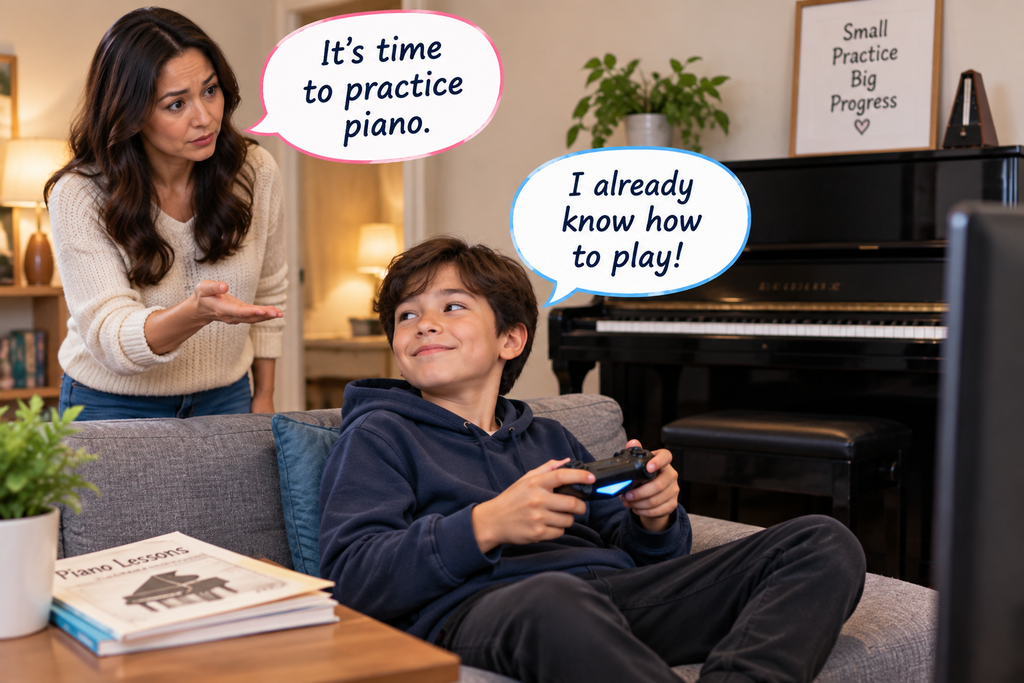
This may be one of the biggest mistakes a piano student can make.
A piano lesson is only one part of learning. What happens between lessons is just as important.
After each lesson, students should go home and practice the assignments their teacher has given them. Regular practice helps reinforce new notes, rhythms, fingerings, and techniques before the next lesson.
Natural musical ability can certainly help, but talent alone is not enough.
I have taught many different types of students over the years, and one thing remains consistent:
Students who practice regularly usually make stronger and more consistent progress.
This does not mean beginners need to practice for hours every day. Especially for young beginners, shorter and more focused practice sessions can be very effective.
The important thing is consistency.
Building a consistent practice routine is just as important as correcting these mistakes. Read my guide on how often a child should practice piano.
3. Ignoring Finger Numbers
Beginners sometimes see finger numbers written in their music but treat them as optional.
They are not.
In beginner music, finger numbers are there to help students find the correct hand position and move comfortably from one note to the next.
The first note of a passage, in particular, will often have a finger number that helps the student know exactly where to place the hand.
If a student ignores that number and starts with a different finger, everything that follows may become unnecessarily difficult. The student may run out of fingers, twist the hand into an uncomfortable position, or play the wrong notes later in the passage.
That is why I frequently remind my students:
Look at the note—and look at the finger number too.
Good fingering eventually becomes part of good technique. Developing that habit from the beginning saves a lot of frustration later.
Many piano beginner mistakes develop simply because students repeat the same habits without realizing them.
4. Not Holding Notes for Their Full Value
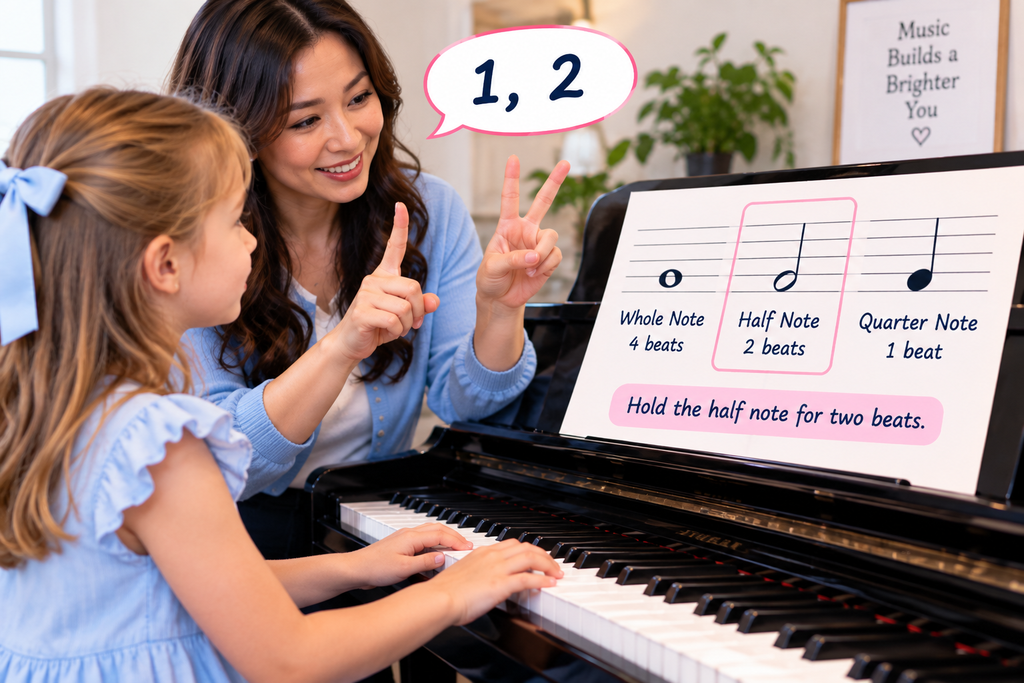
Playing the correct note is only half the job.
You also have to play it for the correct amount of time.
For example, if a half note receives two beats, the student needs to hold that note for the full two beats.
One, two.
If the finger comes off the key too early—or the student rushes immediately to the next note—the rhythm is no longer correct.
The same principle applies to notes that receive one, three, or four beats.
Beginners sometimes become so focused on finding the next note that they forget to listen to the length of the note they are currently playing.
This is why counting aloud can be extremely helpful in the beginning.
Don’t just ask:
“Did I play the correct note?”
Also ask:
“Did I give that note its full value?”
Rhythm is not an extra part of music. Rhythm is part of the music.
5. Playing Too Fast
Many beginners believe that playing faster means playing better.
It doesn’t.
When students play too fast before they are ready, they often begin missing notes, using incorrect fingering, losing the rhythm, or creating unnecessary tension.
I would much rather hear a student play a piece slowly and correctly than quickly with repeated mistakes.
If a student’s natural tempo is too slow, a teacher can gradually help increase the speed. We can count a little faster, use a metronome when appropriate, or slowly work toward the intended tempo.
But a student who constantly rushes needs to learn control.
For beginners, accuracy and control should come before speed.
Learn it correctly first. Speed can come later.
6. Memorizing a Piece and Then Stopping Reading the Music
Some students have excellent memories.
They may play a piece only once or twice and remember much of it. That is a wonderful musical ability.
But it can also create a problem.
Once students realize they remember the piece, they sometimes stop looking at the music completely. Their eyes move to their hands, and they begin playing almost entirely from memory.
I don’t want to discourage memorization. Being able to memorize music is a valuable skill.
But memorization should not replace music reading.
Even when students already know a piece, I encourage them to keep their eyes on the score and follow where they are in the music.
They should know:
Which measure am I playing? What note am I reading? What rhythm is written here?
A beginner needs to develop the connection between what the eyes see on the page and what the hands play on the keyboard.
That connection takes time to build—and it is extremely valuable.
7. Copying Someone Else’s Hands Instead of Learning to Read Music
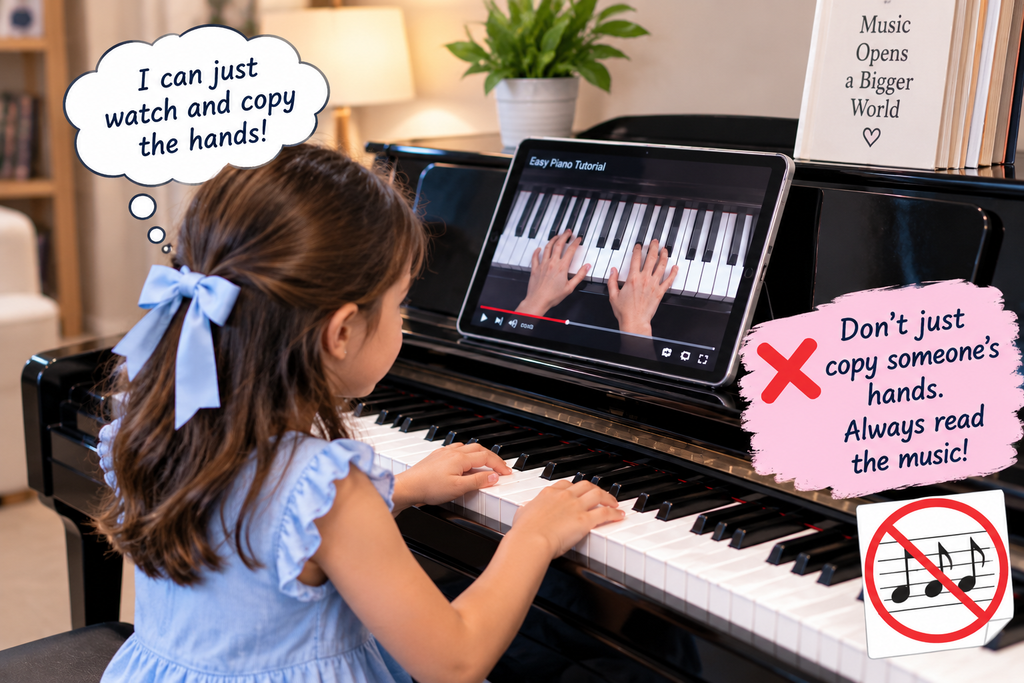
Today, beginners can find thousands of piano tutorials online.
Videos can be useful. They can help students hear a piece, discover new music, or understand a musical idea.
But there is one learning method I do not recommend:
Watching someone’s hands and simply copying which keys they press instead of learning to read the music.
A beginner may be able to learn one song this way, but what happens when the next piece is placed in front of them?
If they cannot read the notes and rhythms independently, they still need someone else to show them what to play.
There is another problem: not every performance or tutorial online uses the same fingering, interpretation, or even the correct notes. An experienced musician may recognize a problem, but a beginner often cannot.
If a beginner learns something incorrectly and repeats it many times, that mistake can become a habit—and habits can be much harder to correct later.
Use videos as a supplement, not as a replacement for learning to read music.
Common Piano Beginner Mistakes to Avoid
One of the most valuable skills I developed through my own musical training is the ability to read music.
When I am given unfamiliar music, I can look at the score, understand the notes and rhythm, and begin working through it without needing someone else to demonstrate every note for me.
That is the kind of independence I want my students to develop.
My goal is not simply to teach a student how to play one song.
I want students to learn the skills that allow them to eventually open a piece of music and begin figuring it out for themselves.
That means learning to recognize notes, understand rhythm, follow fingering, notice key signatures, and read ahead while playing.
It takes time, but once students develop strong reading skills, a whole world of music becomes available to them.
For additional piano practice resources and expert guidance, visit the ABRSM Piano Learning Resources.
Final Thoughts
Every beginner makes mistakes. That is a normal part of learning piano.
The important thing is to identify poor habits early before they become deeply established.
Start with a comfortable hand shape and good posture. Practice regularly. Pay attention to finger numbers. Count the full value of every note. Don’t rush. Continue reading the score even when you begin memorizing the music. And don’t depend on copying someone else’s hands to learn every piece.
Most importantly, build the foundation carefully.
You may not notice the difference immediately, but as the music becomes more challenging, those basic skills become increasingly important.
Correcting these piano beginner mistakes early can make learning easier and help students build a strong foundation.
The goal isn’t simply to learn how to play a few songs. The goal is to become a musician who can read, understand, and enjoy music independently.