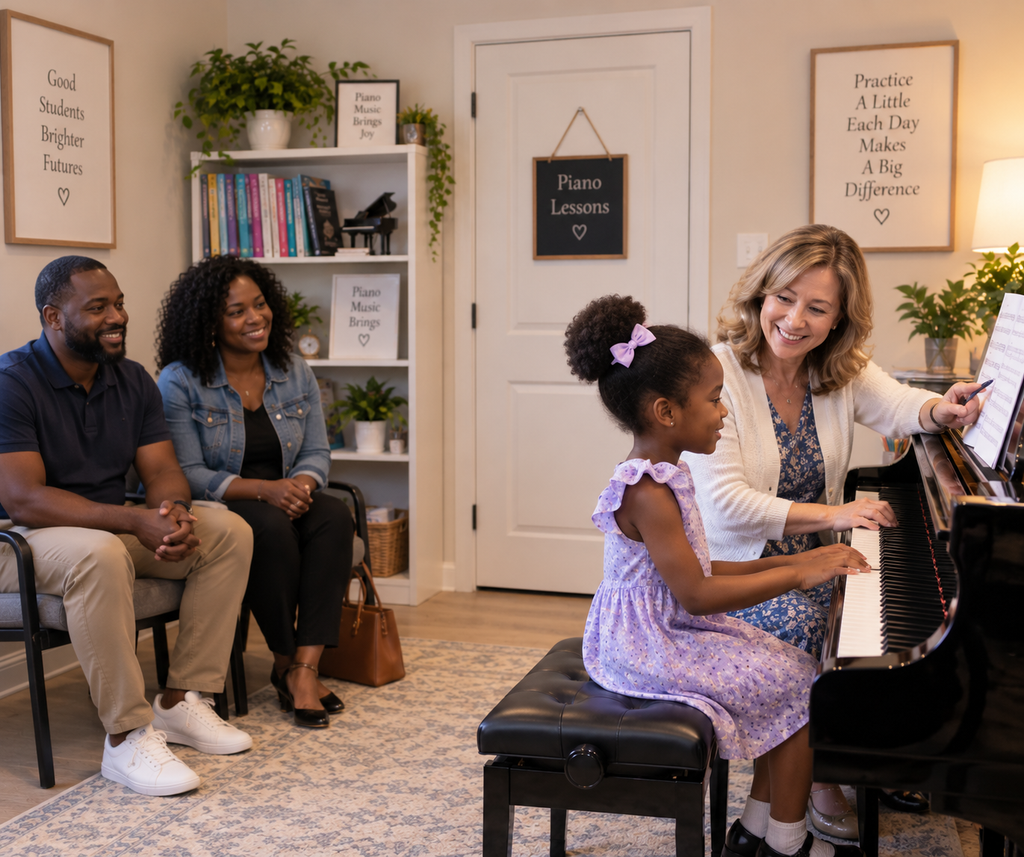
One question I often hear from parents when their child begins piano lessons is, “Can I sit in during the lesson?”
My answer is always, “Of course.”
Especially when a young beginner is starting piano lessons, I think it can be very helpful for a parent to observe. Parents can see how the teacher works with their child, understand what the child is learning, and learn how to support practice at home.
However, after many years of teaching piano, I have also learned something important: a parent’s presence can be very helpful, but too much involvement can sometimes make a lesson more difficult.
The key is knowing when to observe, when to help, and when to let the teacher and child work together.
Why I Welcome Parents in the Beginning
When a new student starts piano lessons, some parents ask me if they are allowed to stay in the room.
I always welcome them.
Parents are trusting a teacher with their child, so I completely understand why they may want to observe at first. They can see my teaching style, hear what I am asking their child to practice, and become familiar with the way I explain new concepts.
This can be especially useful with young beginners who may not remember everything they learned during the lesson.
Interestingly, something often changes after a month or two.
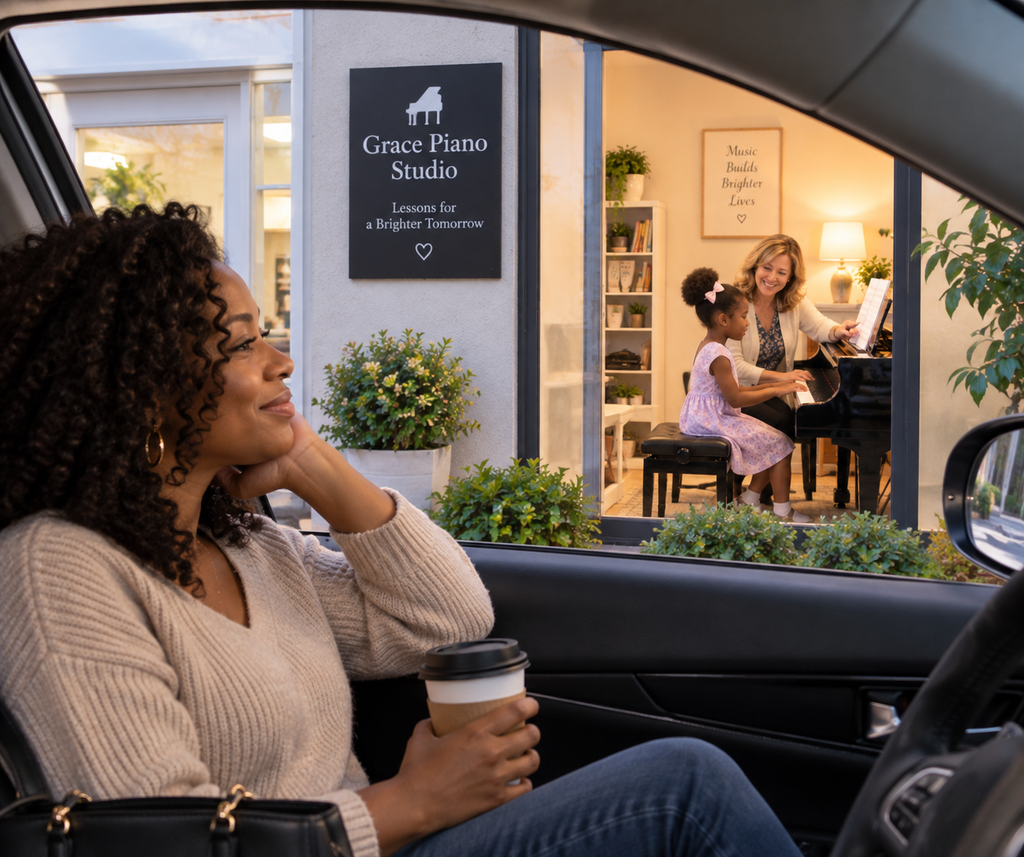
Parents who attended every lesson in the beginning may gradually stop coming into the lesson room. They might wait in the car or run a quick errand while their child has the lesson.
When this happens, I actually feel happy.
To me, it often means, “She trusts me now.”
Building trust between a parent and a piano teacher takes time. Parents should always feel welcome to observe, but it is also perfectly fine when they become comfortable enough to give their child and teacher some space.
The Best Parent Observers Quietly Learn Too
Some of my favorite experiences are with parents who quietly learn along with their children.
A parent does not have to watch every second of the lesson. I do not mind if a parent occasionally looks at a phone, reads a book, or simply sits quietly in the back.
But sometimes, while I am pointing to the music or demonstrating a finger movement, I notice something wonderful.
The parent sitting behind the child is silently moving her own fingers, copying what I am showing the student.
I love seeing that.
Many parents have never learned piano themselves, so while they are watching their child’s lesson, they are learning too.
Sometimes they ask me questions afterward, such as, “Why do you do it that way?” or “Can you show me how that works?”
I welcome those questions.
Parents do not need to know how to play the piano to help their child. Simply understanding what the child is learning can make practice at home much easier.
When Parents Sit In During Piano Lessons: When Is It Too Much?
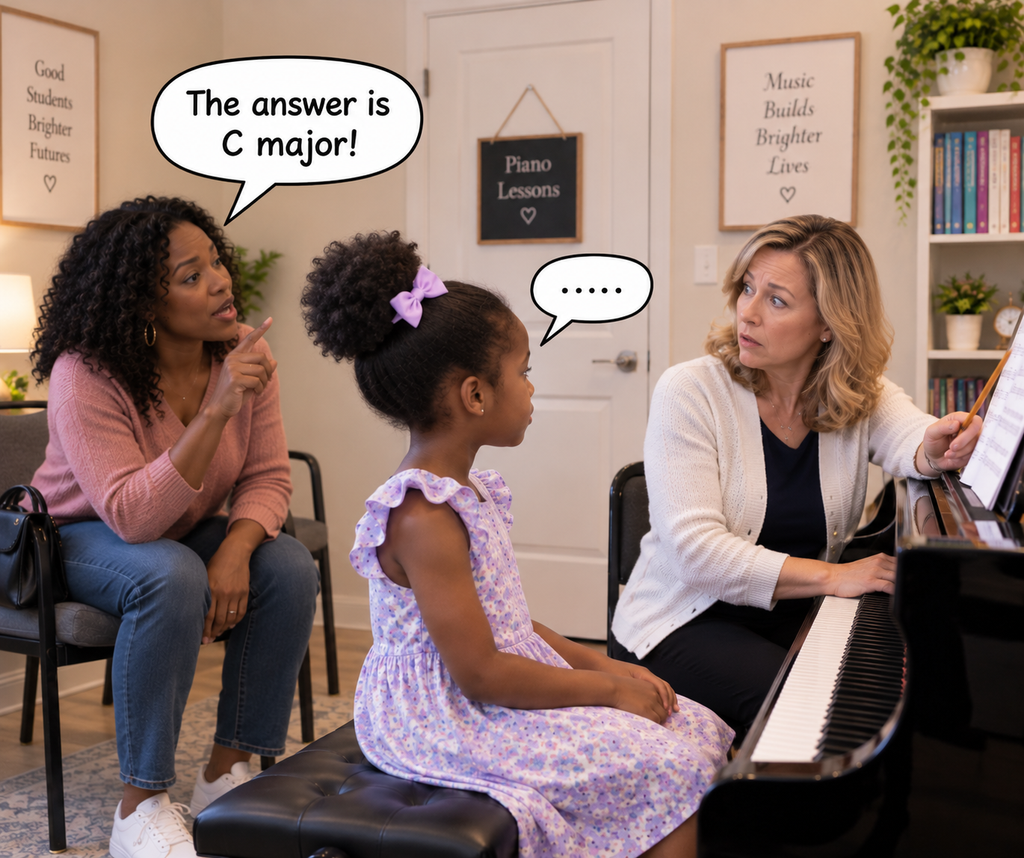
There is also another side to having parents in the lesson.
Sometimes parents want to help so much that they begin participating in the teaching.
For example, I may ask a student, “What note is this?”
Before the child has enough time to think, the parent may answer, “It’s C!”
Or the child may make a mistake, and the parent immediately corrects it.
I understand why parents do this. They want their child to succeed.
But making mistakes is an important part of learning.
As a teacher, I need to know whether the student understands a concept independently. If someone answers for the child, I cannot accurately tell what the child knows.
The student also needs time to think, make a mistake, try again, and eventually find the correct answer.
Children Need Encouragement and Correction
I once taught a child whose parent was very loving and protective. The parent attended the lessons and sometimes found it difficult to watch her child struggle or be corrected.
Her intentions were good. She simply cared deeply about her child.
But as a teacher, I believe children need both encouragement and honest correction.
There are many times when I praise my students, but there are also times when I need to say, “Let’s try that again,” or “That isn’t quite right.”
Being kind does not mean telling a student that everything is correct.
Eventually, this parent asked me honestly whether I thought she was being a little too protective.
I answered honestly that sometimes she was.
It became a helpful conversation because we both wanted exactly the same thing: for her child to learn, grow, and become more independent.
A good parent-teacher relationship should allow for those honest conversations.
Let the Teacher Be the Teacher
If you choose to sit in during your child’s piano lesson, I recommend keeping the roles simple.
During the lesson: observe and learn.
After the lesson: ask questions.
At home: support the practice.
You do not need to become your child’s second piano teacher.
This is especially important when a parent already knows how to play piano. The parent may have learned a different fingering, counting method, or practice technique years ago.
That method may not necessarily be wrong, but giving a beginner two different sets of instructions can be confusing.
If you are unsure about something, ask the teacher. Most teachers would much rather answer a question than have a child become confused between two different methods.
Do Children Learn Better When Parents Sit In During Piano Lessons?
Every child is different.
Some young children feel more secure when a parent is nearby, especially during the first few lessons.
Other children behave very differently when a parent is present.
They may constantly look at Mom or Dad for reassurance, wait for the parent to answer, become frustrated more easily, or have difficulty communicating directly with the teacher.
In those situations, the child may actually focus better when the parent waits outside.
As students become older and more independent, learning to communicate directly with their teacher is also an important skill.
They should gradually learn to listen to instructions, remember assignments, ask questions, and take responsibility for their own practice.
A Parent’s Most Important Role Happens at Home
Parents do not need to sit through every lesson to be involved in their child’s piano education.
In many cases, what happens at home is even more important.
For young beginners, parents can help establish a regular practice routine, remind the child to practice, check the assignment, and provide encouragement.
You do not need to know how to play piano yourself.
Sometimes a simple question such as, “What did your teacher ask you to practice this week?” is enough.
The goal is not to teach the lesson again at home. The goal is to help the child develop consistency and responsibility.
Sometimes Parents Become Piano Students Too
One of my favorite things about teaching children is seeing parents become interested in piano themselves.
I currently teach several adult students, and about half of them are parents of children I originally taught.
The children started lessons first.
Over time, some parents watched the lessons, became curious, asked questions, and eventually said to me, “I want to learn too.”
Now they take their own piano lessons.
I especially enjoy seeing this because piano becomes something the parent and child can share.
Sometimes the parent begins as the person reminding the child to practice, and later they are both practicing their own music at home.
It is never too late for a parent to become a beginner too.
So, Should Parents Sit In During Piano Lessons?
Yes, especially in the beginning, sitting in can be very helpful.
But it is not necessary for every parent or every child.
Some parents observe regularly. Some stay for the first month or two and then begin waiting outside. Some children concentrate better without a parent in the room.
All of these situations can work.
What matters most is that the parent, child, and teacher develop trust and find an arrangement that helps the student learn.
Final Thoughts
When parents sit in during piano lessons, they can play an important role in their child’s piano education, but they do not need to become a second piano teacher.
Observe. Learn. Ask questions. Encourage practice at home.
And most importantly, give your child enough space to think, make mistakes, and learn.
A good piano lesson is a partnership between the teacher, the student, and the parent. When everyone understands their role, the child has the opportunity not only to become a better pianist, but also to become a more confident and independent learner.