Why Is the Left Hand Harder When Learning Piano? A Piano Teacher Explains
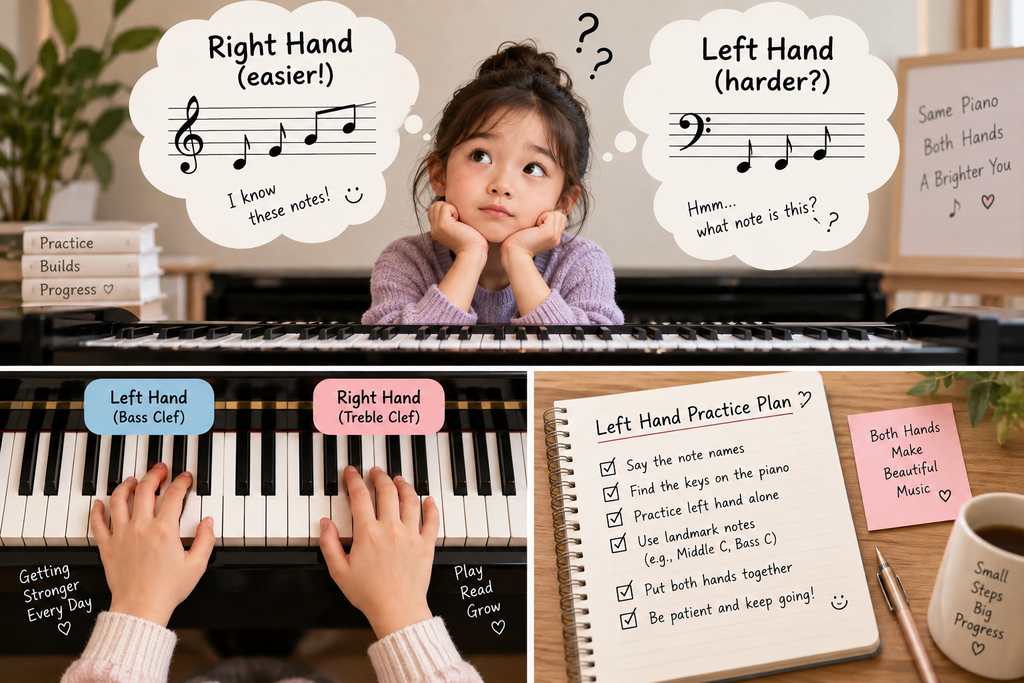
As a piano teacher, I see this all the time: a beginner can read and play notes with the right hand fairly comfortably, but as soon as the left hand begins, everything seems to slow down.
The student may recognize treble clef notes quickly but need several extra seconds to identify notes in the bass clef.
Parents sometimes ask me, “Why is my child’s left hand so much harder?”
This is very common. It does not necessarily mean that a student has a weak left hand or is doing something wrong. There are several reasons why the right hand and treble clef often develop faster than the left hand and bass clef.
Why Do Piano Beginners Struggle With the Left Hand?
For many beginners, the right hand simply feels more familiar.
Beginner piano music often gives the right hand an important role, especially when playing the melody. Students repeatedly see and play treble clef notes, so they gradually begin to recognize them faster.
The left hand, however, often requires more thought.
A student may look at a treble clef note and know it immediately. Then the student looks at the bass clef and pauses:
“What note is this?”
That extra thinking time can make the entire left hand feel slower.
Some Students Already Know Treble Clef From Another Instrument
Over the years, I have noticed something else with some of my students.
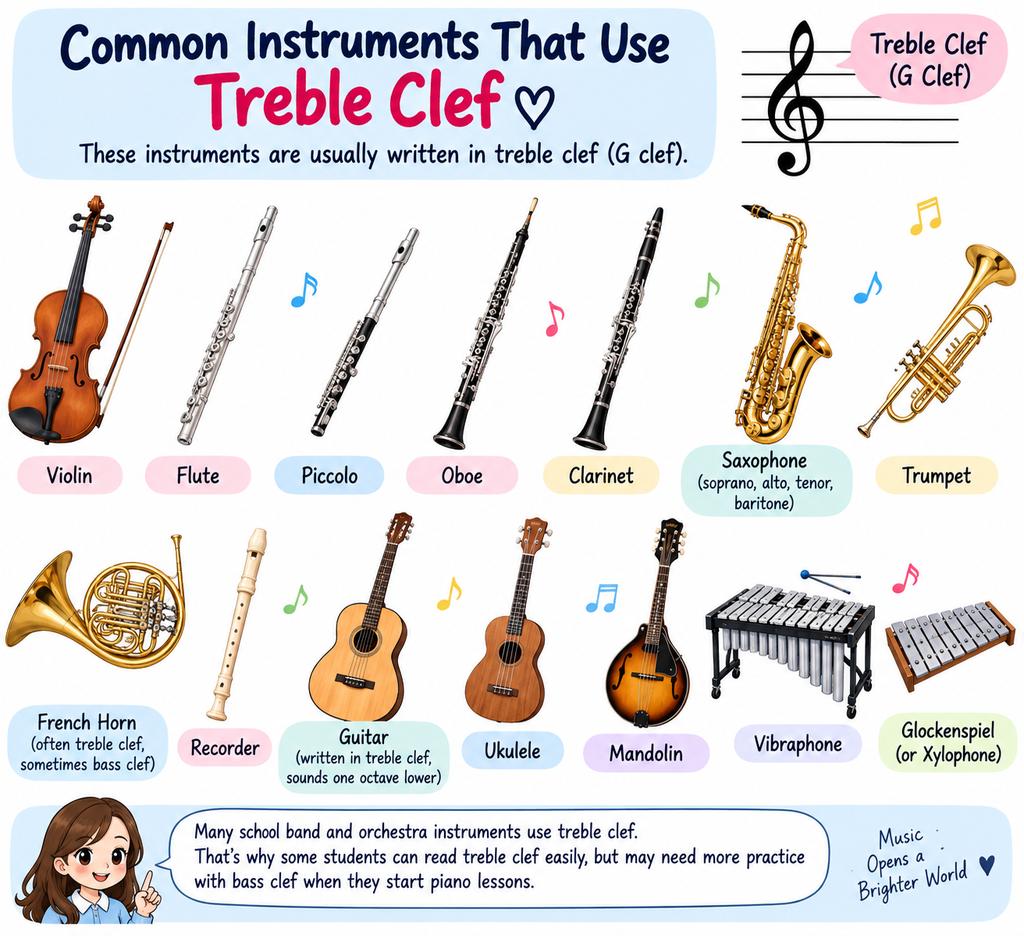
Many children learn another instrument at school before or while they are taking piano lessons. Two very common instruments are flute and violin.
Both commonly use treble clef.
Because of this, a student who has already studied flute or violin may come to piano lessons with a big advantage in reading treble clef. The student may already recognize those notes quickly.
Then we open the piano book and look at the bass clef.
Suddenly, the student slows down.
This makes perfect sense. The student may have spent months or even years reading treble clef but has had very little experience reading bass clef.
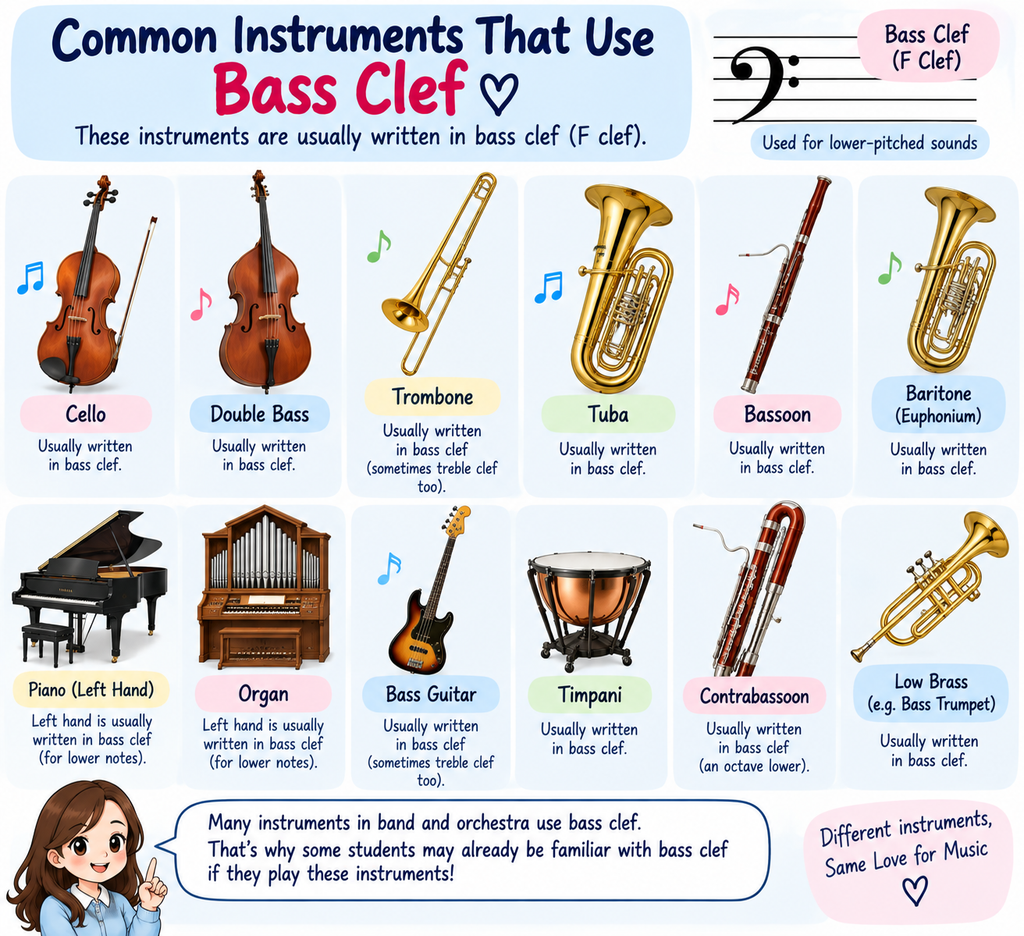
For these students, the problem is not necessarily the left hand itself. Sometimes they simply need much more exposure to bass clef reading.
Why the Right Hand Can Feel More Natural
For right-handed students, there can also be a physical reason.
Children use their dominant hand constantly for writing, drawing, eating, and many other detailed activities. When they begin piano lessons, controlling the fingers of the right hand may therefore feel a little more natural.
However, being left-handed does not automatically mean that piano will be easier with the left hand.
Playing piano requires both hands to develop independence, coordination, and control in ways that are very different from everyday activities.
The Right Hand Often Gets More Attention
Another issue appears as students begin playing more music.
Very often, the right hand carries the melody while the left hand plays an accompaniment.
The melody is easy to hear and remember, so students naturally pay attention to it. Without realizing it, they may begin thinking of the right hand as the “important hand” and the left hand as the hand that simply follows.
I don’t want my students to develop that habit.
Both hands matter.
That is why, when I notice that a student’s left hand and bass clef reading are falling behind, I sometimes do something very different during the lesson.
My “Left-Hand-Only Day”
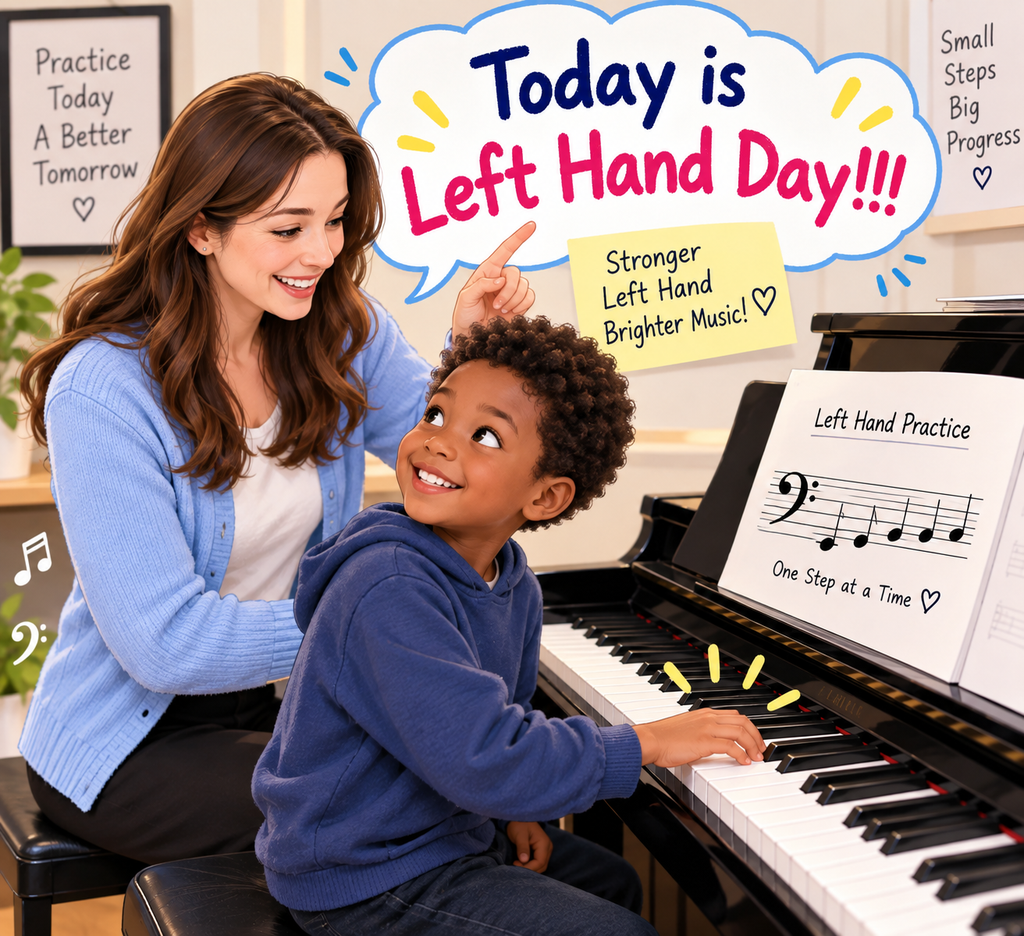
Sometimes I tell a student:
“You know what? Today is a left-hand-only day!”
And I mean it.
For that lesson, whether it is 30 minutes, 45 minutes, or an hour, our main focus is the left hand.
We don’t spend only five minutes practicing the left hand and then move on. We give it serious, concentrated attention.
We Sight-Read With the Left Hand
I may take the student’s piano book and go through many pieces, sometimes reviewing material throughout the book.
The goal is not to perform every piece perfectly.
Instead, we are reading.
The student looks at the bass clef and plays left hand only, moving from one exercise or piece to another.
We keep going.
Read it. Play it. Move to the next one.
This gives the student a large amount of bass clef exposure in one lesson.
And I have found this to be very effective.
When students spend an extended period reading bass clef instead of practicing it for only a few minutes, I can often see their recognition becoming faster even during the lesson.
What If the Student’s Left Hand Gets Tired?
There is one practical issue with a left-hand-only lesson.
Students sometimes tell me:
“My left hand hurts!”
If we have been concentrating on one hand for a long time, I don’t force the student to continue.
We take a break.
For five or ten minutes, we might work on music theory, talk about another musical concept, or do something that allows the hand to rest.
Then we return to the piano and continue our left-hand work.
The goal is focused practice, not physical strain. Any real pain is a reason to stop and reassess technique rather than push through it.
Practice the Left Hand Separately at Home
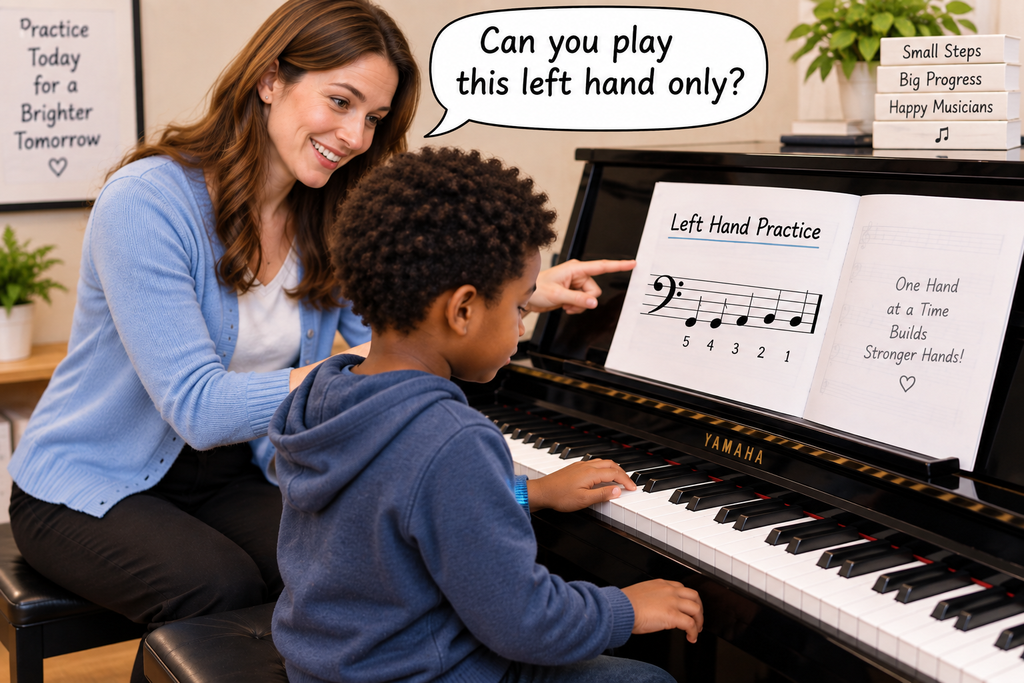
Parents can use a simpler version of this idea at home.
If your child constantly struggles with the left hand, don’t always ask them to play the entire piece with both hands.
Let the left hand have its own practice time.
The student can:
1. Look at the bass clef note.
2. Say the note name.
3. Find the correct key on the piano.
4. Play a short section with the left hand only.
5. Repeat until the notes begin to feel familiar.
Then put the hands together.
Building good practice habits can also help beginners become more confident with both hands.
Sometimes separating the hands actually helps students learn the piece faster.
Use Landmark Notes to Read Bass Clef Faster
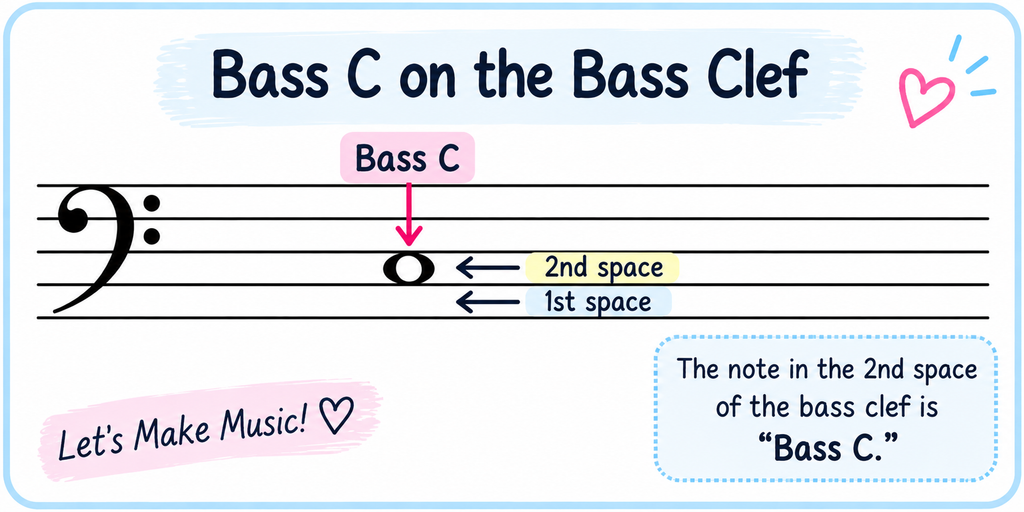
I also encourage students to recognize important landmark notes, such as Middle C and Bass C.
Instead of treating every note as a completely new puzzle, students can begin looking at how notes relate to a landmark.
Is the next note higher or lower?
Does it move by a step or a skip?
Is the musical line moving upward or downward?
Eventually, students need to move beyond identifying every single note individually and begin seeing the patterns and direction of the music.
That is when music reading starts becoming much more natural.
Will the Left Hand Eventually Catch Up?
In most cases, yes.
The left hand doesn’t need to remain the “weak hand.”
It needs attention.
It needs repetition.
And most importantly, it needs enough opportunities to read and play independently.
This is why I occasionally dedicate an entire lesson to the left hand. When a student spends 30 or 45 minutes seriously working with bass clef and left-hand playing—with appropriate breaks when needed—that concentrated practice can make a noticeable difference.
So if your child reads treble clef easily but hesitates every time they see bass clef, don’t be discouraged.
Maybe they simply need their own:
“Today is a left-hand-only day!”
Sometimes giving the weaker hand the spotlight is exactly what it needs to catch up.