One question parents sometimes ask me is, “Is one piano lesson a week enough, or would twice-a-week lessons be better?”
In the United States, once-a-week piano lessons are the most common arrangement. In my experience teaching on the East Coast, most children take one private piano lesson per week, while twice-a-week lessons are less common.
There are practical reasons for this. Many children have extremely busy schedules. In addition to school, they may participate in soccer, baseball, basketball, swimming, Taekwondo, or other activities. Some study another instrument such as violin, flute, or clarinet, while others have academic tutoring.
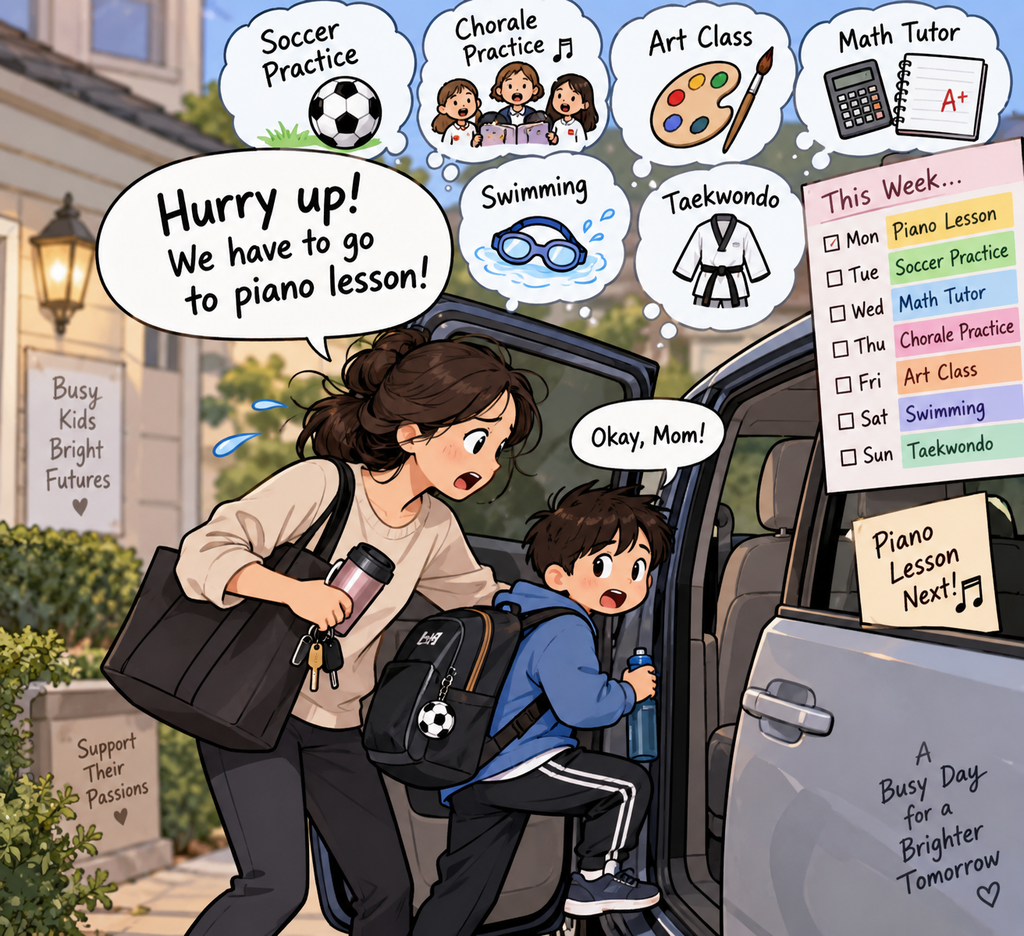
Parents are busy as well. In many families, both parents work, and transporting a child to multiple activities throughout the week can become difficult.
Cost is another important consideration. Naturally, taking two private piano lessons per week can cost approximately twice as much as taking one.
But if we look beyond scheduling and cost and focus strictly on musical progress, is once a week or twice a week better?
From a teacher’s perspective, there are definite advantages to both.
Are Once-a-Week Piano Lessons Enough?
For most beginning students, one piano lesson per week can work very well, especially when the student practices consistently between lessons.
Young beginners commonly start with a 30-minute lesson. As students advance, lessons may increase to 45 or 60 minutes depending on their age, level, repertoire, and individual needs.
During a weekly lesson, I introduce new concepts, correct technical issues, review assigned pieces, and give the student material to practice at home.
The student then has several days to work independently before returning for the next lesson.
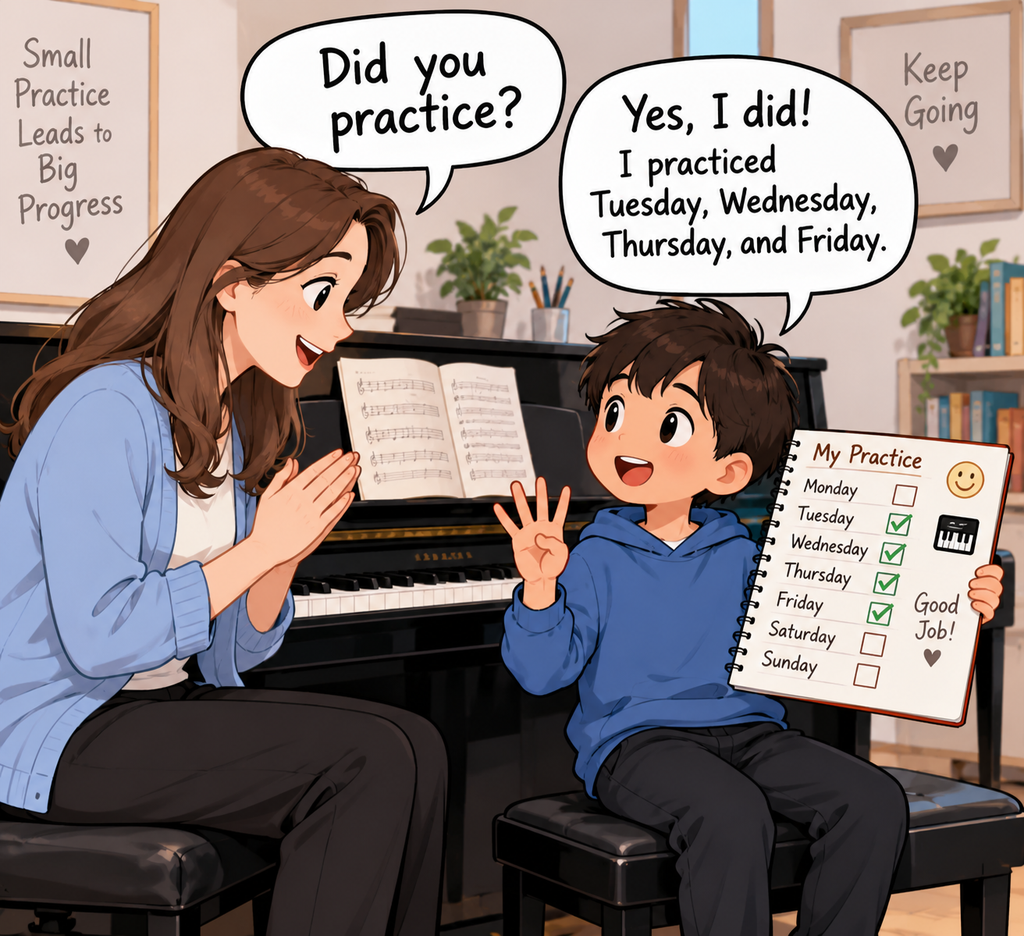
For example, if a student has a lesson on Monday, I generally expect practice during the weekdays before the next lesson. I personally like to give younger students some flexibility on the weekend. If they want to practice on Saturday or Sunday, that is wonderful, but I also understand that children need time to rest and enjoy their weekend.
The goal is not simply to accumulate practice hours. The goal is to establish a consistent and sustainable practice routine.
What Happens at the Next Weekly Piano Lesson?
When the student returns the following week, one of the first things I do is review the previous assignment.
If the student demonstrates a secure understanding of the material, we can pass the piece or exercise and move forward.
If the student understands the basic concept but still needs refinement, I may correct specific details and assign additional practice.
If the material is not yet sufficiently prepared, the student may need another week before progressing to the next page or concept.
This is a perfectly normal part of learning an instrument.
The advantage of weekly lessons is consistency. Students receive regular instruction while still having enough time between lessons to develop independence.
However, there is also a limitation: progress can sometimes be slower.
Why Can Once-a-Week Piano Lessons Lead to Slower Progress?
Imagine that a student learns something new on Monday.
The teacher explains it correctly, but when the student practices independently on Wednesday, the student misunderstands one small detail.
Perhaps the rhythm is incorrect. Maybe the fingering is wrong, the hand position changes, or the student misreads a note.
If the student takes lessons only once a week, that mistake may not be corrected until the following Monday.
In some cases, the student may unintentionally practice the same mistake for several days.
This is one reason regular teacher feedback is so valuable. The sooner a problem is identified, the easier it usually is to correct.
Weekly lessons still provide excellent continuity, but students must take greater responsibility for their independent practice between lessons.
What Are the Benefits of Twice-a-Week Piano Lessons?
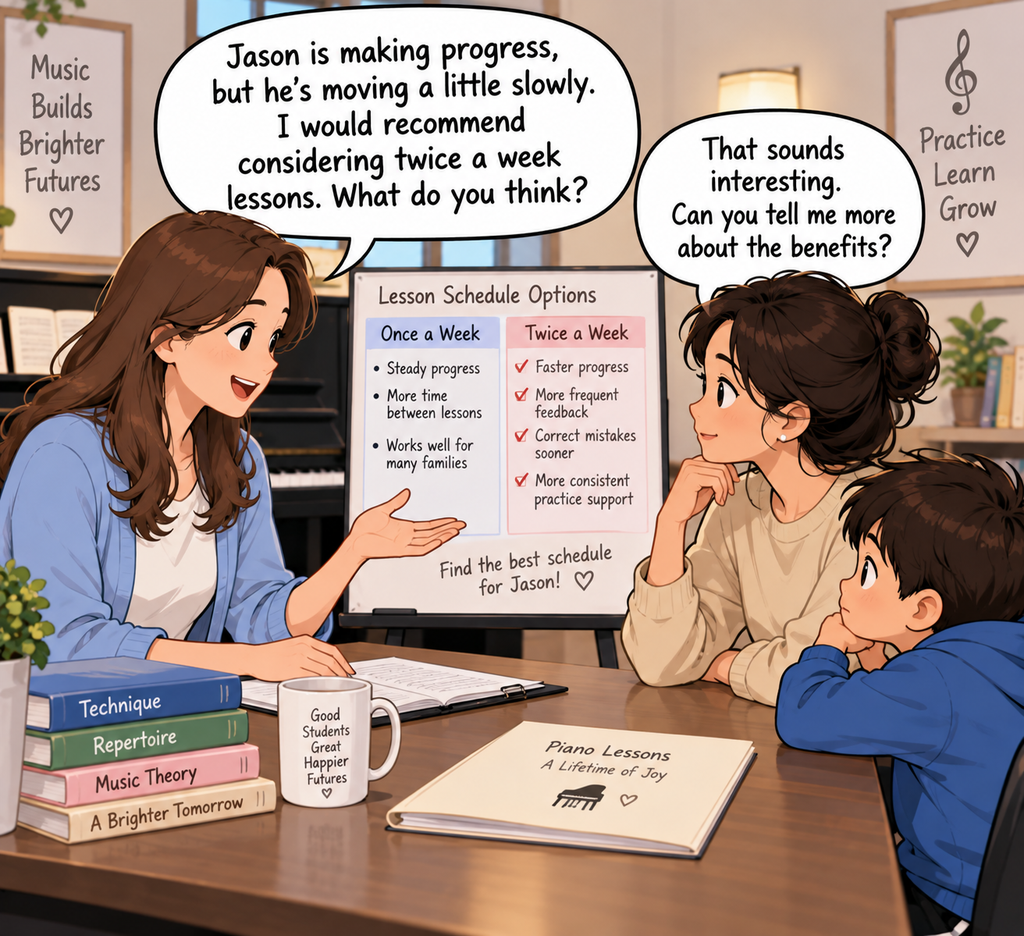
If a family has both the financial flexibility and sufficient time in their schedule, I often recommend considering two piano lessons per week, particularly for students who want to progress more quickly.
A good schedule might be Monday and Thursday or Tuesday and Friday.
I prefer leaving approximately two or three days between lessons rather than scheduling them on consecutive days.
Why?
Because the student needs time to absorb the material and practice independently.
For example, suppose a student comes to a lesson on Monday. We learn new material, and the student practices it on Tuesday and Wednesday.
On Thursday, I can immediately evaluate what happened during those practice sessions.
If everything is going well, we can move forward.
If something has gone wrong, I can correct it before the mistake becomes habitual.
That shorter feedback cycle can make a significant difference in a student’s development.
Twice-a-Week Lessons Create More Opportunities for Guided Practice
There is another advantage that parents sometimes overlook.
Children do not always practice according to plan.
A student may have every intention of practicing on Tuesday and Wednesday, but then schoolwork becomes overwhelming. There may be soccer practice, a school project, tutoring, or another unexpected commitment.
Suddenly, Thursday arrives and the piano has barely been touched.
With once-a-week lessons, that could mean losing a substantial portion of the week.
With twice-a-week lessons, however, the student still returns to the teacher.
Even if independent practice was limited, the second lesson creates a guaranteed opportunity for structured, supervised practice and immediate reinforcement.
As a teacher, I can review the material, correct problems, reinforce technique, and help the student continue moving forward.
For some students, that additional accountability is extremely beneficial.
Can Students Progress Faster With Two Piano Lessons a Week?
In many cases, yes.
Twice-a-week instruction can accelerate progress because there is less time between teacher evaluations.
Instead of waiting seven days for feedback, the student may receive professional guidance every three or four days.
This creates a cycle of:
Lesson → Practice → Teacher Feedback → Correction → New Material
rather than:
Lesson → One Full Week of Independent Practice → Teacher Feedback
The first cycle allows the teacher to intervene more frequently and make smaller adjustments before problems become established.
Of course, every student progresses differently. Age, concentration, practice habits, motivation, musical aptitude, and family support all influence the rate of progress.
For that reason, I would never promise that taking twice as many lessons automatically produces twice the progress.
However, in my teaching experience, students who receive more frequent instruction often have the opportunity to progress considerably faster, particularly when they also practice consistently at home.
My Experience Learning Piano in Korea
My perspective on lesson frequency is also influenced by my own childhood.
I was born in Korea and grew up there through my early high school years. I began learning piano as a young child, and the system I experienced was quite different from the typical private-lesson model I see in the United States.
At that time, many children attended a piano academy very frequently—often several days a week.
We would go to the academy, practice independently, and a teacher would come by to listen, correct us, or give a short lesson. Even if the individual instruction lasted only 10 or 15 minutes on a particular day, we had frequent contact with a teacher.
Then we would return to a practice room and continue working.
The important difference was frequency.
We were not necessarily receiving a long private lesson every day. Instead, we were practicing frequently and receiving frequent professional feedback.
That environment made it difficult to practice an incorrect technique or misunderstanding for an entire week without someone noticing.
Piano Lessons in Korea vs. the United States
The financial structure was also different from what I commonly see with private piano instruction in the United States.
Many Korean piano academies operated on a monthly tuition system rather than charging separately for each short instructional interaction. Students could therefore attend frequently as part of their regular academy schedule.
Private music instruction in the United States is generally more expensive on a per-lesson basis because individualized instructional time carries a significant labor cost.
This is one reason why simply saying, “Every student should take piano lessons twice a week,” is unrealistic.
What may be educationally beneficial is not always financially or logistically practical for every family.
Once a Week or Twice a Week: Which Do I Recommend?
For most families, once-a-week piano lessons are completely appropriate.
A motivated student who attends consistently and practices productively between lessons can make excellent progress with one lesson per week.
But if parents ask me which arrangement can provide more opportunities for faster development, my answer is twice a week.
Two lessons per week can provide:
- More frequent professional feedback
- Faster correction of mistakes
- Greater accountability
- More opportunities for guided practice
- More consistent reinforcement of new concepts
- Potentially faster progression through curriculum and repertoire
However, the additional lesson should not replace independent practice.
The ideal situation is still:
Teacher instruction + independent practice + regular feedback.
The Most Important Factor Is Consistency
Whether a student takes piano lessons once a week or twice a week, consistency matters more than simply counting lessons.
A student who takes one lesson every week and practices thoughtfully between lessons may progress much more successfully than a student who takes two lessons but rarely practices independently.
At the same time, for families who have the time, budget, and desire for more intensive instruction, twice-a-week lessons can be an excellent option.
From my perspective as a piano teacher—and from my own experience growing up with frequent piano instruction—I have seen how valuable regular teacher feedback can be.
Once a week is practical, effective, and sufficient for many students. Twice a week can provide additional structure and accelerate progress.
Ultimately, the best lesson schedule is the one that allows a student to remain consistent, motivated, and actively engaged with the piano over time.