Piano lesson mistakes can happen even when a student plays the same piece well at home.
Have you ever practiced a piano piece at home and played it really well, only to make piano mistakes during lessons as soon as your teacher starts listening?
You are not alone.
I hear students say this all the time:
“I played it better at home.”
And my answer is usually:
“I know. I totally know. Don’t worry.”
As a piano teacher, I understand that playing well at home and playing during a piano lesson can feel very different.
Making mistakes during a piano lesson does not automatically mean that a student did not practice.
In fact, I can usually tell very quickly whether a student practiced at home—even before the student finishes playing the piece.
Piano Lesson Mistakes: As a Teacher, I Can Usually Tell Who Practiced
After teaching piano for many years, I have learned to recognize the difference between a student who practiced and a student who did not.
Sometimes I can sense it from the moment the student sits down at the piano.
A student who practiced often has a certain confidence.
They sit down, open the book, and seem ready to show me what they worked on.
It is almost as if they are saying:
“I practiced this. Let me show you.”
A student who has not practiced may look less confident. Sometimes the student looks tired, hesitates to begin, starts talking about something else, or simply does not seem ready to play.
Of course, these signs alone do not prove anything.
But once the student begins, I can usually tell much more.
The First Note Can Tell Me a Lot
When we begin a lesson, I open the piece that I assigned the previous week.
Piano lesson mistakes often become noticeable from the very first note.
I might say:
“Okay, you can start from the beginning.”
Or simply:
“Show me.”
Then I watch what happens.
Suppose the first note is G.
If the student has practiced the piece, they will usually know where to begin. They find G, place the correct finger on the key, position the other hand, and get ready to play.
They may make mistakes after they start.
That is okay.
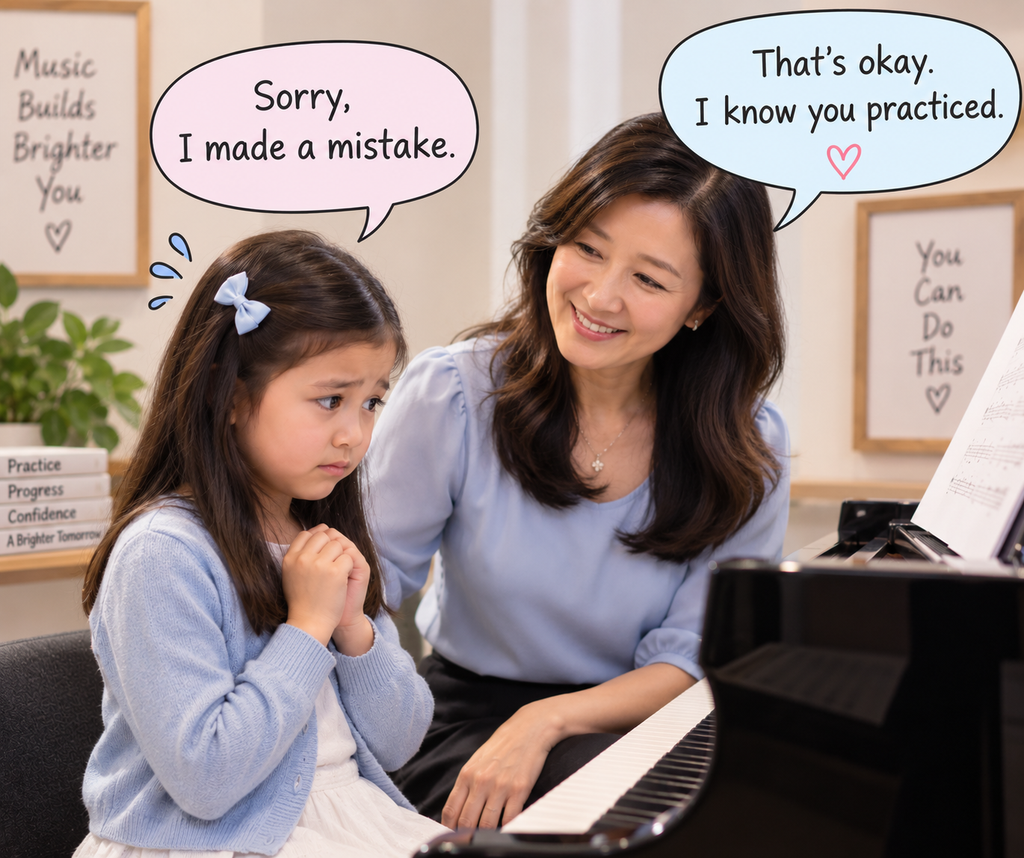
But they know where they are.
They recognize the piece because they have spent time with it during the week.
That tells me something important:
This student practiced.
Whether the student practiced once or ten times is another question. But I can see that the student opened the book at home and worked on the assignment.
And to me, that matters.
I Also Notice the Pencil Marks in the Music
During lessons, I often write things in my students’ music.
Piano lesson mistakes can also show me what a student may need to practice more carefully at home.
I may write a finger number, circle something that needs attention, or make a small note to remind the student what we discussed.
Those markings become part of the student’s practice instructions for the week.
When the student comes back the following week, I notice whether those markings mean anything to them.
If I wrote a specific finger number and the student practiced the piece while looking at the music, they should at least recognize that instruction.
If the student seems to have no idea why the marking is there, that can be a strong clue that the music was not really practiced during the week.
Students sometimes try to rely on memory and play enough to get through the lesson.
But teachers notice more than wrong notes.
We notice how students approach the music, how they find their starting position, whether they recognize corrections from the previous lesson, and how their hands respond when we work on the piece again.
Why Piano Mistakes During Lessons Do not Mean you Did Not Practice
This is something I especially want students and parents to understand.
A student can practice all week and still make piano lesson mistakes.
That is completely possible.
At home, the student is in a familiar environment. There may be nobody watching. The student can stop, start again, repeat a measure, or take as much time as needed.
Then lesson day comes.
Now the teacher is sitting beside the student.
The student knows someone is listening carefully.
Suddenly, the same piece can feel different.
Research on music performance anxiety also supports what teachers often observe: nervousness can be associated with mistakes, memory problems, shaking, physical tension, and other changes in performance.
That is why I do not get upset simply because a student makes a mistake.
What matters to me first is that the student practiced.
If I know that a student made an effort at home, I am happy.
Really happy.
The student does not have to walk into my studio and play everything perfectly.
That is why we have lessons.
We can work on the mistakes together.
“But I Played It Better at Home!”
I have heard this sentence many times.
A student makes several mistakes, looks at me with frustration, and says:
“But I played it better at home!”
I believe them.
I often say:
“I know. I totally know. Don’t worry.”
I also mad piano mistakes during lessons, even when I had practiced carefully at home.
I Had the Same Problem When I Was a Piano Student
When I was young, I could practice at home and play beautifully.
Sometimes I would play so well that I impressed myself.
I would think, “Wow, I can really play this!”
Then my lesson would begin.
My teacher would sit next to me.
Suddenly, I was nervous.
I would make mistakes that I had not been making at home. Sometimes I felt as if I could not remember anything. Even the notes on the page did not seem as clear as they had when I was practicing alone.
One day, I became so frustrated because I knew I could play the piece better.
So I asked my teacher if she could wait outside.
She actually did.
She went outside the room and closed the door.
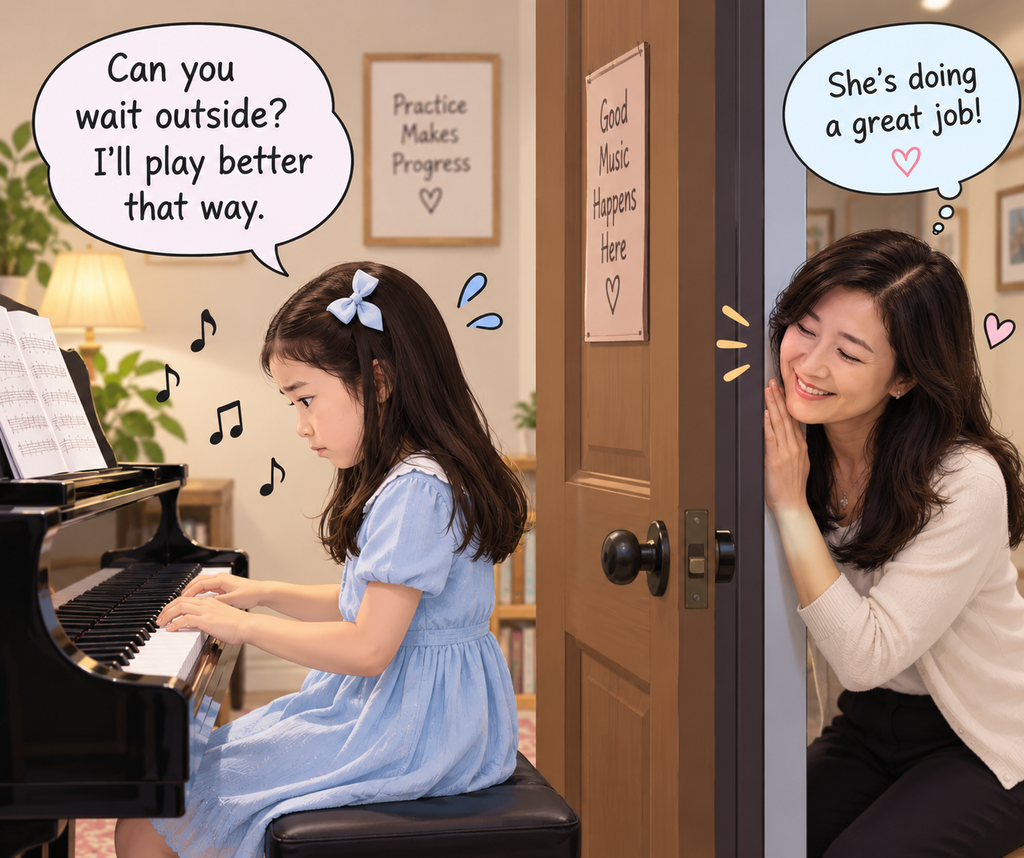
Of course, she could still hear me playing through the door.
But somehow, not having my teacher sitting directly beside me helped.
I still remember that experience today.
It is one reason I understand my students when they tell me they played better at home.
I have been there.
Why Piano Mistakes During Lessons Can Happen When Students Feel Nervous
Nervousness is not always just a feeling.
Sometimes I can actually see it.
This can happen with children, but I notice it especially with some adult students.
I may see a student’s hands trembling slightly.
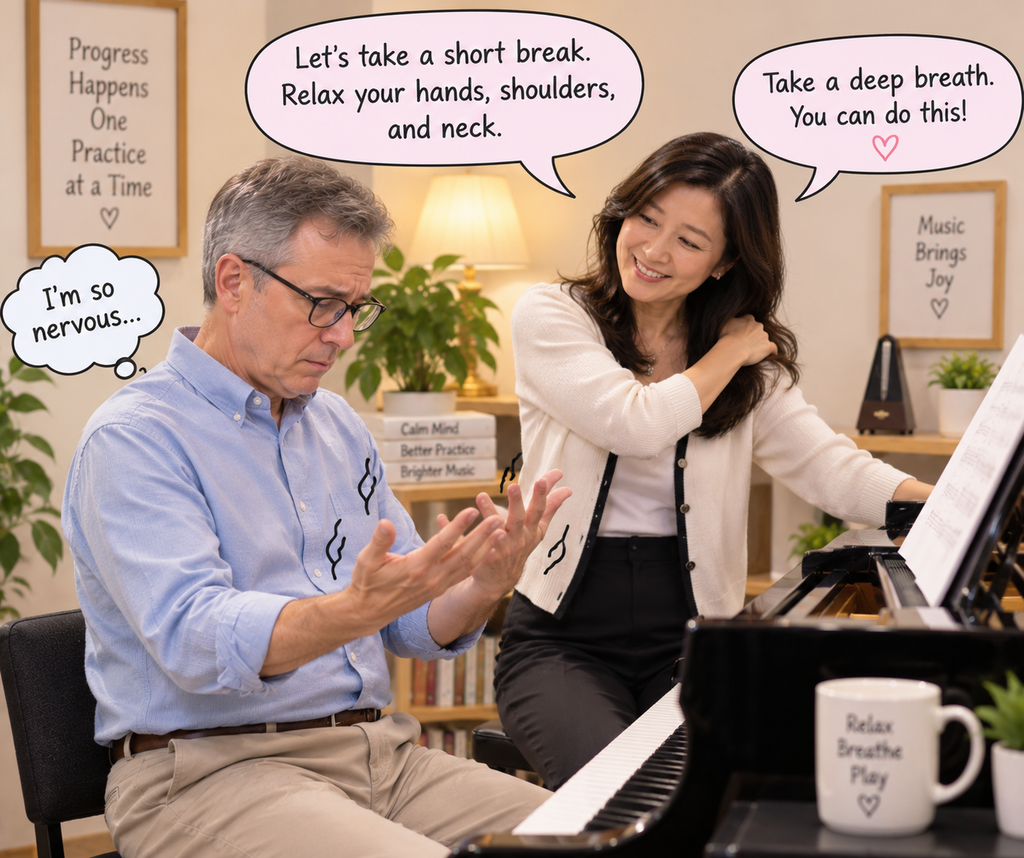
Sometimes the student can feel the shaking, too.
When that happens, I do not want to keep pushing the student through the piece while the tension continues to build.
I would rather stop for a moment.
I may ask the student to take their hands off the piano, relax their shoulders, stretch a little, or gently shake out their hands.
Then we take a moment before trying again.
The goal at that point is not to force the student to play.
The goal is to help the student become physically more relaxed so we can return to the music calmly.
Why Piano Mistakes During Lessons Improve With Practice
This is another way I can often recognize that a student really practiced.
We go back and work on the piece together.
Maybe we practice a difficult section once or twice.
Then something interesting happens.
The student’s fingers begin to remember.
A passage that seemed difficult a few minutes earlier starts coming back.
Sometimes the student does not even consciously remember every movement, but the repeated physical patterns from practice begin to return.
People often call this “muscle memory.” More precisely, repeated practice can build learned motor patterns that make familiar movements easier to reproduce.
This is why practice matters even when the first performance in the lesson does not go perfectly.
The work you did at home did not disappear just because you became nervous.
It is still there.
Piano Lessons Are Also Practice for Playing in Front of Someone
There is another skill piano students need to develop.
They need to learn how to play while someone is listening.
Practicing alone and performing for another person are not exactly the same experience.
At home, you may feel completely comfortable.
During a lesson, one person is listening.
At a recital, dozens of people may be listening.
That feeling takes experience.
I no longer experience the same level of nervousness that I did when I was young. Over the years, I have played many times in churches, recitals, and other performance settings.
Those experiences matter.
The more experience you have playing in front of other people, the more familiar the situation becomes.
Why I Believe Piano Recitals Are Important
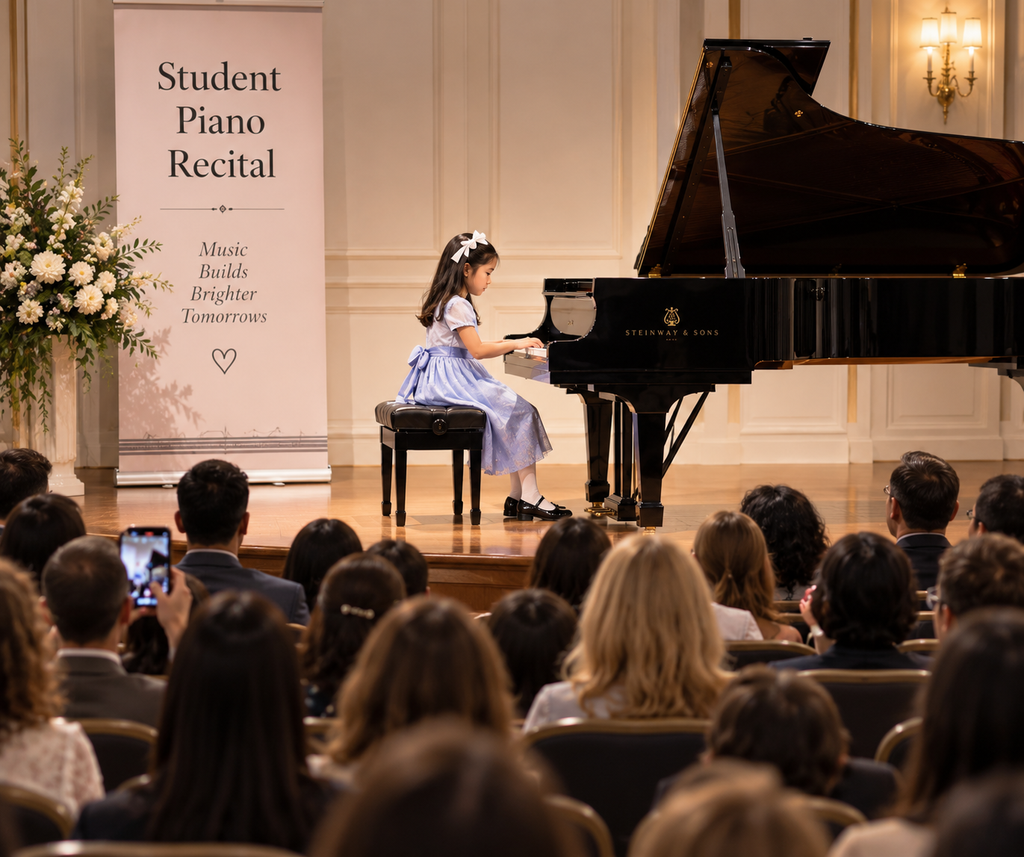
This is one reason I believe students should have opportunities to perform in recitals.
A recital is not only about showing everyone how well you can play.
It is also part of learning how to perform.
At home, your family may hear you practice.
During a lesson, your teacher hears you play.
But at a recital, you may walk to the piano knowing that many people are watching and listening.
That is a different experience.
Students need opportunities to learn what that feels like.
They learn how to walk to the piano, sit down, find their starting position, begin despite feeling nervous, continue after a small mistake, and finish the piece.
Performance experience itself can be practiced. Recent research with studio music teachers has also found that simulated performance and learning to accept mistakes are commonly used strategies for helping students manage music performance anxiety.
That is one reason I value giving students a recital experience, even if it is only once a year.
Regular practice at home also helps students feel more confident during lessons. If you’re wondering how much practice is appropriate, read my guide on how often children should practice piano.
A Mistake Does Not Erase the Practice You Did
If you practiced your piano assignments and then made piano mistakes during lessons, do not assume that all your practice was wasted.
Your teacher may be able to see much more than you realize.
We can see how you find the first note.
We can see whether you remember your hand position.
We can see whether you noticed the finger numbers and markings from the previous lesson.
And when we practice together, we can often see the work you did at home begin to come back through your fingers.
I do not expect my students to be perfect when they arrive for a lesson.
If everything were already perfect, there would be very little for us to work on together.
What I want is effort.
Practice at home.
Come to your lesson.
Show me what you did.
If you make mistakes, we will work on them together.
And if you tell me:
“I played it better at home!”
I will probably smile and say:
“I know. I totally know. Don’t worry.”