One of the most common concerns I hear from parents is, “Why does my child hate practicing piano?” If your child hates practicing piano, there may be several reasons behind it.
After teaching piano for more than 25 years, I have learned something important:
There is not just one reason children do not practice piano.
Some children are simply not very interested. Some are talented enough to get by without much practice. Others become frustrated because they keep making the same mistakes.
And sometimes, a student simply needs a break from the same music.
Before pushing a child to practice more, I think it is important to ask a different question:
Why doesn’t this child want to practice?
1. Why a Child Hates Practicing Piano When Interest Is Low
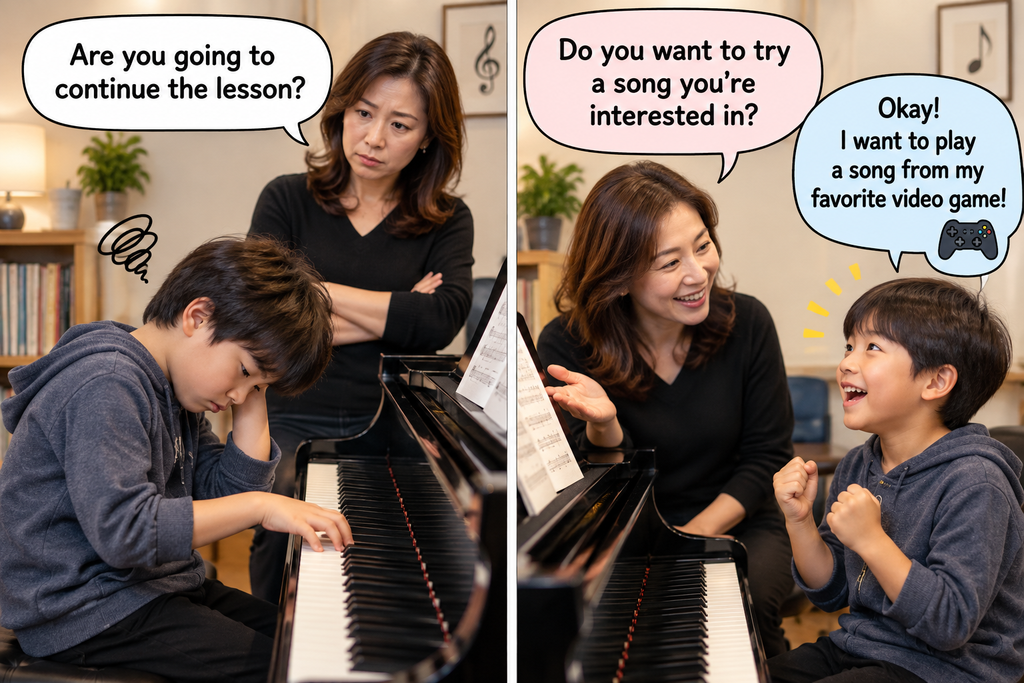
I believe interest makes an enormous difference.
Think about something a child truly enjoys, such as a favorite video game.
Parents usually do not have to say:
“You have been playing for only ten minutes. Go back and play your game.”
Children can play for a long time because they are interested.
Of course, piano practice is different from playing a game. Learning an instrument requires patience, concentration, repetition, and discipline.
But I still believe genuine interest matters.
When I was a child, my mother did not have to constantly tell me to practice piano.
I would come home from school, sit at the piano, and sometimes practice for two or three hours on my own.
Why?
Because I loved it.
Piano was fun for me. I wanted to play. I wanted to learn the next piece. I wanted to get better.
That childhood experience still influences the way I teach today.
Look for the Smallest Spark of Interest
Not every child will love piano enough to practice for hours, and I do not expect them to.
But when I see even a small spark of interest in a student, I pay attention to it.
Maybe the student suddenly loves one particular piece.
Maybe they ask to play something again.
Maybe they become excited when they recognize a melody.
That is when I want to build on that interest.
Instead of simply saying, “You need to practice more,” I want to give the student a reason to want to play again.
2. Why Some Talented Children Avoid Piano Practice
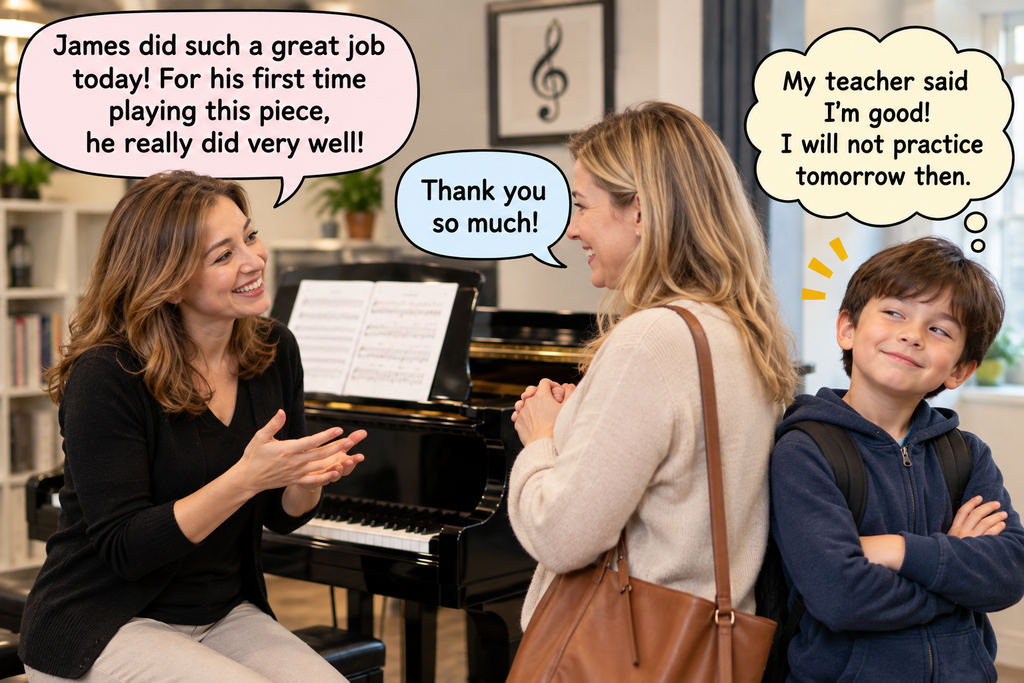
Sometimes a child hates practicing piano not because they dislike music, but because they are talented enough to get by without much practice.
They learn quickly. They read music easily. They understand new concepts almost immediately.
Sometimes they come to a lesson without practicing very much and can still play well enough to move on to the next page.
Naturally, I encourage them.
“You’re doing so well!”
I may tell their parents that their child has a lot of musical ability.
But occasionally, something interesting happens.
The child begins to think:
“I’m already good at piano. Why do I need to practice?”
They realize that they can come to their lesson, play reasonably well, and continue to the next piece without doing very much work at home.
For a while, that may actually work.
But eventually, piano becomes harder.
Pieces become longer. Technique becomes more demanding. The music requires greater control, coordination, and attention to detail.
Eventually, natural ability alone is not enough.
Talent can help a student learn quickly, but students still need to learn how to practice.
Being talented is wonderful. Learning how to use that talent is even more important.
3. Children May Stop Practicing Because They Keep Making the Same Mistake
Sometimes a child actually likes piano but becomes frustrated during practice.
They play a passage.
Wrong note.
They try again.
Another mistake.
They try several more times and still cannot play it correctly.
Eventually they think:
“I can’t do this.”
And they stop.
This is another reason piano practice can become frustrating.
When it comes to piano, my own personality is very persistent.
If I cannot play something, I usually keep working on it until I can.
And even after I can play it correctly, I continue practicing until I feel that I truly own it.
But not every child naturally practices that way.
Some students need to be taught how to work through frustration.
4. Do Not Practice the Whole Piano Piece Over and Over
When one small section is causing the problem, playing the entire piece repeatedly is usually not what I want my students to do.
Instead, we isolate the problem.
Maybe it is only two measures.
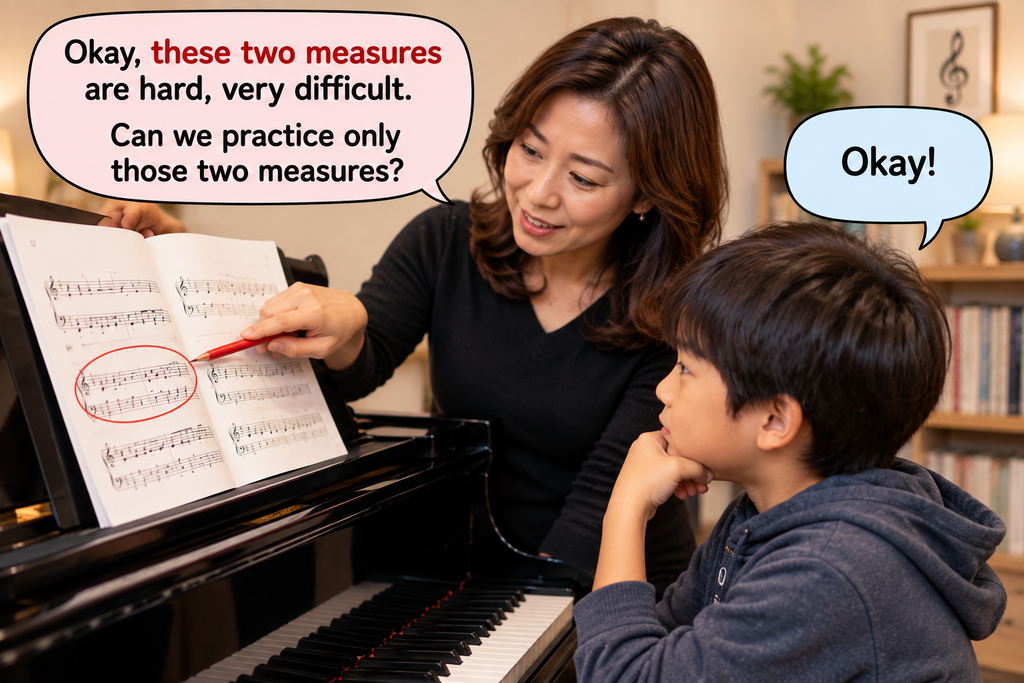
Maybe it is three.
We work on those measures again and again.
Sometimes ten times.
Sometimes twenty.
And sometimes we may repeat a difficult section many more times until the student’s hands finally begin to understand what to do.
Then I ask the student to go back and play from the beginning.
Now something important happens.
The student reaches the place where they were struggling before.
And this time, they make it through.
That is one of my favorite moments in a piano lesson.
5. Help Children See Their Own Improvement
When a student finally plays a section correctly after struggling with it, I want them to notice what just happened.
I may clap and say:
“You did it! Did you see that?”
I give my students a lot of encouragement during lessons.
Sometimes I make a big deal out of their improvement.
“Wow! Listen to how much better that sounds!”
“You couldn’t do that a few minutes ago, and now you can!”
When students recognize their own improvement, their attitude can change.
They sit a little taller.
They smile.
And very often, they want to try again.
This teaches something much more powerful than simply telling a child:
“You need to practice.”
The student has just experienced why we practice.
Practice changed something they could not do into something they could do.
That feeling of accomplishment can become motivation.
6. When Piano Practice Becomes Too Frustrating
At the same time, I do not believe every difficult piece needs to become a battle.
There is a difference between giving up after struggling with two measures for five minutes and being stuck on the same piece for weeks.
If a student wants to quit immediately because something is difficult, I usually encourage them to keep going.
We break it down.
We repeat it.
We work through the problem.
But if a student has been working on the same piece for a month or even two months, cannot move forward, and is gradually losing interest in piano altogether, sometimes I make a different decision.
Let’s move on.
There are times when letting go of one piece is better than allowing that one piece to destroy a child’s interest in playing piano.
Not every piece needs to be perfect.
And not every piece needs to be finished.
7. If Your Child Hates Practicing Piano, Try Different Music
Sometimes I temporarily step away from the method book.
If a student has been moving from page to page for a long time and seems bored, I may find something completely different.
I am not worried about finishing another page that week.
I want to find music that makes the child interested again.
Maybe the student loves Super Mario.
We might try an easy arrangement of a Super Mario theme.
Maybe the child loves The Lion King.
We might play a familiar song from the movie.
Maybe there is music from a favorite game, movie, or cartoon.
It does not always have to come from the regular lesson book.
Sometimes a student simply needs a musical break.
Then I watch what happens.
A student who has been avoiding practice may suddenly ask:
“Can I play that song again?”
Now I know something important.
The interest is coming back.
Once that spark returns, we can gradually return to the method book and continue developing the skills the student needs.
8. Constantly Forcing Piano Practice Is Not Always the Answer
When a child hates practicing piano, simply pushing harder may not solve the real problem.
Parents naturally want their children to succeed.
When a child does not practice, the first reaction may be to remind them more often, push harder, or create stricter practice rules.
Sometimes children do need structure and reminders.
But if a parent has to fight with a child every single day just to get them to sit at the piano, I think it is worth looking deeper.
Why is the child resisting?
Is the music too difficult?
Are they bored?
Are they frustrated because they cannot hear any improvement?
Do they enjoy piano but simply not know how to practice?
Are they talented and convinced that they do not need practice?
Or have they simply not found music that excites them yet?
The answer may be different for every child.
What Should Parents Do When a Child Hates Practicing Piano?
If your child hates practicing piano, start by looking for the reason behind the resistance.
Before immediately increasing practice time, try to discover the reason behind the resistance.
If the child is frustrated, make the task smaller.
Instead of saying, “Practice for 30 minutes,” try focusing on two difficult measures.
If the child is bored, introduce a piece they recognize and enjoy.
If they have been stuck on one piece for too long, consider putting it aside temporarily.
And when they finally accomplish something that was difficult, let them know that you noticed.
Celebrate improvement, not just the number of minutes spent practicing.
Parents who want additional music education resources can also explore the Music Teachers National Association (MTNA).
Final Thoughts From a Piano Teacher
When a child hates practicing piano, the first step is to understand the reason instead of simply asking for more practice.
After teaching piano for more than 25 years, I do not expect every student to approach practice the same way.
Some students naturally practice.
Some need encouragement.
Some need structure.
Some need to experience success before they become motivated.
And sometimes a student simply needs different music.
As a teacher, I believe part of my job is knowing when to push, when to encourage, when to change the approach, and sometimes when to let a piece go.
I want my students to improve, but I also want them to develop a relationship with music that can last much longer than one lesson book.
Progress matters.
Practice matters.
But interest matters too.
Sometimes the best way to help a child practice more is not to say:
“Practice more.”
Sometimes it is to help them remember why they wanted to play the piano in the first place.