Piano finger numbers are an important part of learning to play the piano correctly and comfortably.
When learning piano, students often focus on reading the correct notes.
Of course, reading notes is extremely important. But there is another skill that can make a huge difference in how smoothly and comfortably you play:
finger numbers.
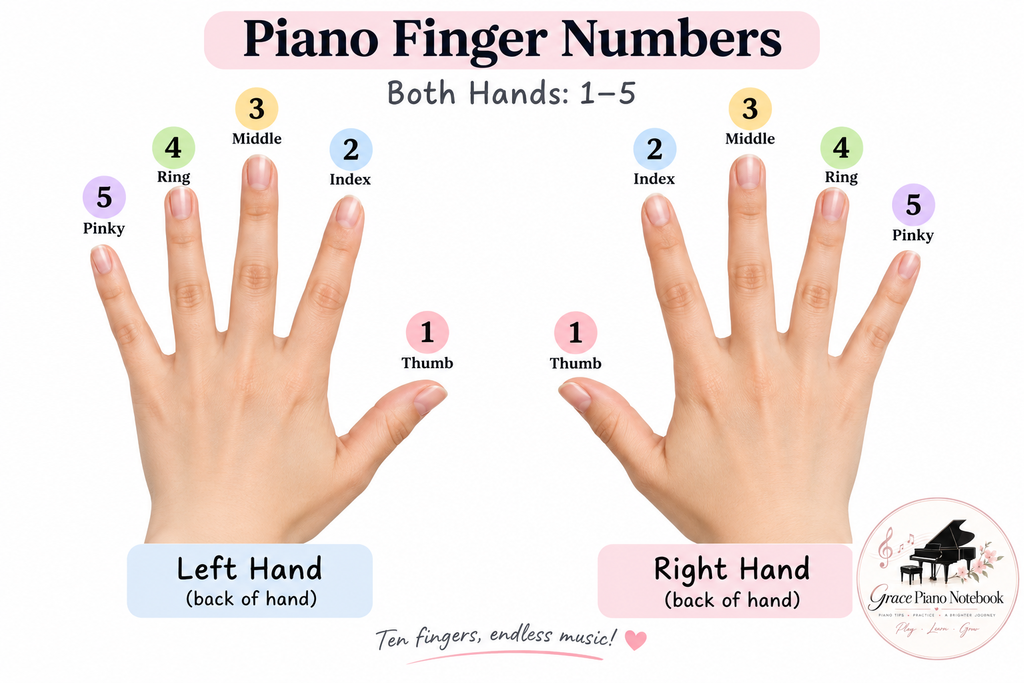
We have ten fingers—five on the right hand and five on the left hand—and when we play piano, every finger has an important job.
Good fingering can help you move naturally across the keyboard, prepare for the notes that come next, and play a passage more smoothly.
As a piano teacher, finger numbers are one of the first things I pay attention to when a student begins learning a new piece.
What Are Piano Finger Numbers?
Piano fingering uses the numbers 1 through 5 for each hand.
1 = Thumb
2 = Index finger
3 = Middle finger
4 = Ring finger
5 = Pinky
The numbering is the same for both hands.
That means both your right thumb and left thumb are finger 1, and both pinkies are finger 5.
Every finger matters. We do not have an “unimportant” finger when we play piano. Learning how and when to use each one is part of developing good piano technique.
Why Do Piano Books Include Finger Numbers?
If you open a beginner piano book—or even many classical scores—you will often see finger numbers printed above or below certain notes.
These numbers are usually recommended fingerings provided by the editor or publisher.
The important word here is recommended.
A printed finger number does not always mean that every pianist must use that exact finger 100 percent of the time.
Our hands are different. A fingering that feels natural for one pianist may feel uncomfortable for another.
Sometimes a teacher may recommend changing a printed fingering because another choice works better for that particular student or passage.
However, students should not simply ignore printed fingering and choose random fingers.
There is usually a reason that fingering was suggested.
Good Fingering Helps Prepare for the Next Note
One of the biggest mistakes beginners make is choosing a finger based only on the note they are playing right now.
Good fingering requires you to think ahead.
Imagine playing:
C – D – E – F – G – A
Suppose you begin C with finger 1 and simply continue:
C(1) – D(2) – E(3) – F(4) – G(5)
Now you still need to play A.
But your fifth finger is already on G.
If you have not planned ahead, you may end up trying to use finger 5 again, moving awkwardly, or suddenly changing the position of your hand.
That is not smooth fingering.
An experienced pianist looks ahead and thinks:
“Where am I going next?”
You may need to change position, cross a finger, move the thumb underneath, or otherwise prepare the hand before you arrive at the next group of notes.
That is why fingering is not only about the current note.
Good fingering prepares you for what comes next.
For another helpful explanation of piano fingering, Yamaha also offers a guide to the basics of keyboard fingering.
Piano Fingering Comes From Experience
The more music you play, the easier these decisions become.
When I look at music, I am not looking only at one note at a time. I can see what is coming next, and often I already know which fingering will allow my hand to move comfortably through the passage.
Even when finger numbers are not printed in the score, years of playing and teaching make it much easier for me to choose a fingering.
When students ask me which finger they should use, I can usually recommend one quickly because I am looking ahead at the entire passage.
That ability does not happen overnight.
Good fingering develops through experience.
Every Finger Is Different
Look at your hand carefully.
Your five fingers are not the same length, strength, or shape.
The thumb is short and positioned differently from the other fingers. It also has a wide range of movement, which makes it especially useful for changing positions and reaching different keys.
The index and middle fingers are generally longer and strong.
The middle finger is usually the longest finger.
The ring finger tends to have less independence, while the pinky is shorter and often weaker.
The spaces between our fingers are also different. The distance and flexibility between the thumb and index finger are very different from the space between fingers 3 and 4 or fingers 4 and 5.
These physical differences are one reason fingering matters so much.
Good fingering uses the natural characteristics of the hand rather than fighting against them.
Pay Attention to Circled Finger Numbers
In some piano books, you may see a finger number with a circle around it.
When I see this, I tell my students:
“Pay attention. Something is happening here.”
The circled number may indicate an important position change, a crossover, a new hand position, a lift, or another fingering detail that deserves extra attention.
Do not simply pass over it.
Stop for a moment and ask why that particular finger has been emphasized.
Understanding why a fingering is marked is much more useful than blindly following the number.
How I Teach Fingering When Learning a New Piece
When one of my students sees a new piece for the first time, I teach them to focus on the basic information in the music carefully.
First, we make sure the student can identify the notes correctly.
Is that note C? E? G? Where is it on the keyboard?
Then I pay close attention to the fingering.
Are you using a finger that allows your hand to move comfortably through the passage?
At the same time, we continue working on the rhythm and other basic elements of the music.
As the piece develops, we can add more attention to dynamics, articulation, pedaling, musical expression, and other details.
Fingering is not a small detail that I add only at the end.
It is part of learning how to play the piece correctly and comfortably from the beginning.
How to Find the Right Fingering by Yourself
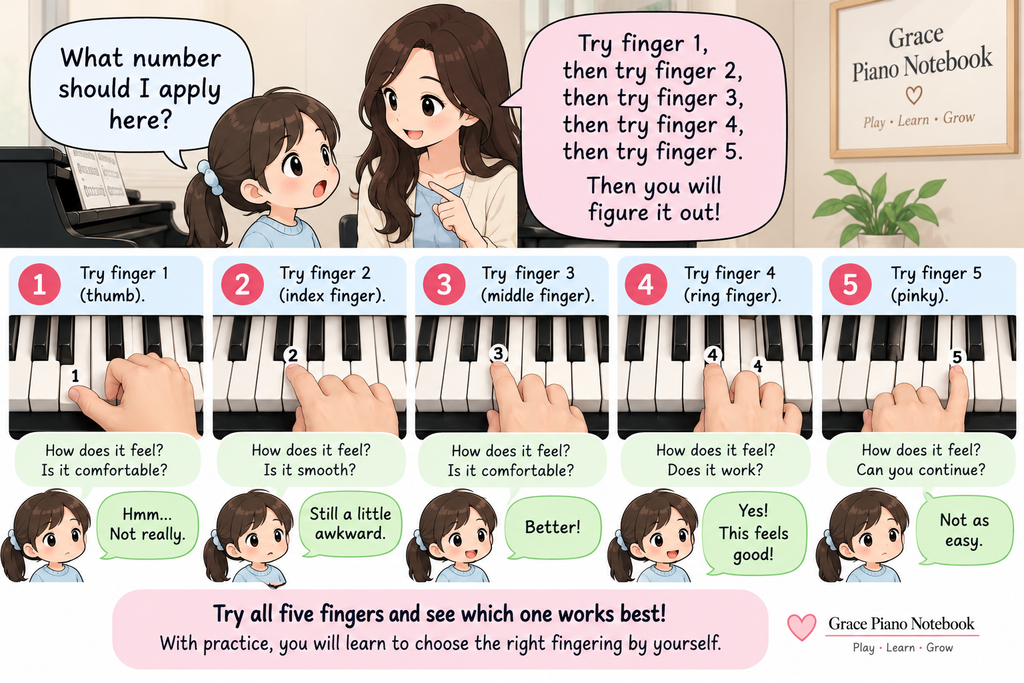
A piano teacher will not always be sitting next to you.
Eventually, students need to be able to open a piece of music and make some fingering decisions independently.
So when a student asks me:
“What finger should I use here?”
I do not always give the answer immediately.
Sometimes I say:
“Try finger 1.”
Then I have the student continue playing several more notes.
I ask:
“How does it feel? Is it smooth? Is it comfortable?”
If the student says no, we have already learned something.
Finger 1 probably is not the best choice.
Then I might say:
“Okay. Try finger 2.”
We play the passage again.
Still uncomfortable?
Try finger 3.
Then 4.
Then 5.
We experiment until the student discovers which fingering allows the passage to continue naturally.
Try All Five Fingers When You Are Unsure
Students can use this same method when practicing alone.
If you are not sure which finger to use, experiment.
Try 1. Try 2. Try 3. Try 4. Try 5.
But do not judge the fingering by playing only that one note.
Keep going.
Ask yourself:
Does this feel comfortable?
Can my hand move smoothly to the next notes?
Am I creating an awkward stretch?
Will I have to make an unnecessary jump later?
Does this fingering prepare my hand for what comes next?
This kind of experimentation is how students begin developing their own fingering judgment.
Eventually, you will not need to test every finger. Experience will help you recognize good fingering much faster.
The goal is not simply to have a teacher tell you the answer forever.
The goal is to eventually understand how to find the answer yourself.
Do Not Write Finger Numbers on Every Note
This is extremely important.
Do not write a finger number on every single note.
Sometimes I see music where almost every note has been labeled:
1, 2, 3, 1, 4, 5, 2, 4…
Students sometimes do this themselves, and sometimes teachers write all the numbers for them.
I do not recommend it.
Why?
Because the student can easily stop reading the actual notes and begin playing by reading only the finger numbers.
That is not the purpose of fingering.
When you look at music, the first thing you should read is the note.
Ask:
“What note is this?”
Then the finger number gives you additional information:
“Which finger should I use to play this note?”
The order matters.
Read the Note First, Then Check the Finger Number
Finger numbers should support note reading—not replace it.
If every note has a number written beside it, it may feel easier at first. But the student can become dependent on those numbers.
Instead, write finger numbers only where they are truly helpful.
For example, you may want to mark a finger number when there is an important hand-position change, crossover, thumb-under, unusual fingering, or a place where the correct finger prepares the hand for the next passage.
Those are useful reminders.
But you do not need a number on every note.
The note comes first. The finger number is a guide, not a replacement for reading music.
If you are still learning how to identify notes on the staff, read my guide on How to Read Sheet Music for Beginners.
Finger Numbers Are More Than Just Numbers
Learning piano finger numbers is not simply about memorizing 1,2,3,4, and 5.
It is about learning how your hand moves.
It is about understanding the different strengths, lengths, and flexibility of your fingers.
It is about looking ahead instead of thinking about only the note directly in front of you.
And eventually, it is about being able to make good fingering decisions even when your teacher is not there.
At first, you may need help.
Later, you may need to try several possibilities.
But with enough practice and experience, you begin to look at a passage and understand naturally where your hand needs to go.
That is when finger numbers stop being something you simply follow and become something you truly understand.
Read the note. Look ahead. Choose the finger. Then let your hand move naturally.