What is a measure in music? When beginning piano students look at a piece of sheet music, they often notice vertical lines running through the staff.
What are those lines?
Why do we need them?
And do we stop when we reach one?
These vertical lines are called bar lines, and they help divide music into smaller sections called measures.
Understanding measures and bar lines is important because they help us see how the beats are organized. But there is one misunderstanding I see often with beginning piano students:
They see a bar line, and they stop.
A bar line does not mean stop.
Let’s look at what measures and bar lines really mean and how I explain them to my piano students.
What Is a Measure in Music?
A measure is a small section of music that contains a certain number of beats.
I like to explain a measure to my beginning students as a room.
Imagine that a piece of music is a long house.
Instead of having one enormous open space, we divide the house into smaller rooms.
Music works in a similar way.
We organize the beats into smaller groups, and each group is called a measure.
For example, in 4/4 time, we can organize the beats like this:
1 2 3 4 | 1 2 3 4 | 1 2 3 4 |
Each group of four beats is one measure.
The vertical lines between those groups are called bar lines.
What is a Measure in Music and Why Is It Important?
When parents ask me, “What is a measure in music?” I explain that measures help students organize beats into smaller, easier-to-read groups.
Imagine reading music without any measures:
1 2 3 4 1 2 3 4 1 2 3 4 1 2 3 4…
It would quickly become difficult to see how the beats are organized.
Measures make the music easier to read.
Instead, we can see:
1 2 3 4 | 1 2 3 4 | 1 2 3 4 |
Now we can easily recognize each group of beats.
Measures help musicians keep track of where they are in the music, understand the rhythm, and communicate about specific places in a piece.
For example, a piano teacher can say:
“Let’s start at measure 8.”
The student immediately knows where to look.
What Is a Bar Line?
Understanding what a measure is in music also helps students recognize why bar lines are important.
A bar line is the vertical line that separates one measure from the next.
Going back to our room example:
Measure = Room
Bar Line = Wall between the rooms
The wall helps us see where one room ends and the next room begins.
In music, the bar line does the same thing.
It shows us where one measure ends and another measure begins.
For more practice with reading music, you can also explore the free music theory lessons at MusicTheory.net.
What is a Measure in Music? How to Draw Bar Lines
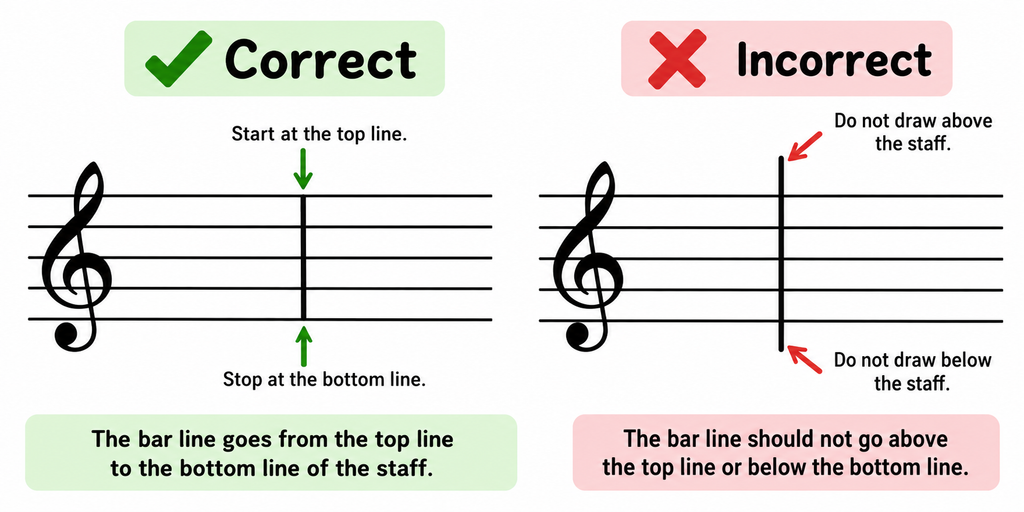
When beginning students first learn to draw bar lines, I often see them make the line too long.
A staff has five lines, and the bar line should stay within those five lines.
Start the bar line at the top line of the staff and draw it straight down to the bottom line of the staff.
The bar line should not extend above the top staff line or below the bottom staff line.
I tell my students:
“Start at the top line and stop at the bottom line.”
It sounds like a small detail, but drawing bar lines correctly helps students understand how measures are visually organized on the staff.
Once students know how to draw a bar line correctly, there is another very important thing they need to understand:
A bar line tells us where a measure ends.
It does not tell us to stop playing.
A Bar Line Is Not a Stop Sign
One of the most common things I see with beginning piano students is a tiny pause at every bar line.
For example, a student might play:
C C E E | STOP | E E D D | STOP
The notes may be correct.
The rhythm inside each measure may even be correct.
But the music does not flow because the student is treating every bar line like a stop sign.
When this happens during a lesson, I often play back exactly what the student just played.
I stop at the same places the student stopped.
Then I ask:
“Do we have a stop sign?”
Then I ask:
“Where is the stop sign?”
Usually the student looks at the music and answers:
“No.”
Exactly.
There is no stop sign.
The bar line is only organizing the music into measures. It is not telling us to stop playing.
I often point to the places where the student stopped and show them:
“You stopped here, and you stopped here.”
Then I draw an arrow across the bar line and write:
→ CONTINUE →
I have the student play the passage again, this time continuing smoothly into the next measure.
This simple visual reminder can make a big difference.
Think about walking from one room into another room.
You know that you have entered a new room, but you do not have to stop at the doorway.
Music should continue moving through the bar line in the same way.
What is a Measure in Music? Understanding Time Signatures
When learning what a measure is in music, students should also understand how the time signature determines the organization of beats.
For beginning students, we often see time signatures such as 2/4, 3/4, and 4/4.
In 2/4 time:
1 2 | 1 2 | 1 2 |
In 3/4 time:
1 2 3 | 1 2 3 | 1 2 3 |
In 4/4 time:
1 2 3 4 | 1 2 3 4 | 1 2 3 4 |
The bar lines make these groups easy to see.
This is why understanding the time signature and understanding measures go together.
The time signature helps us understand how the beats are organized, while the bar lines show us the boundaries between measures.
To learn more about how beats are organized in each measure, read my guide: What Is a Time Signature in Piano Music? A Beginner’s Guide to 2/4, 3/4, and 4/4.
A Piece Can Have More Than One Time Signature
Here is something beginning students may not realize:
The time signature at the beginning of a piece does not always stay the same until the end.
Some pieces use one time signature from beginning to end.
Other pieces change time signatures in the middle.
A piece might begin in 4/4, change to 3/4, and later return to 4/4.
Another piece may change more than once.
That is why I teach my students not to look only at the beginning of the music.
Scan the Entire Piece Before You Play
Before playing a new piece, I want my students to take a quick look through the entire piece.
They do not need to study every note yet.
They do not need to analyze every rhythm.
Just scan the music from beginning to end.
Look at the time signature at the beginning.
Then quickly look through the rest of the piece.
Does the time signature stay the same?
Maybe it changes somewhere in the middle.
Or does it change and then return to the original time signature?
This only takes a few seconds, but it is a very useful habit.
When students immediately begin playing without looking through the music first, they may miss important information that appears later.
I want students to develop the habit of seeing the whole piece first and then looking at the details.
What Is a Double Bar Line?
Sometimes students see two vertical lines together instead of one.
This is called a double bar line.
A double bar line can show an important division or transition in the music.
It may indicate that one section of the music has ended and another section is beginning.
It does not automatically mean that the performer should stop.
Just like a regular bar line, students should look at the musical context and continue according to what the music tells them to do.
What Is the Final Bar Line?
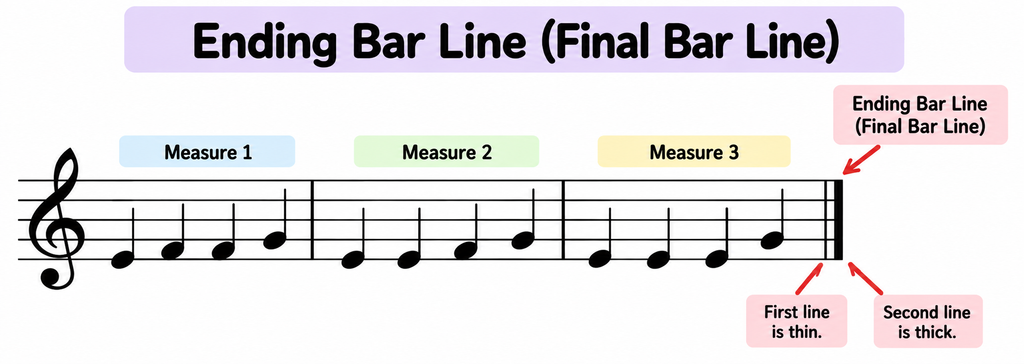
At the very end of a piece, you will usually see a special bar line made of two lines:
one thin line and one thick line.
This is called the final bar line.
It tells us that the piece has ended.
So it is helpful for beginning students to recognize the difference:
Single bar line: separates measures
Double bar line: can mark a division or change in the music
Final bar line: shows the end of the piece
My Piano Teacher Tip: Look Before You Play
When students receive a new piece, their first instinct is often to put their hands on the piano and start playing immediately.
I encourage them to do something different.
Look first. Play second.
Take a few seconds and scan the whole piece.
First, check the time signature.
Next, look at how the measures are organized.
Finally, notice any changes throughout the piece.
Notice where the music begins and where it ends.
You do not need to understand every detail yet.
The goal is simply to get a quick picture of the music before your fingers start moving.
This small habit can help students become more independent music readers.
Final Thoughts
Measures and bar lines are not just lines and spaces on a page.
They help organize music so that we can see and understand the beats more clearly.
Remember:
A measure groups beats together.
A bar line separates one measure from the next.
When you draw a bar line, start at the top line of the staff and stop at the bottom line.
And most importantly:
A bar line is not a stop sign.
When you reach a bar line, keep the beat moving and continue into the next measure.
Before you begin a new piece, take a few seconds to scan the entire piece as well. Check the time signature and see whether anything changes later in the music.
Good music reading begins before you play the first note.