Every piano student plays wrong notes. Many parents wonder why piano students keep playing wrong notes, even after practicing the same piece several times. When a student is learning a new piece, I expect mistakes.
They are reading new notes, learning new finger numbers, figuring out the rhythm, and coordinating both hands at the same time.
Making mistakes is part of learning.
As a piano teacher, I am not concerned when a student plays a wrong note the first time.
But what if the student makes the same mistake again?
And again?
And again?
That is when I start paying attention.
After teaching piano for 25 years, I have found that repeated mistakes are often not about a lack of ability. Many times, they come from the way a student is practicing.
Here are four things I teach my students when the same wrong notes keep coming back.
1. A Mistake Is Okay — But Pay Attention When It Happens Again
Let’s say a student plays F, but the correct note should be played with finger 1.
The first time it happens, that is okay.
I usually do not immediately grab a highlighter or make a big mark on the music.
I simply use a pencil.
I may circle the note and write a small 1 next to it.
Now the student has a reminder.
The next time we play that section, I expect the student to notice my handwriting.
This is where attention becomes very important.
If the student approaches the same place without thinking about it, there is a good chance the same mistake will happen again.
Sometimes, while a student is playing, I can see that we are getting closer to a place I marked earlier.
I will say:
“It’s coming.”
Or:
“My handwriting is coming.”
Immediately, the student becomes more alert.
They start looking ahead.
They remember that something important is coming.
And very often, they play it correctly.
Learn to Look Ahead
This is something I want students to eventually learn to do without me reminding them.
If you know that you have made a mistake in a certain place before, prepare for it before you get there.
Maybe the marked note is four measures away.
Maybe it is eight measures away.
That is okay.
As you get closer, think:
“That spot is coming. This time I am going to get it right.”
Good practicing is not just moving your fingers.
It is paying attention to what is coming next.
2. Why Piano Students Keep Playing Wrong Notes When They Play Too Fast
Some students naturally love to play fast.
Other students naturally play more slowly.
Neither one is necessarily a problem.
Eventually, pianists need to be able to play both fast and slow music.
But when you are first learning a new piece, accuracy is more important than speed.
Playing too fast is one reason piano students keep playing wrong notes.
I sometimes give my students this example.
Imagine two piano students.
Student A
Student A plays very fast.
But while playing, the student makes 20 or 30 mistakes.
Student B
Student B plays more slowly.
But the student makes only a few mistakes.
Then I ask:
“Which student do you think I prefer, Student A or Student B?”
My students almost always know the answer.
Student B.
Why?
Because we can always increase the tempo later.
Once the notes, rhythm, fingering, dynamics, and other details are learned correctly, we can gradually make the piece faster.
But when a student rushes through a new piece and repeatedly practices wrong notes, those wrong notes can become part of the way the student remembers the piece.
Better Practice Helps Piano Students Stop Playing Wrong Notes
When you are reading a new piece, give your brain enough time to actually read the music.
Look at the note.
Look at the fingering.
Notice the rhythm.
Then play.
You do not need to prove that you can play fast.
First learn it correctly. Then build the speed.
For more ideas about developing effective music practice habits, visit ABRSM‘s music education resources.
3. Piano Students Keep Playing Wrong Notes When They Don’t Read the Music
Another common reason students keep playing wrong notes is that they are not really reading the music.
They may be looking at their hands most of the time.
Or they may have played the beginning of the piece so many times that they are trying to play from memory.
Sometimes I ask a student:
“Are you the composer?”
Of course, the answer is no.
Then I ask:
“If you didn’t write this piece, how do you know what comes next without looking at the music?”
Even I look at the music when I am reading a piece.
That is what the music is there for.
Some students tell me:
“But if I don’t look at my hands, I might play a wrong note.”
And I tell them:
“It’s okay. You might make a mistake. Don’t worry. Trust me.”
Learning to keep your eyes on the music takes practice.
For more help with this, read my guide on when to look at your hands while playing piano.
A few wrong notes while developing that skill are okay.
The goal is to learn how to actually read the music instead of depending on your fingers to remember where to go.
Memorization Comes Later
Memorization can be wonderful.
But for most beginning students, it should not replace learning to read.
First, learn the notes.
Learn the rhythm.
Learn the fingering.
Learn the dynamics.
Learn the pedal.
Learn the musical details.
Then, if you want to memorize the piece, that can come later.
Memorization should not be a shortcut around reading the music.
4. Fix the Problem When Piano Students Keep Playing Wrong Notes
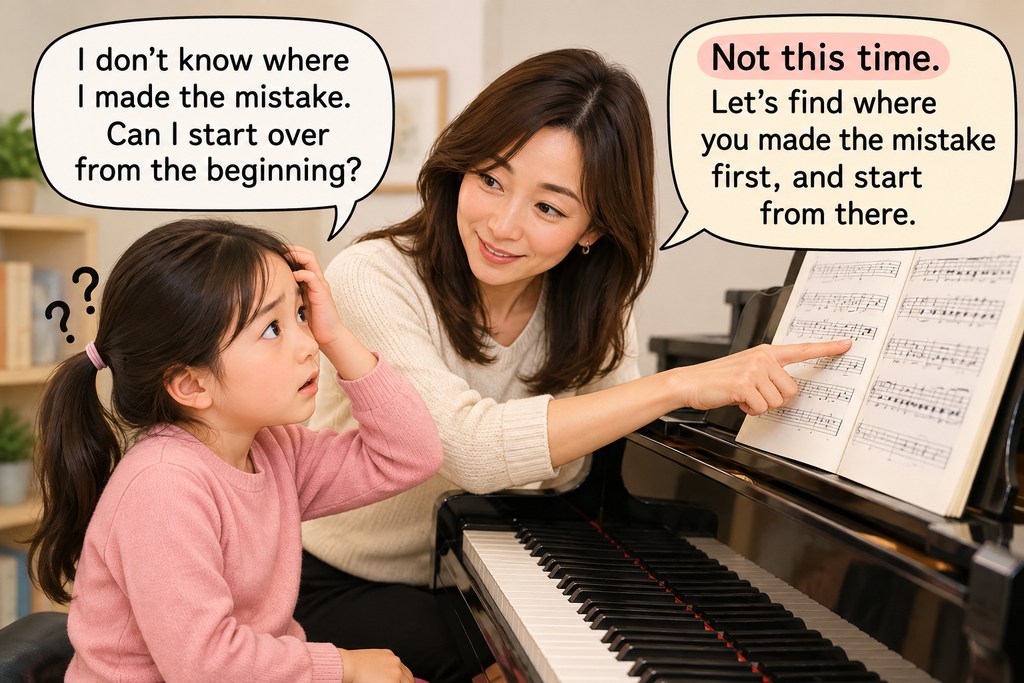
This is one of the most important practice habits I teach.
A student may be able to play an entire page from the beginning.
Then suddenly, there is a mistake in measure 21.
What happens next?
Some students immediately go all the way back to measure 1.
Then they play everything again just to reach measure 21.
If the rest of the piece was going well and the problem happened in one specific place, there is usually no reason to start the entire piece over.
If the mistake happened in measure 21, work on measure 21.
Sometimes I will point to a specific place in the music and say:
“Start here.”
Or I might say:
“Measure 21, second beat.”
A student who has been depending mostly on memory may suddenly have trouble starting there.
Why?
Because the student learned the piece as one long sequence:
Beginning → next part → next part → next part.
The student knows how to start from the beginning, but may not actually know how to read the music in the middle.
But Sometimes Starting Over Is the Right Choice
This does not mean that a student should never start over from the beginning.
Sometimes a student begins a piece and makes mistake after mistake. The tempo may be too fast, the student may not be focused, or the playing may simply be falling apart.
In that situation, I may stop the student and say:
“Let’s start again from the beginning.”
But this time, we reset.
Slow down.
Look carefully at the music.
Pay attention to the notes and markings.
Starting over can be useful when the whole performance needs a fresh start.
But if there is just one specific mistake in measure 21, I do not want the student to automatically return to measure 1. I want the student to find measure 21, understand what went wrong, correct it, and practice from there.
A Pianist Should Be Able to Start in Different Places
This is an important skill.
If someone gives me a piece of music and points to a measure in the middle, I should be able to look at that measure and begin there, even if I have never played the piece before.
Why?
Because I am reading the music.
Students should gradually develop the same skill.
Practice starting from different measures.
If you make a mistake, stop and look at that exact place.
Figure out what happened.
Correct it.
Then try it again.
The goal is not “never start over.” The goal is to know when you need to start over and when you need to work on one specific problem.
The Goal Is Not to Play Without Any Mistakes
I do not expect beginning piano students to play new music perfectly.
Mistakes are part of learning.
Understanding why piano students keep playing wrong notes can help them develop better practice habits.
The important question is:
What do you do after the mistake?
Do you notice it?
Do you mark it?
Do you pay attention when that place comes again?
Do you slow down enough to read accurately?
Do you keep your eyes on the music?
Do you practice the difficult measure instead of starting over from the beginning?
Those habits are much more important than trying to play a new piece perfectly the first time.
After 25 years of teaching piano, this is something I remind my students again and again:
Making a mistake is okay.
But once you know about the mistake, pay attention, correct it, and try not to practice the same mistake over and over again.
That is how students become better readers, better practicers, and ultimately better pianists.