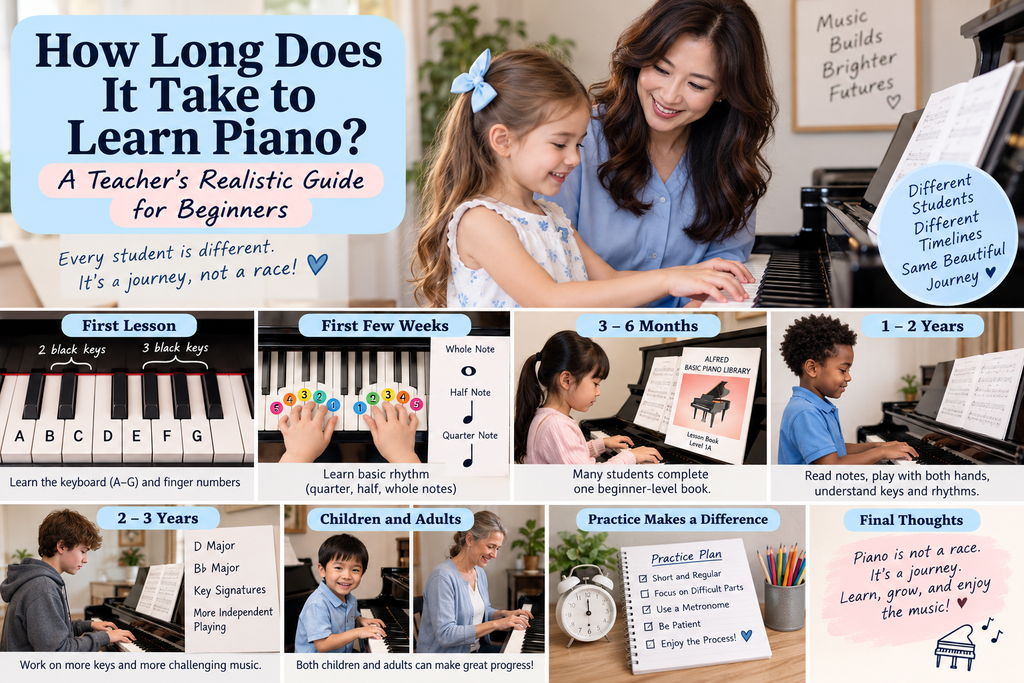
One of the most common questions I hear from new students and parents is, “How long does it take to learn piano?”
The most accurate answer is: It depends.
What Affects Your Progress?
Every student is different. Age, natural ability, concentration, practice habits, lesson consistency, and previous musical experience can all affect how quickly someone progresses.
Some students learn new concepts almost immediately. Others need more repetition and time before they feel comfortable. This is true for both children and adults.
That is why I don’t like to tell a beginner, “After three months, you will be able to play this,” or “After one year, you should be at this level.”
After teaching piano since 2001, however, I can give students and parents a general idea of what progress often looks like for a beginner.
What Can You Learn in the First Few Piano Lessons?
For beginning students, I often use the Alfred Basic Piano Library. With very young children, usually around five or six, I may start with materials designed specifically for young beginners.
At the very beginning, we learn the keyboard itself.
Students learn to recognize the groups of two black keys and three black keys, understand finger numbers, and then begin identifying the white keys from A through G.
Many beginners can understand these basic concepts during their very first lesson.
During the first couple of weeks, we may also begin learning basic rhythm, including quarter notes, half notes, and whole notes.
These concepts may seem simple, but I consider them extremely important. A strong foundation makes everything that comes later much easier.
How Long Does It Take to Finish a Beginner Piano Level?
This is where the answer really becomes case by case.
In my experience, many students take approximately three to six months to complete one beginning-level book.
Some students may finish faster than three months. Others may need more than six months.
And that’s okay.
Finishing a book quickly does not necessarily mean that a student is learning better.
I would much rather have a student truly understand the notes, rhythm, hand position, and musical concepts than rush through a book simply to move to the next level.
Practice habits make a big difference as well. A student who practices consistently throughout the week will usually progress differently from someone who practices only occasionally.
What Do Beginners Learn at Level 1?
During the first level, students are building several skills at the same time.
They begin reading music with both the right and left hands and become comfortable with basic keyboard positions, especially C position and G position.
They also begin learning:
Quarter notes, half notes, and whole notes
Basic rests and counting
Sharps and flats
Basic dynamics such as piano (soft) and forte (loud)
Playing simple music with both hands
At this stage, I don’t want my students simply memorizing songs.
I want them to understand what they are playing and why.
That understanding becomes increasingly important as the music becomes more difficult.
What Happens at Level 2?
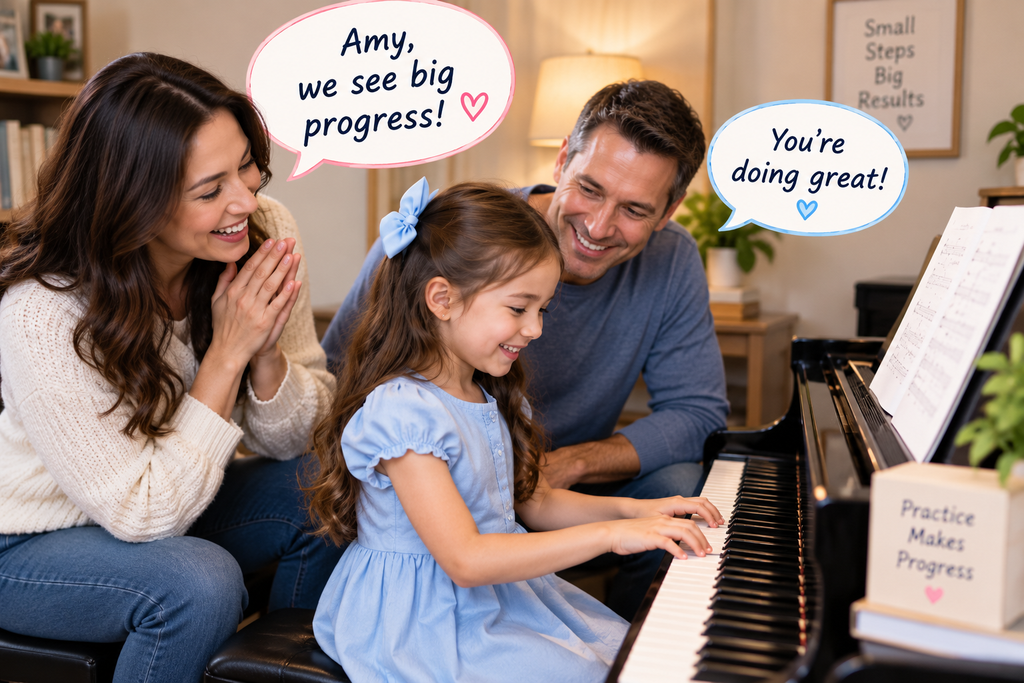
As students move into the next level, the keyboard begins to feel much bigger.
Instead of staying around a few familiar notes, the right hand gradually learns notes farther up the keyboard toward treble C, while the left hand becomes more comfortable moving downward toward low C.
In other words, students gradually expand outward from the center of the piano.
Rhythm also becomes more challenging. Students begin working with eighth notes, dotted rhythms, and more complicated counting.
This is also an important stage for understanding keys.
Students begin learning major keys such as C major, which has no sharps or flats, and then move into keys such as G major and F major, where sharps and flats become part of the music.
This is when students begin to realize that reading music is much more than simply recognizing individual notes.
What Can You Expect After One to Two Years?
So, how long does it take to learn piano well enough to read music and play with both hands?
For many students, one to two years of consistent lessons and practice can make a significant difference.
Depending on the student’s individual pace, a beginner may work through Level 1 and into Level 2 during this period.
By this stage, I generally want my students to be able to:
Read basic notes without depending entirely on memorization
Understand and count common rhythms
Play with both hands together
Read notes across a wider range of the keyboard
Recognize basic sharps and flats
Understand basic dynamics
Begin understanding major keys and key signatures
But this is not a deadline.
One student may reach these skills in a year. Another may need two years or longer. Both students can become good pianists.
Instead of asking, “Am I behind?”, I encourage students to ask:
“Am I improving compared with where I was a few months ago?”
That is a much healthier and more useful way to measure progress.
What Happens After Two or Three Years?
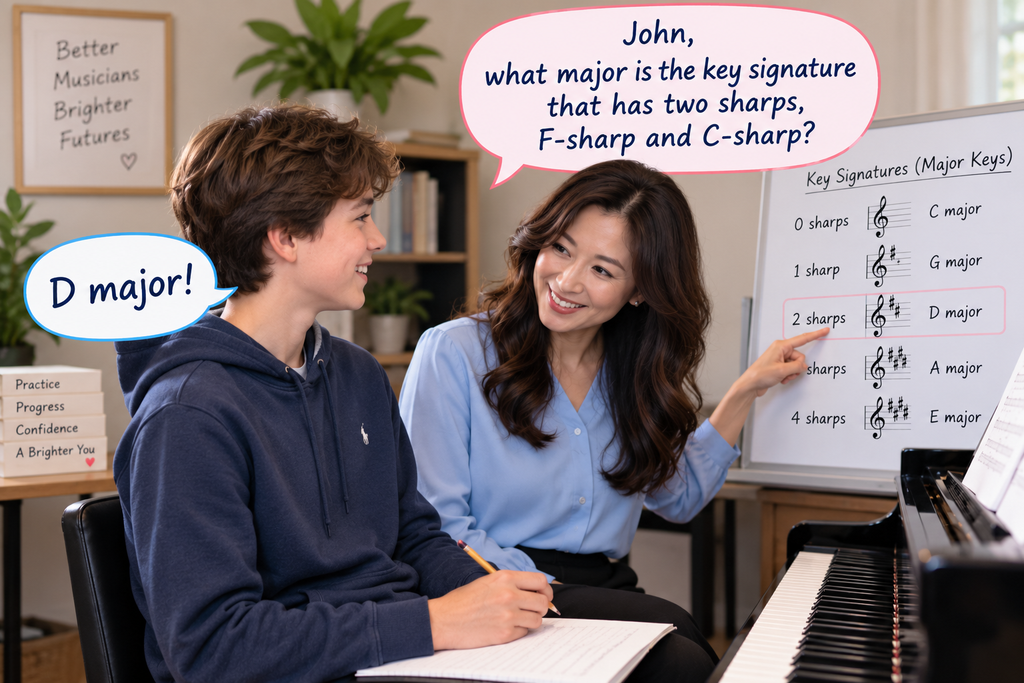
After two or three years, students who have built a strong foundation can begin working with more key signatures and increasingly challenging music.
They may encounter keys such as D major or B-flat major and learn to look at the key signature before playing.
Instead of waiting for the teacher to identify every note, students should gradually become more independent.
When they see an easier piece of music for the first time, they can begin asking themselves:
What key is this in?
Next, check the time signature.
What notes do I need to watch for?
How should I count this rhythm?
To me, this is one of the most important changes in a piano student’s development.
The student is no longer simply learning individual songs. The student is learning how to read and understand music.
Does Practicing More Mean You Will Learn Faster?
Practice matters tremendously, but more time does not always mean better practice.
For beginners, consistent and focused practice is usually more valuable than one very long practice session once a week.
A student who practices a manageable amount regularly has repeated opportunities to reinforce what was learned during the lesson.
The quality of practice matters too. Playing a piece from beginning to end over and over without correcting mistakes is very different from slowing down, counting carefully, and working on difficult sections.
This is one reason two students who have taken piano lessons for the same amount of time may be at completely different levels.
Children and Adults May Progress Differently
Age alone does not determine how quickly someone will learn piano.
Children often have the advantage of starting young and having many years to develop their skills. Adults, on the other hand, may understand explanations and patterns more quickly because of their life experience.
At the same time, adults may have less practice time because of work and family responsibilities.
I’ve taught students of many different ages, and I have seen both children and adults make excellent progress.
What matters much more than age is consistency, patience, good instruction, and regular practice.
So, How Long Does It Really Take to Learn Piano?
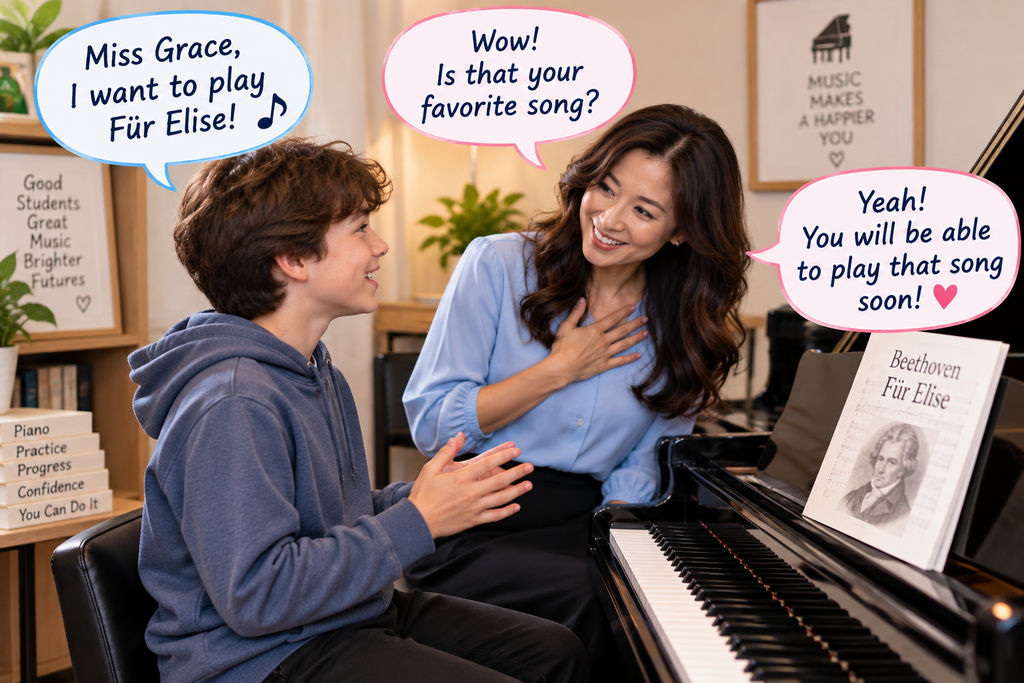
There is no magic number.
You can learn the names of the piano keys in one lesson.
You can begin playing simple music within the first few weeks.
Over the next several months, you can develop stronger note-reading and rhythm skills.
After one or two years of consistent study, many students can read basic music, count rhythms, and play with both hands with increasing independence.
After two or three years, students with a solid foundation may be able to understand key signatures and work through easier pieces much more independently.
But these are general observations from my teaching experience—not promises or deadlines.
Every student has different strengths, challenges, goals, and practice habits.
Final Thoughts
If you are wondering how long it takes to learn piano, try not to measure progress only by months, years, or how quickly you finish a method book.
Piano is not a race.
A strong musical foundation takes time, and that foundation is far more valuable than moving quickly through levels without fully understanding them.
As a teacher, I would rather see a student progress steadily, understand what they are playing, and develop good habits than rush to reach the next level.
Learn carefully, practice consistently, and give yourself time.
The real goal isn’t simply to finish a piano book.
It’s to reach the point where you can look at music, understand it, and enjoy playing it on your own.