When beginning piano students first learn the difference between 3/4 vs. 3/8 time signature, they often think they are almost the same.
After all, both have the number 3 on top.
But look at the bottom number.
One has a 4.
The other has an 8.
That small difference is very important.
As a piano teacher, I like to explain 3/4 and 3/8 with a simple comparison: the USA and Mexico.
Both are countries, but they use different currencies.
In a similar way, 3/4 and 3/8 both have 3 on top, but the bottom number tells us that we are using a different note value for the beat.
Let’s look at the difference step by step.
First, Remember What a Time Signature Tells Us
If you are new to time signatures, start with my beginner’s guide to 2/4, 3/4, and 4/4 time signature first.
A time signature has two numbers.
You can also learn more about time signature at MusicTheory.net.
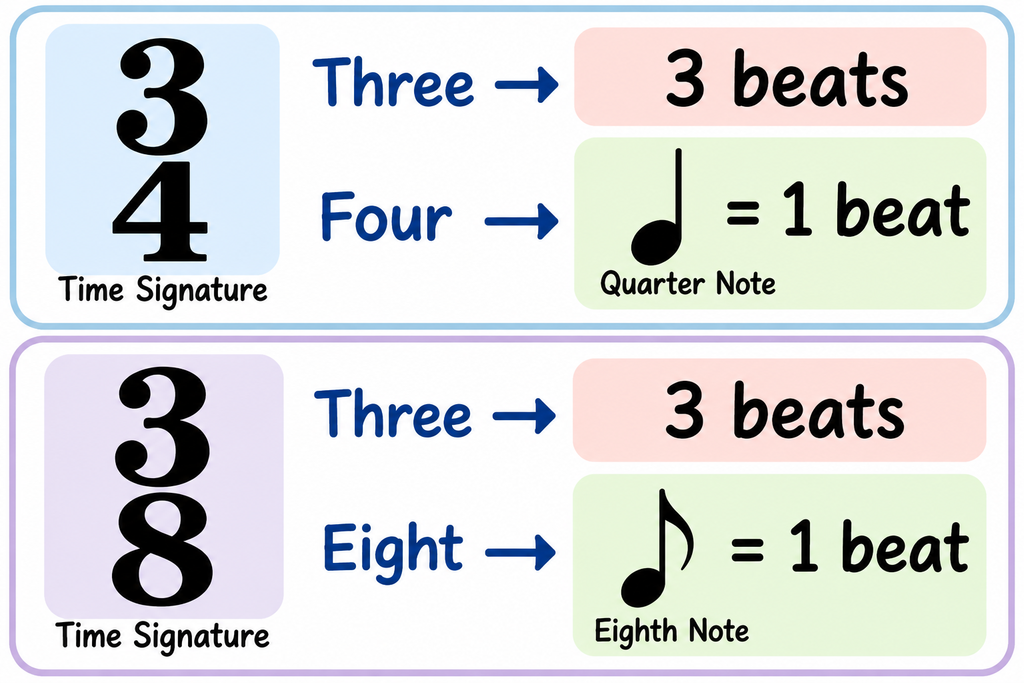
The top number tells us how many beats are organized in each measure.
The bottom number tells us what kind of note represents the beat unit.
For example:
3/4 → 3 beats, quarter note gets the beat
3/8 → 3 eighth-note beats, eighth note gets the beat
This is the first important difference between 3/4 and 3/8.
Think of 3/4 and 3/8 Like the USA and Mexico
Here is a simple example I like to use with my students.
Imagine that you are traveling from the USA to Mexico.
Both are countries.
But they do not use the same currency.
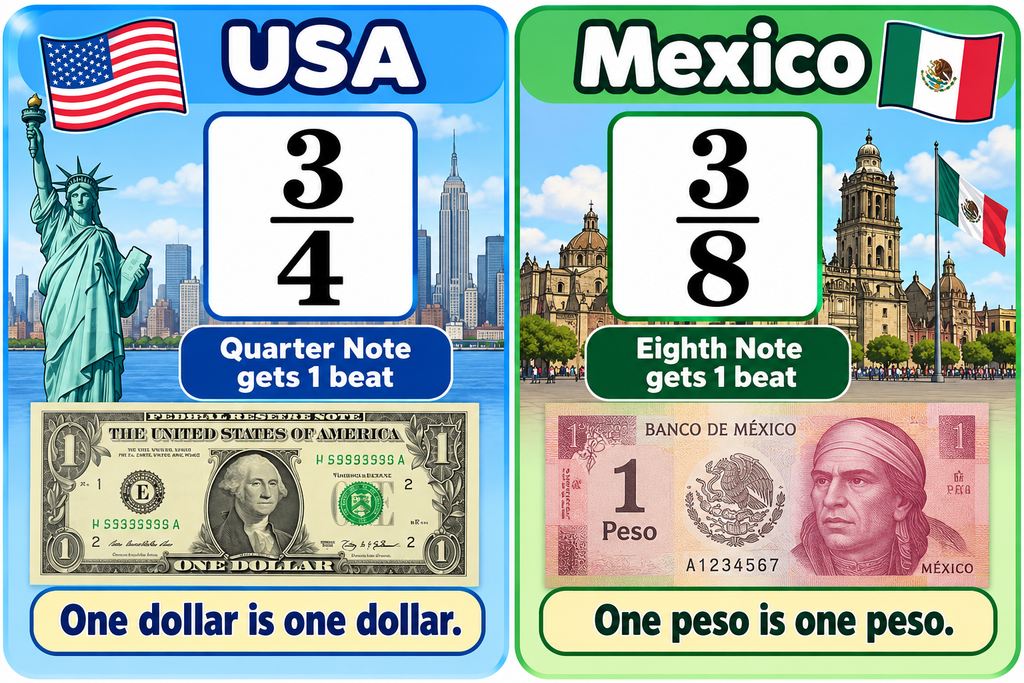
USA
In the USA, we use dollars.
Mexico
In Mexico, the currency is the peso.
They are both money, but the unit is different.
Now think about 3/4 and 3/8 in a similar way.
USA → Dollar
Mexico → Peso
3/4 → Quarter Note
3/8 → Eighth Note
Both time signatures have 3 on top, but the unit represented by the bottom number is different.
This is a simple way to remember why the bottom number matters.
What Does 3/4 Time Mean?
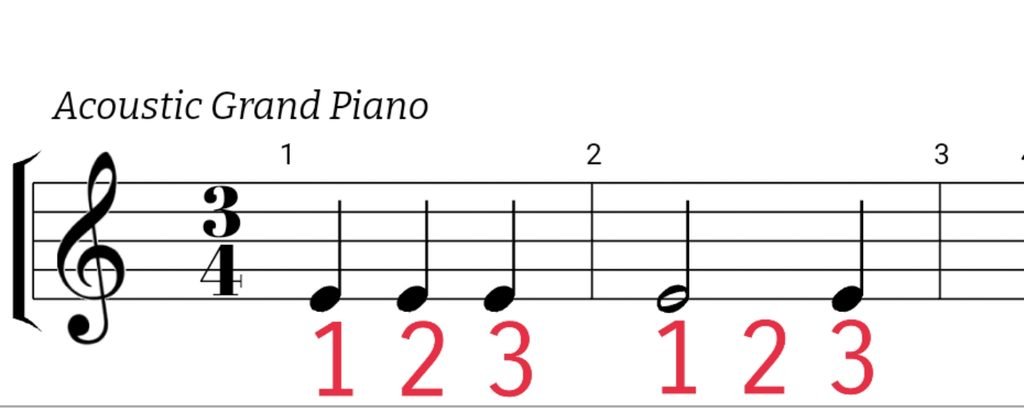
In 3/4 time, the top number is 3.
That tells us there are three beats in each measure.
The bottom number is 4.
The number 4 represents the quarter note.
So in 3/4 time:
There are 3 beats in each measure, and the quarter note receives 1 beat.
A measure containing three quarter notes can be counted:
1 – 2 – 3
Then the next measure begins again:
1 – 2 – 3 | 1 – 2 – 3
Understanding 3/8 in a 3/4 vs.3/8 Time Signature Comparison
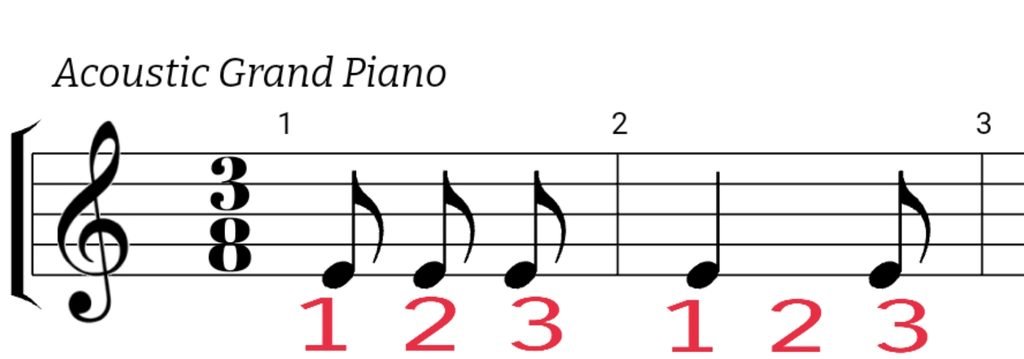
Now look at 3/8 time.
The top number is still 3.
But the bottom number has changed from 4 to 8.
The number 8 represents the eighth note.
For a simple beginner explanation, we can think of 3/8 as having three eighth-note beats in each measure.
Three eighth notes fill the measure:
1 – 2 – 3
Then the next measure begins:
1 – 2 – 3 | 1 – 2 – 3
The numbers may look the same when we count, but what those numbers represent is different.
In 3/4, we are counting quarter-note beats.
In 3/8, we are counting eighth-note beats.
3/4 vs. 3/8 Time Signature: What is the Main Difference?
The easiest way for a beginner to remember the difference is:
3/4 → Quarter note gets 1 beat
3/8 → Eighth note gets 1 beat
The top number is the same, but the bottom number is different.
That bottom number changes the note value used as the beat unit.
Just remember our USA and Mexico example:
USA → Dollar
Mexico → Peso
Different places, different units.
In the same way:
3/4 → Quarter Note
3/8 → Eighth Note
Don’t Look Only at the Top Number
Beginning students sometimes see the 3 on top and stop there.
They think:
“Both have three beats, so they are the same.”
But I always want my students to look at both numbers.
Ask yourself two questions:
1. What does the top number tell me?
How many beats are organized in the measure?
2. What does the bottom number tell me?
What kind of note represents the beat?
If you ask both questions, the difference between 3/4 and 3/8 becomes much easier to understand.
Is 3/8 Faster Than 3/4?
This is another common question.
Because an eighth note is shorter than a quarter note, students sometimes assume that 3/8 must always be faster than 3/4.
But that is not necessarily true.
The time signature and the tempo tell us different things.
The time signature tells us how the beats are organized.
The tempo tells us how fast the music should be played.
A piece in 3/4 can be fast or slow.
A piece in 3/8 can also be fast or slow.
So do not decide the speed of the music simply by looking at the bottom number.
3/4 vs. 3/8 Time Signature: What Fits Inside One Measure?
Here is another easy way to see the difference.
In 3/4 time, three quarter notes can fill one measure:
Quarter Note + Quarter Note + Quarter Note
In 3/8 time, three eighth notes can fill one measure:
Eighth Note + Eighth Note + Eighth Note
Seeing the notes inside the measure can make the difference much clearer than simply memorizing the numbers.
How to Practice the 3/4 vs. 3/8 Time Signature
The next time you open a new piece of piano music, do not immediately start playing.
First, find the time signature.
Then ask:
What is the top number?
What is the bottom number?
If you see 3/4, think:
3 beats — Quarter Note
If you see 3/8, think:
3 eighth-note beats — Eighth Note
Then look at the notes inside the first measure and see how they fit into that time signature.
Doing this every time you begin a new piece will eventually become a natural habit.
Final Thoughts on 3/4 vs. 3/8 Time Signature
At first, 3/4 and 3/8 can look almost the same because they both have the number 3 on top.
But the bottom number makes an important difference.
In 3/4 time, the quarter note represents the beat.
In 3/8 time, the eighth note represents the beat.
Remember the USA and Mexico example:
USA → Dollar
Mexico → Peso
And in music:
3/4 → Quarter Note
3/8 → Eighth Note
Once you learn to look at both the top and bottom numbers of a time signature, understanding 3/4 and 3/8 becomes much easier.