When beginning piano students first see a 6/8 time signature, it can look a little confusing.
What does the 6 mean?
What does the 8 mean?
And how should we count the notes inside each measure?
Before playing a piece in 6/8, I want my students to understand one important idea:
There are six eighth-note counts to fill in each measure.
Once you understand that, counting 6/8 becomes much easier.
Let’s look at it step by step.
What Does 6/8 Time Signature Mean?
A time signature has two numbers.
In 6/8, the top number is 6 and the bottom number is 8.
The top number 6 tells us that there are six counts in each measure.
The bottom number 8 tells us that the eighth note gets one count.
So for beginning students, I explain 6/8 like this:
6 = six counts in each measure
8 = an eighth note gets one count
That is the first thing I want my students to understand before we begin counting rhythms in 6/8.
Imagine Six Spaces in a Room
I like to have my students imagine that one measure is like a room.
In 6/8, our room needs six eighth-note counts.
Imagine six spaces:
1 2 3 4 5 6
Every measure needs to fill those six spaces.
If we have six eighth notes, the rhythm fits perfectly:
♪ ♪ ♪ ♪ ♪ ♪
1 2 3 4 5 6
Then the bar line tells us that the measure is finished.
The next measure begins again:
1 2 3 4 5 6 | 1 2 3 4 5 6
This is the basic counting pattern I want beginning students to understand first.
Compare 3/8 and 6/8 Time Signature
If you already understand 3/8, a 6/8 is easier to visualize.
In 3/8, we need three eighth-note counts to complete one measure:
1 2 3
In 6/8, we have six eighth-note counts:
1 2 3 4 5 6
So visually, our 6/8 room has twice as much space to fill with eighth-note counts as our 3/8 room.
This is a simple way for beginners to see the difference between the two time signatures.
Why the Bottom Number Matters in a 6/8 Time Signature
When students see a new time signature, I always want them to look at the bottom number.
In 6/8, the bottom number is 8.
That means the eighth note is our basic counting unit.
Think back to our currency example.
When the bottom number was 4, we were working with quarter-note beats.
Now the bottom number is 8.
We have changed our unit.
That means the values of the notes need to be understood in relation to the eighth note.
This is why knowing the bottom number is so important.
Note Values You Need to Know in a 6/8 Time Signature
Before trying different rhythms, students should know these note values.
Eighth Note = 1 Count
An eighth note gets 1 count.
♪ = 1
Six eighth notes can fill one complete measure:
1 + 1 + 1 + 1 + 1 + 1 = 6
Quarter Note = 2 Counts
A quarter note is equal to two eighth notes.
So in 6/8:
Quarter note = 2 counts
If I see a quarter note, I know it takes up two of the six spaces in my measure.
Dotted Quarter Note = 3 Counts
A dotted quarter note is equal to three eighth notes.
So:
Dotted quarter note = 3 counts
This is a very important note value to recognize in 6/8 because dotted quarter notes appear frequently in music written in 6/8.
Half Note = 4 Counts
A half note is equal to four eighth notes.
So:
Half note = 4 counts
If we put a half note into our six-count room, it fills four spaces.
We still need two more counts to complete the measure.
Dotted Half Note = 6 Counts
A dotted half note is equal to six eighth notes.
So:
Dotted half note = 6 counts
That means one dotted half note can fill an entire measure of 6/8.
Nothing else is needed to complete the six counts.
Remember These Five Note Values in a 6/8 Time Signature
When beginning students first learn 6/8, these are the note values I especially want them to recognize:
Eighth note = 1 count
Quarter note = 2 counts
Dotted quarter note = 3 counts
Half note = 4 counts
Dotted half note = 6 counts
Once students understand these values, they can begin looking at a measure and figuring out how the rhythm adds up to six.
How Do We Fill a Measure of 6/8?
Now imagine our six spaces again:
1 2 3 4 5 6
There are many possible rhythm combinations that can fill those spaces.
Let’s look at a few common examples.
Two Dotted Quarter Notes
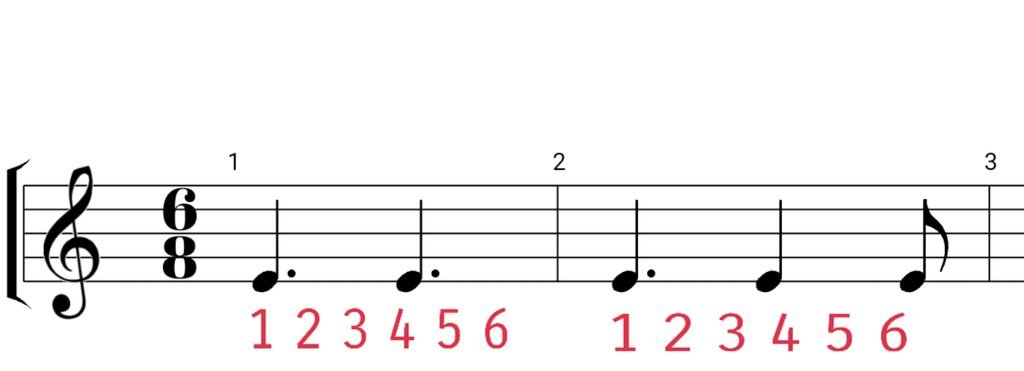
A dotted quarter note gets 3 counts.
So two dotted quarter notes give us:
3 + 3 = 6
That fills the entire measure.
This is a rhythm students will often see in 6/8 music.
One Dotted Half Note
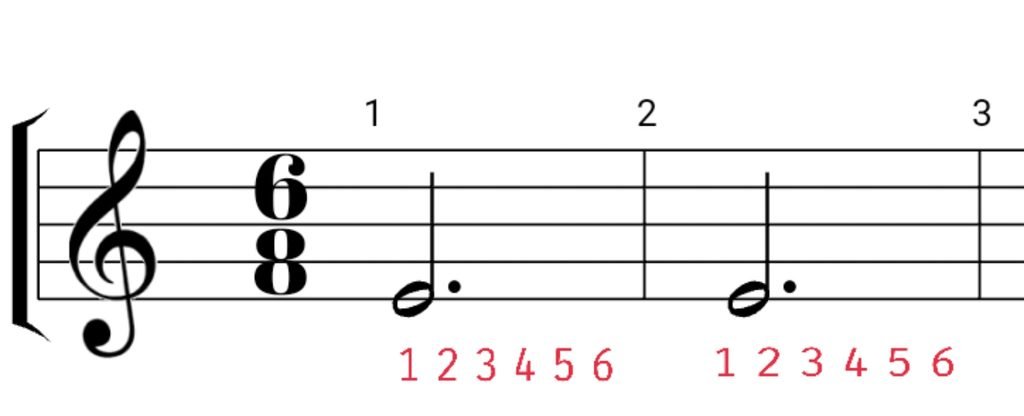
A dotted half note gets 6 counts.
So:
6 = 6
One dotted half note fills the entire measure by itself.
When students see a dotted half note in 6/8, I want them to recognize immediately:
This note fills my whole six-count room.
Quarter Note + Eighth Note + Quarter Note + Eighth Note
A quarter note gets 2 counts.
An eighth note gets 1 count.
So we can have:
Quarter note + eighth note + quarter note + eighth note
Now add the values:
2 + 1 + 2 + 1 = 6
The measure is complete.
This is another useful rhythm pattern for beginning students to recognize.
How to Check Each Measure in 1 6/8 Time Signature
When students are unsure about a rhythm in 6/8, I tell them not to guess.
Look at each note.
Find its value.
Then add the counts.
Ask yourself:
Does this measure equal 6?
For example:
3 + 3 = 6
Yes. The measure is complete.
2 + 1 + 2 + 1 = 6
Yes. The measure is complete.
6 = 6
Yes. The measure is complete.
Thinking this way helps students understand the rhythm instead of simply memorizing what it looks like.
What I Tell My Piano Students
When teaching a 6/8 time signature, I ask my students to look at the two numbers before they begin playing.
When a student sees 6/8 for the first time, I do not want them to immediately put their hands on the piano and start playing.
First, we look at the time signature.
I ask:
“What does the top 6 tell you?”
Then:
“What does the bottom 8 tell you?”
Next, we imagine our measure with six spaces:
1 2 3 4 5 6
Then we look at the notes inside the measure.
How many counts does each note get?
Do all the notes together equal six?
Once the student can answer those questions, the rhythm usually becomes much easier to understand.
Final Thoughts
Learning how to count a 6/8 time signature becomes much easier once you understand the note values.
Start with the two numbers.
Top 6 = six counts in each measure
Bottom 8 = the eighth note gets one count
Then remember the important note values:
Eighth note = 1
Quarter note = 2
Dotted quarter note = 3
Half note = 4
Dotted half note = 6
Finally, look at the notes in each measure and make sure they fill all six counts.
Think of the measure as a room with six spaces.
Once you know how much space each note takes, counting 6/8 becomes much easier.
Before you play, count first.
When you understand how the rhythm fills the measure, your hands will have a much easier time following the music.