When beginning piano students first learn piano rests, they are learning that rhythm includes both sound and silence.
Most students usually start with notes such as the quarter note, half note, and whole note.
A quarter note gets 1 beat.
The half note gets 2 beats.
Whole note gets 4 beats.
Then rests begin to appear in the music.
Quarter rest.
Half rest.
Whole rest.
At first, rests can look like something completely new. But there is actually an easy way to understand them.
Look at their names.
Quarter note — quarter rest.
Half note — half rest.
Whole note — whole rest.
The beat values are the same.
The difference is simple:
A note means we make a sound.
A rest means we have silence.
But there is one very important thing beginning piano students need to understand:
Silence still has to be counted.
A Rest Does Not Mean the Beat Disappears
One of the most common mistakes I see with beginning piano students happens when they first start playing rests.
They see a rest and think:
“I don’t play anything here, so I can just skip it.”
But that is exactly where the rhythm can begin to fall apart.
A rest does not mean that time stops.
The sound stops, but the beat keeps moving.
A quarter rest means you need to rest for 1 beat.
With a half rest, you need to rest for 2 beats.
In 4/4 time, a whole rest means resting for the entire measure.
The value has not changed just because we are silent.
Notes and Rests Have the Same Beat Values
Here is an easy way to compare them:
Quarter note = 1 beat
Quarter rest = 1 beat of silence
Half note = 2 beats
Half rest = 2 beats of silence
Whole note = 4 beats in 4/4 time
Whole rest = a whole measure of silence
When students understand this connection, rests become much easier.
You already know the word “quarter.”
You already know the word “half.”
You already know the word “whole.”
Now you are simply learning the silent version.
How I Teach Students to Count Piano Rests
When I teach a beginning student to play rests, I do not want the student to simply stop and wait.
I want the student to count the silence.
Sometimes I gently hold the student’s hand during the rest so the student can physically feel that we have to wait.
For a quarter rest, we might say:
“Rest.”
For a half rest:
“Rest, 2.”
For a whole rest in 4/4 time:
“Rest, 2, 3, 4.”
While I count, I may continue holding the student’s hand so the student does not play the next note too early.
This helps the student feel something very important:
We are resting, but the music is still moving.
The hand may be quiet.
The piano may be quiet.
But our counting is not quiet.
We still know exactly where the beat is.
Silence Has a Length
Learning to count piano rests helps students understand that silence has a specific length.
This is one of the most important ideas I want beginning students to understand.
Not all silence is the same length.
A quarter rest is not simply “stop.”
It means:
Be silent for exactly 1 beat.
A half rest means:
Be silent for exactly 2 beats.
A whole rest means:
Be silent for the whole measure.
If a student rests too quickly, the next note will come too early.
If a student rests too long, the next note will come too late.
That is why rests are part of rhythm.
Good rhythm includes both sound and silence.
How to Draw a Quarter Rest
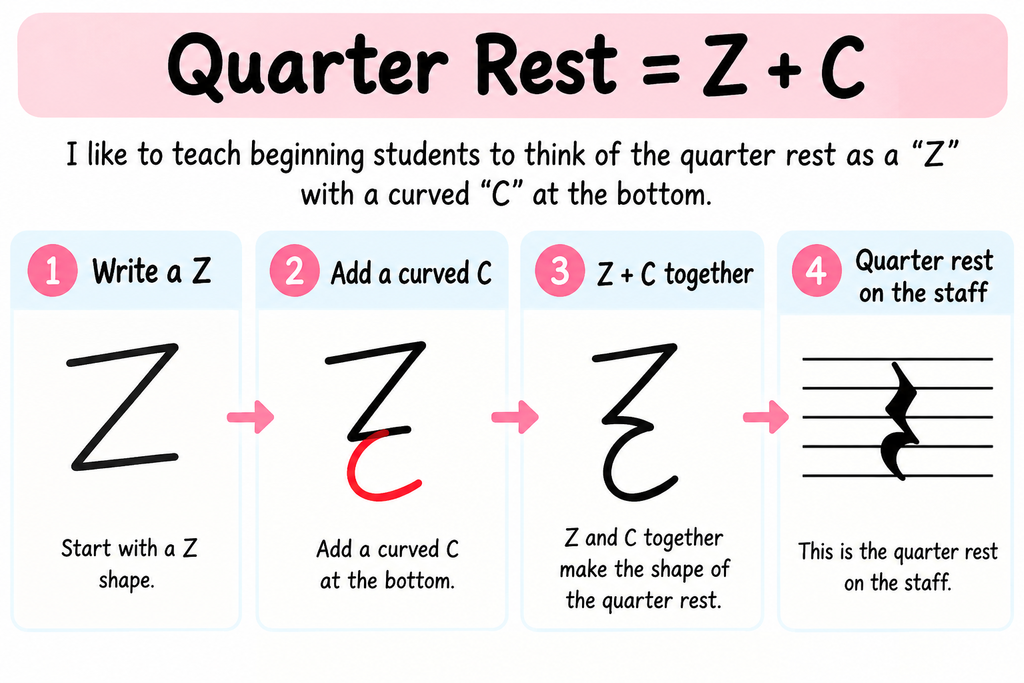
Students should not only recognize rests when they see them in music. I also like them to practice drawing them.
The quarter rest can look complicated at first.
One way I help beginning students remember the shape is to break the motion into simple parts.
I may describe it as:
line, line, line, round
or think of the shape as something similar to:
Z, then C.
It does not have to look perfect the first time.
The important thing is to practice the motion.
I like students to draw the quarter rest several times — five times, ten times, or more — until the shape starts to feel familiar.
Recognizing a symbol is one skill.
Being able to draw it yourself can help you remember it even better.
Piano Rests: Half Rest vs. Whole Rest
Two piano rests that beginners often confuse are the half rest and whold rest.
They look very similar.
Both look like small rectangles attached to a line of the staff.
But they face in different directions.
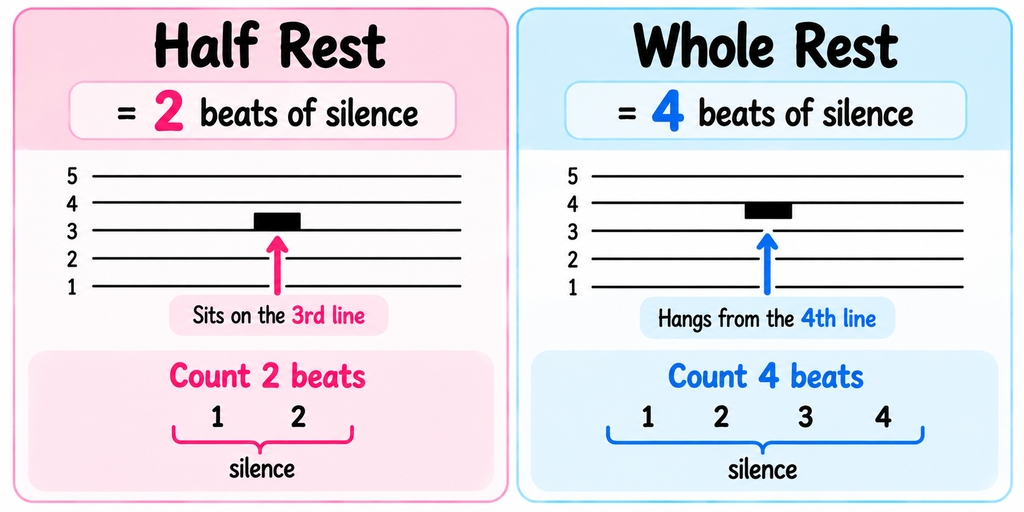
A half rest sits on top of a staff line, like a hat sitting right side up.
A whole rest hangs down from a staff line, like an upside-down hat.
Students often mix these two up, so I use a simple memory trick.
My Memory Trick for the Whole Rest
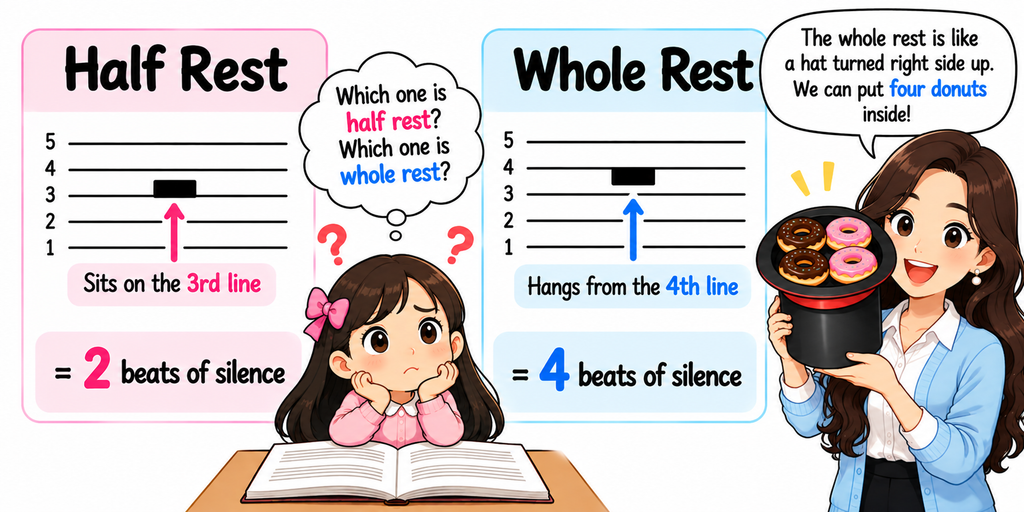
I learned a simple way to remember the whole rest when I was young, and I still remember it today.
Imagine turning the shape into a little container.
A whole rest represents a whole measure of silence, so in 4/4 time we have four beats to think about.
Imagine that we need a container big enough to hold lots of things — apples, donuts, or candies.
Turn the “hat” over so you can fill it up.
That helps me remember:
Whole rest = upside-down hat = a container that can hold more.
Is it a little silly?
Maybe.
But sometimes the silly memory tricks are the ones we remember for the rest of our lives.
That is one reason I like giving my students simple visual ways to remember musical symbols.
If a memory trick stays with a student for years, it has done its job.
How Do You Actually Play Piano Rests?
Playing piano rests correctly requires both counting and controlled hand movement.
Knowing what a rest means on paper is only the beginning.
Now we have to play it correctly at the piano.
A rest means there should be no piano sound during that time.
So if your finger has just played a key, you need to release the key when the rest begins.
But this is where I see another common beginner mistake.
Some students release the key and move their entire hand far away from the piano.
Sometimes the hand goes several inches into the air.
Sometimes it goes all the way down to the student’s lap.
That is usually unnecessary.
Take Your Hand Off the Keys — But Don’t Leave the Keyboard
This is something I often tell my students:
Take your fingers off the keys, but don’t leave the keyboard.
You only need to release the key enough for the sound to stop.
Your hand can stay very close to the keyboard.
Even about half an inch above the keys can be enough.
You are resting, but you are not finished playing.
Another note is coming.
If you move your hand all the way to your lap, you now have to travel from your lap back to the keyboard before you can play the next note.
That extra movement takes time and can make it harder to play the next note exactly on the correct beat.
Instead, stay close.
Rest, but Stay Ready
I like to think of the hand as being on standby during a rest.
You are not pressing a key.
You are not making a sound.
But your hand is still ready.
As soon as the rest is finished, you need to play the next note on time.
So remember:
Release the key.
Stay close to the keyboard.
Keep counting.
Be ready for the next note.
The exact movement may change depending on the music and the length of the rest. But for beginning piano students, there is usually no need to make a big movement every time a rest appears.
A small, controlled release is often enough.
Why Piano Rests Are Part of the Music
When students understand piano rests, they begin to see that silence is an important part of rhythm.
Beginning students sometimes think notes are the music and rests are the empty spaces between the music.
But rests are part of the music too.
A composer chooses when we hear sound and when we hear silence.
Both matter.
So when you see a rest, don’t think:
“Nothing happens here.”
Instead, think:
“This is silence with a specific number of beats.”
Keep counting.
Keep feeling the beat.
Stay close to the keyboard.
And be ready to play the next note right on time.
That is how we make rests part of the rhythm — instead of letting them interrupt it.