Learning how to count dotted notes can feel confusing for beginning piano students. When students first learn note values, everything ususally feels fairly simple.
A quarter note gets 1 beat.
A half note gets 2 beats.
A whole note gets 4 beats.
Then a dot appears next to a note.
For many students, that tiny dot suddenly makes rhythm feel much more complicated.
As a piano teacher, I see this often. Students who were confidently counting quarter notes and half notes may suddenly hesitate when they see a dotted note.
But dotted notes do not have to be confusing.
I like to teach them step by step, using something students can actually picture: a table with four plates—or even better, four donuts.
Let’s start with the easiest dotted note.
How to Count Dotted Notes: The Dotted Half Note
A dotted half note gets 3 beats in 4/4 time.
When I teach beginning students, they usually learn the basic note values very early in their lessons.
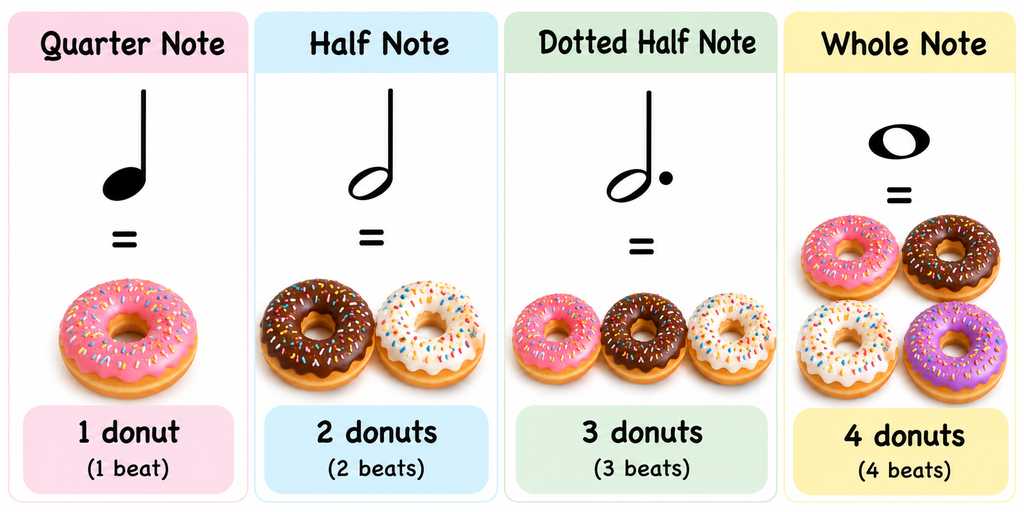
- Quarter note = 1 beat
- Half note = 2 beats
- Dotted half note = 3 beats
- Whole note = 4 beats
In method books such as Alfred, students may encounter the dotted half note during their first lesson or within the first few lessons.
Most students understand it quickly.
I simply tell them:
“A dotted half note gets three beats. Count 1, 2, 3.”
Once they understand that, I sometimes tell them:
“That’s it!”
Why?
Because in a very basic sense, they have now learned notes that can represent 1, 2, 3, and 4 beats.
Of course, rhythm becomes much more detailed later. We have eighth notes, dotted quarter notes, sixteenth notes, and many other rhythms.
But for a brand-new piano student, understanding 1, 2, 3, and 4 beats is a big first step.
How to Count a Dotted Quarter Note
Understanding how to count dotted notes becomes more important when students reach the dotted quarter note.
A dotted quarter note gets 1½ beats.
I first explain it very simply:
1 + ½ = 1½ beats
That means a dotted quarter note is longer than 1 beat, but shorter than 2 beats.
Sometimes I tell a student:
“Hold it a little longer than a quarter note.”
A student with a strong natural sense of rhythm may understand immediately.
But many students do not.
What exactly does “a little longer” mean?
How much longer?
That is why I do not want students to simply guess the length of a dotted quarter note. I want them to understand its exact rhythmic value.
To do that, we need to understand the eighth note and how a beat can be divided into halves.
How to Count Dotted Notes: Start With Four Beats
Let’s stay in 4/4 time.
Imagine that you are having a birthday party.
Your mom sets a table for four people.
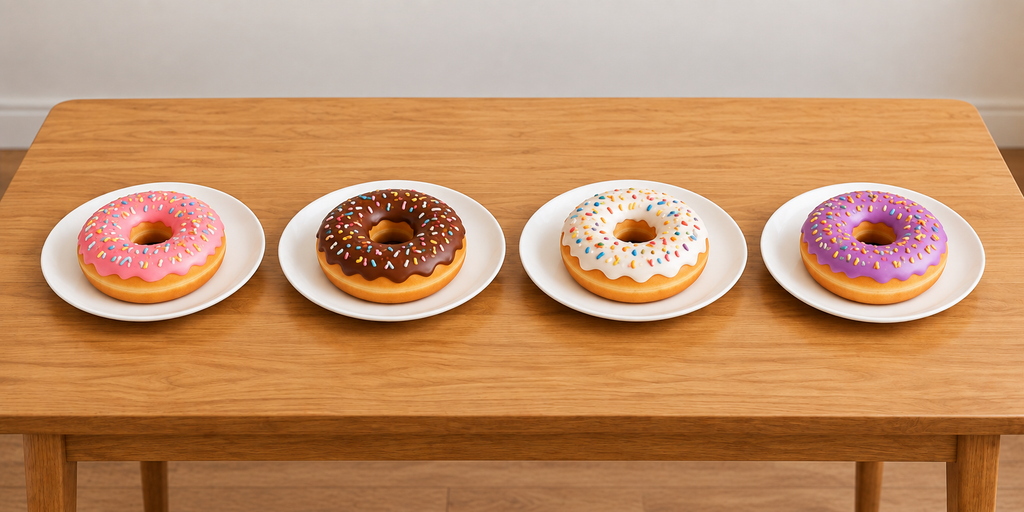
There are four plates on the table because four people can sit there.
For younger students, I like to imagine that each plate has a donut on it.
Each whole donut represents one beat.
So our four donuts represent:
Beat 1 | Beat 2 | Beat 3 | Beat 4
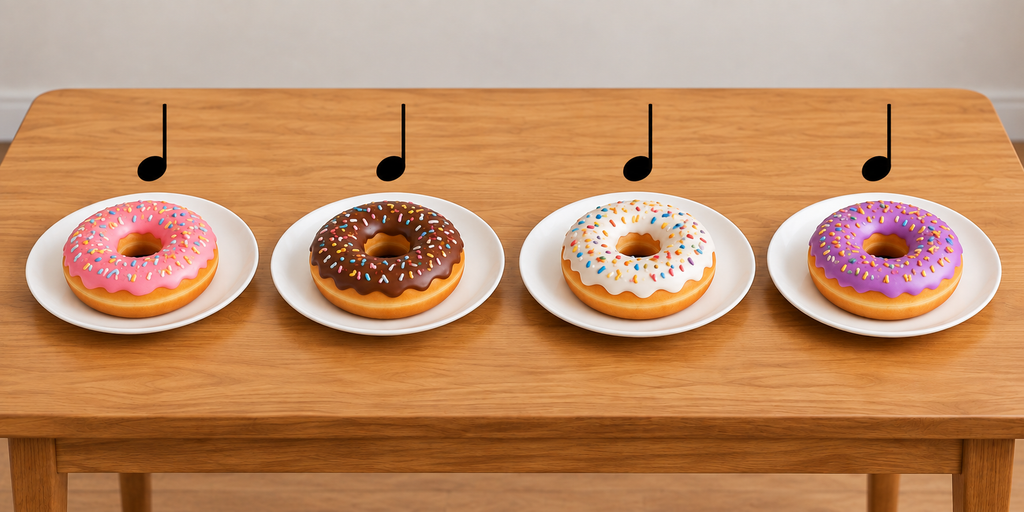
If we had four quarter notes, each quarter note would take one whole donut.
Simple.
But now let’s change our rhythm to:
Dotted Quarter Note | Eighth Note | Quarter Note | Quarter Note
Counting a Dotted Quarter Note With Donuts
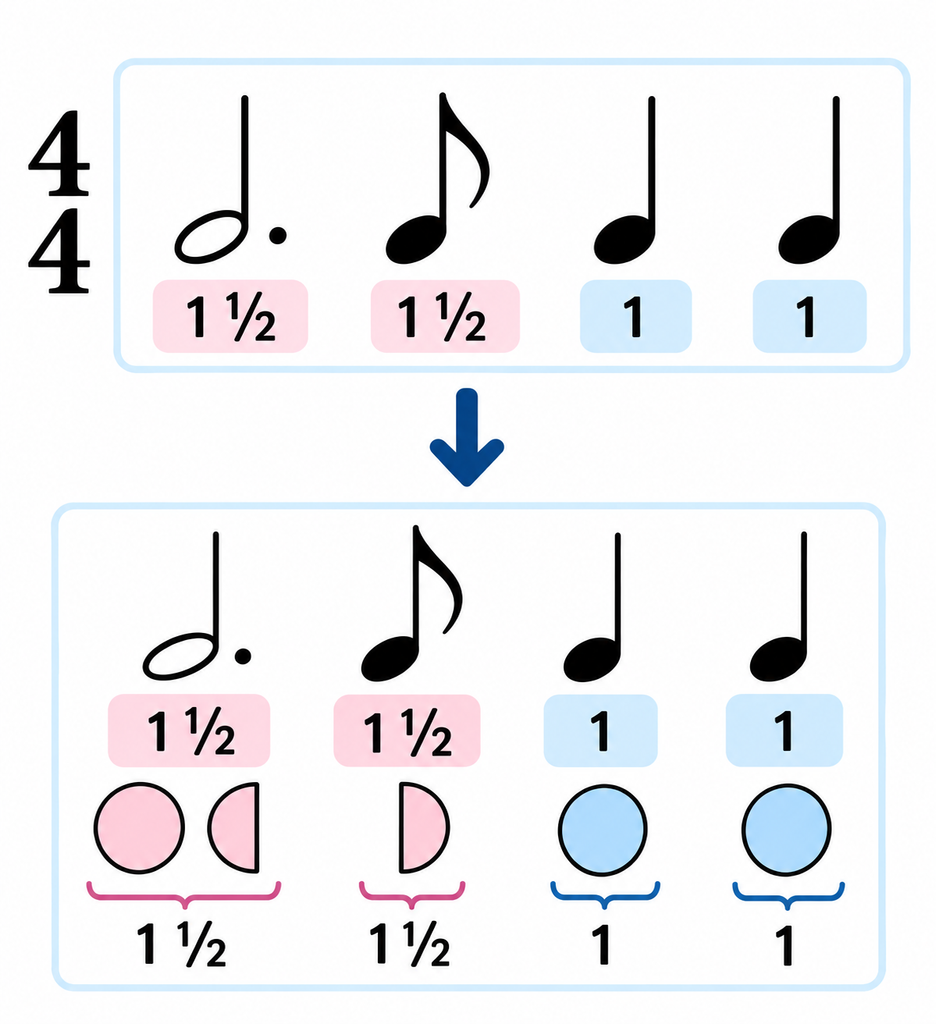
A dotted quarter note needs 1½ beats.
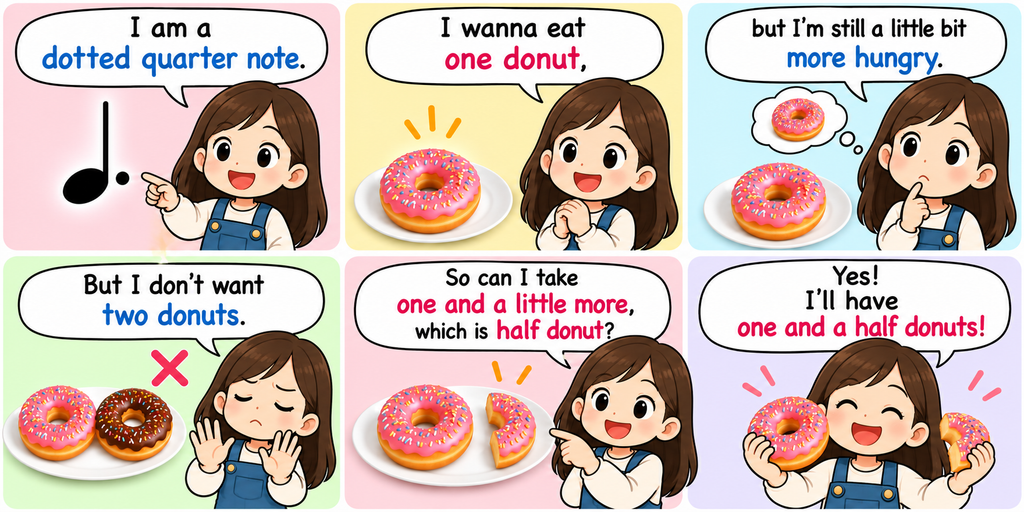
So imagine that the first person gets:
one whole donut + half of the second donut.
That person has now received 1½ donuts.
This is exactly how much space the dotted quarter note takes:
1 whole beat + ½ beat = 1½ beats
But now look at the second donut.
Half of it is still left.
Who gets that half?
The eighth note.
An eighth note gets ½ beat, so it fits perfectly into the remaining half of the second beat.
Then the third and fourth beats each contain a regular quarter note.
So we have:
Dotted Quarter = 1½ beats
Eighth Note = ½ beat
Quarter Note = 1 beat
Quarter Note = 1 beat
Altogether:
1½ + ½ + 1 + 1 = 4 beats
Now the dotted quarter note is no longer just a strange note with a dot beside it.
The student can actually see where the 1½ beats come from.
Cut All Four Donuts in Half
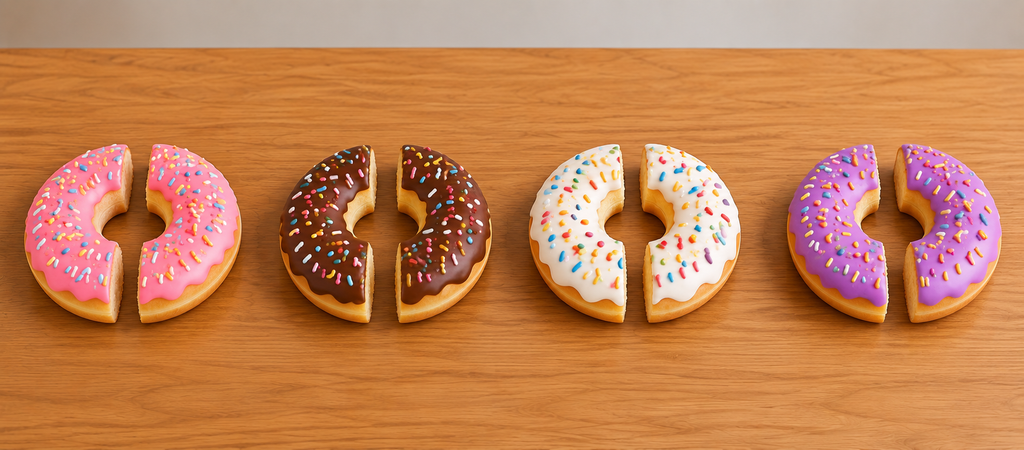
Now I take the explanation one step further.
Imagine cutting all four donuts in half.
Four whole donuts now become eight half-donut pieces.
Each half represents ½ beat.
Now look at our rhythm again:
Dotted Quarter | Eighth | Quarter | Quarter
The dotted quarter note takes 3 half-donut pieces.
Why?
Because:
½ + ½ + ½ = 1½
The eighth note takes 1 half-donut piece.
Each quarter note takes 2 half-donut pieces.
So our rhythm becomes:
3 + 1 + 2 + 2 = 8 half-beat pieces
And eight half-beats equal four full beats.
This visual explanation is especially helpful for students who do not immediately understand what 1.5 means.
Instead of asking them to imagine a decimal number, I can show them three half pieces.
“Do You Understand?”
When I teach this in a lesson, I stop at this point and ask:
“Do you understand?”
Most students begin to see the idea.
They can see that the dotted quarter note is not randomly held “a little longer.”
It has an exact value.
But understanding the value is only part of the lesson.
Now we have to count it.
How to Count Dotted Notes With “1 & 2 & 3 & 4 &”
The key to learning how to count dotted notes is dividing each beat into smaller, equal parts.
1 & 2 & 3 & 4 &
Think about our four donuts again.
After cutting every donut in half, we have eight spaces:
1 | & | 2 | & | 3 | & | 4 | &
Now place our rhythm over those eight spaces.
The dotted quarter note takes the first three half-beat spaces:
1 & 2
The eighth note lands on the next:
&
The third-beat quarter note covers:
3 &
And the fourth-beat quarter note covers:
4 &
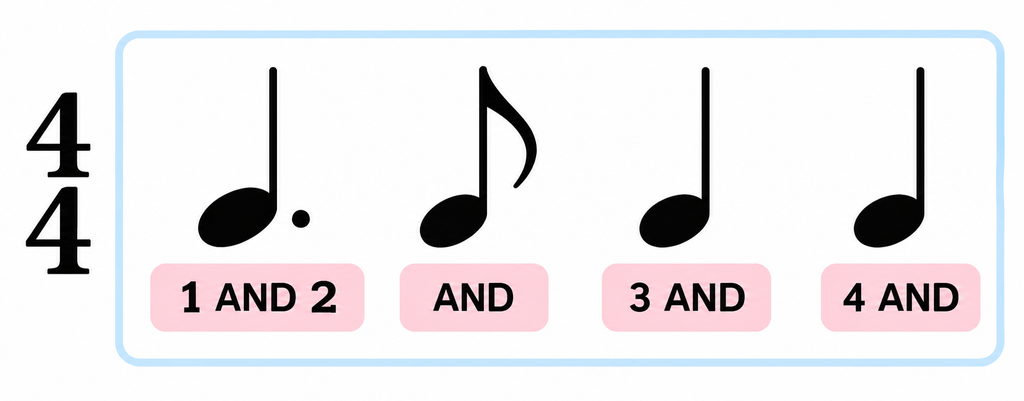
So visually, the rhythm fits perfectly inside:
1 & 2 & 3 & 4 &
This is why learning eighth-note counting first is so helpful before trying to understand dotted quarter notes.
Don’t Just Guess How Long to Hold It
One of the biggest problems I see is students trying to play a dotted quarter note by feeling that it should be “a little longer.”
That may work sometimes, but it does not build reliable rhythm.
Instead, students should understand:
Dotted Quarter Note = 1½ beats = three half-beats
Once they understand that, the counting becomes much more logical.
They are no longer guessing.
They know exactly where the note begins and where the next note belongs.
Say the Counting Out Loud
Students can eventually count internally, but when they are first learning a new rhythm, I prefer that they count out loud.
For this rhythm:
Dotted Quarter | Eighth | Quarter | Quarter
keep the steady subdivision going:
1 & 2 & 3 & 4 &
The dotted quarter is held through:
1 & 2
The eighth note begins on:
&
Then the quarter notes continue through:
3 &
and:
4 &
Saying the counting out loud helps students connect what they see on the page with the steady pulse they need to feel.
A Small Dot Does Not Have to Be Scary
When students first see a dot next to a note, some immediately think the rhythm is going to be difficult.
But I want my students to understand that the dot is giving us information.
We simply need to break the rhythm into smaller pieces.
For beginning students, remember:
Dotted Half Note = 3 beats
and
Dotted Quarter Note = 1½ beats
If 1½ beats feels confusing, divide the beats into halves.
Then:
1½ beats = 3 half-beats
Once students can see and count those smaller pieces, dotted quarter notes become much easier to understand.
Final Thoughts
Learning how to count dotted notes becomes easier when students understand why each note has a certain value.
That is why I like using simple visual examples such as donuts.
Start with four whole beats.
Divide them into halves.
Then connect those halves to:
1 & 2 & 3 & 4 &
The goal is not just for a student to remember that a dotted quarter note equals 1½ beats.
The goal is for the student to be able to see it, understand it, count it, and eventually play it confidently.
Dotted rhythms become more complex as students progress, including dotted eighth notes and other combinations. Those rhythms deserve their own explanation.
For now, mastering the dotted half note and dotted quarter note gives beginning piano students a strong foundation for the rhythms they will encounter next.