Learning how to count rhythm in piano music is one of the most important skills for beginning piano students. Reading the correct notes is important, but students also need to understand when to play each note and how long to hold it.
That is rhythm.
Many beginning students concentrate so much on finding the correct keys that they forget to count. They may play all the correct notes, but if the rhythm is incorrect, the music will not sound the way it is supposed to.
That is why I teach my students to count from the very beginning.
In this guide, we will start by looking at the time signature, learn how to count quarter notes, and then see what happens when eighth notes appear.
First, Look at the Time Signature
Before you start counting, the first thing you should look at is the time signature.
At the beginning of a piece, you may see time signatures such as 4/4, 3/4, or 6/8.
The time signature gives us important information about how the music is organized.
For this article, let’s use 4/4 time.
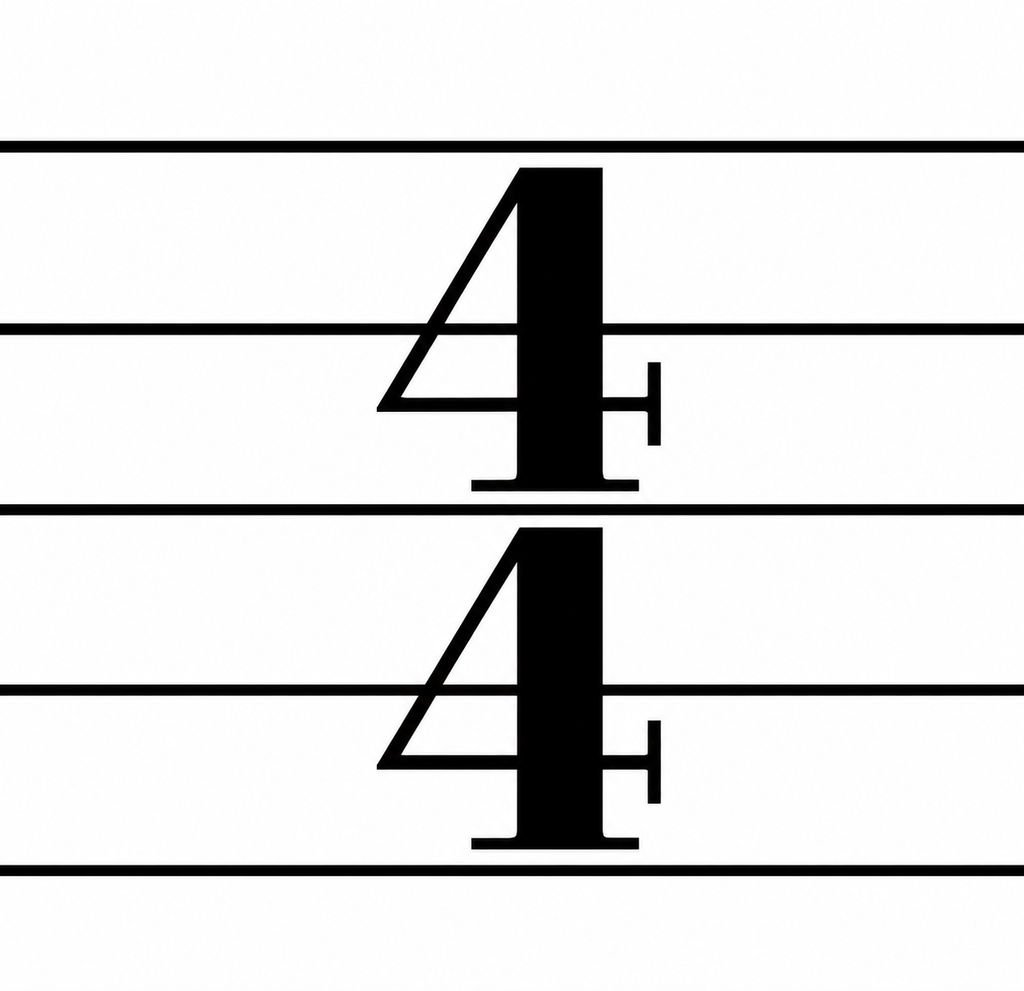
In 4/4 time:
There are 4 beats in each measure.
A quarter note receives 1 beat.
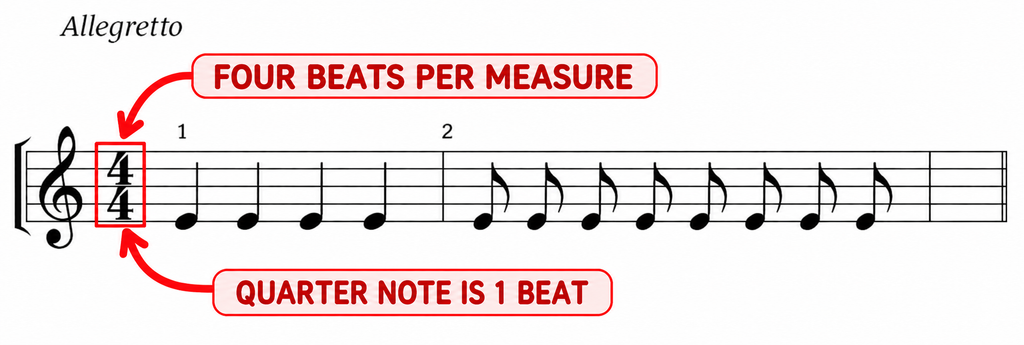
I want my beginning students to understand these two ideas before they start playing.
For more information about rhythm and note values, you can visit the Music Theory Section from Open Music Theory.
Counting Rhythm by Thinking of Each Measure as a Room
I often tell my students to imagine that every measure is a room.
In 4/4 time, each room needs to contain the same total amount of time: 4 beats.
So we can count:
1 – 2 – 3 – 4 | 1 – 2 – 3 – 4 | 1 – 2 – 3 – 4
Every measure is another room.
The notes inside each room may look different, but each room still needs a total of four beats in 4/4 time.
This helps students understand that every note has to fit into its correct place inside the measure.
How to Count Rhythm in Piano Music With Quarter Notes
One of the easiest ways to learn how to count rhythm in piano music is to start with quarter notes.
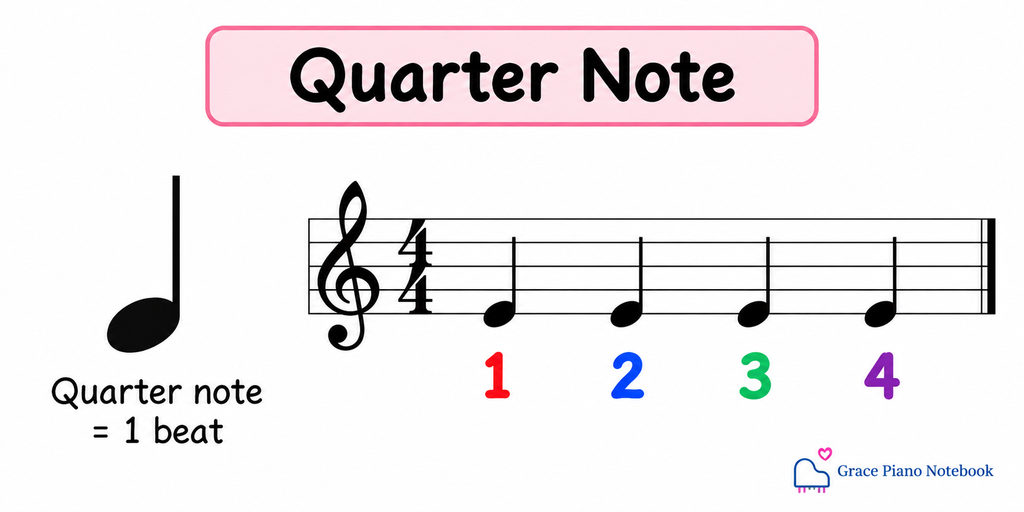
A quarter note receives one beat in 4/4 time.
So if one measure contains four quarter notes, counting is simple:
1 – 2 – 3 – 4
Each quarter note receives one beat.
Say the Numbers Out Loud
I often have beginning students count out loud while they play.
Instead of silently hoping that the rhythm is correct, say:
1 – 2 – 3 – 4
Counting out loud helps students connect three things:
what they see, what they play, and what they hear.
At first, counting and playing at the same time may feel difficult. With practice, it becomes much more natural.
How to Count Rhythm With Eighth Notes
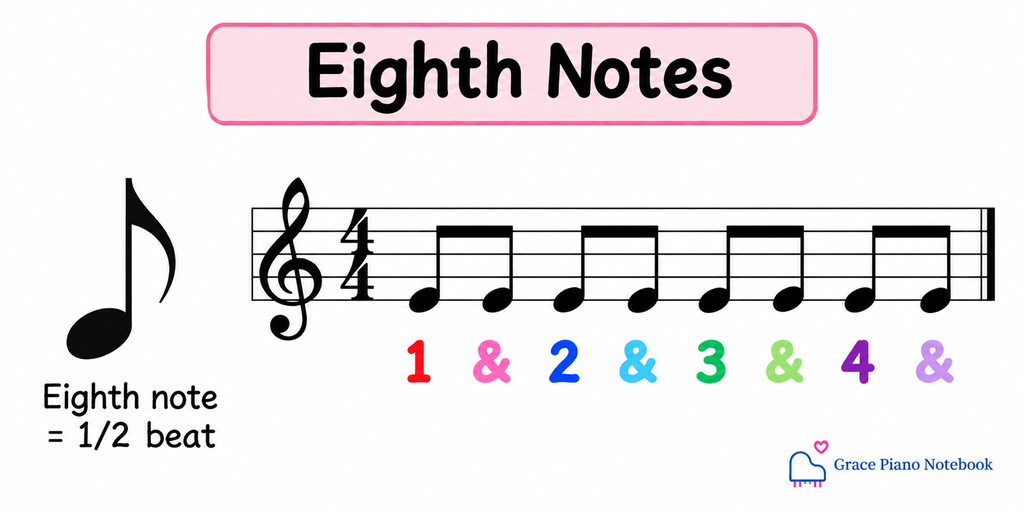
Quarter notes are usually easy for beginners to understand.
But when eighth notes appear, many students become confused.
Instead of immediately telling a young student:
“An eighth note gets half a beat.”
I like to give them something they can actually picture.
How I Explain Eighth Notes With a Donut
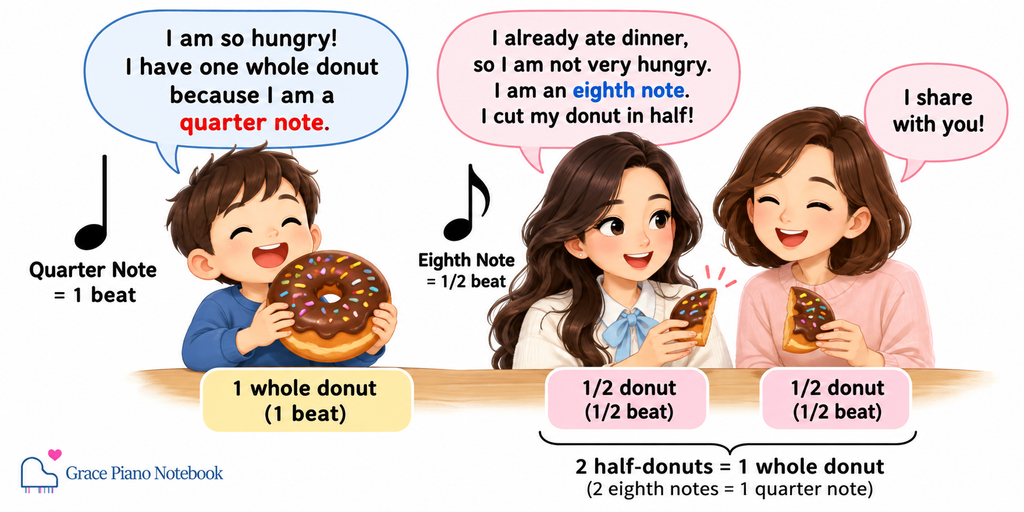
I often use a donut to explain the difference.
I tell my student:
“Imagine you are a quarter note and I am an eighth note.”
Then I say:
“You are very hungry. You have one donut, and because you are a quarter note, you eat the whole donut.”
Then I tell them:
“But Miss Grace already ate dinner, so I am not very hungry. I am an eighth note. I cut my donut in half, and I share it with your mom.”
Now one whole donut has become two half-donuts.
The same idea happens in music:
1 quarter note = 2 eighth notes
Then I ask my student:
“Who will finish eating first—you or Miss Grace?”
Usually they say:
“Miss Grace!”
Then I ask:
“Why?”
And they often answer:
“Because you have a smaller piece!”
Exactly.
The eighth note represents a smaller part of the beat, so it takes less time.
For many young students, this is much easier to understand than simply memorizing the words “half a beat.”
Four Donuts Become Eight Smaller Pieces
Now let’s take the donut example one step further.
Imagine there are four whole donuts on a table.
Think of those four donuts as the four beats in our 4/4 measure:
1 – 2 – 3 – 4
Now Mom cuts every donut in half.
How many smaller pieces do we have?
Eight.
We still started with four whole donuts.
In the same way, our 4/4 measure still has 4 beats per measure.
But each beat has now been divided into two equal parts.
So instead of only thinking:
1 – 2 – 3 – 4
we can divide the beats and count:
1 & 2 & 3 & 4 &
There are still only four beats.
We have simply divided those four beats into eight smaller subdivisions.
How to Count Piano Rhythm: 1 &2&3&4&
When eighth notes appear, we need a way to count the two equal parts of each beat.
That is why we use:
1 & 2 & 3 & 4 &
The numbers represent the main beats:
1, 2, 3, 4
The & falls halfway between each numbered beat.
1 & = two equal parts of beat 1
2 & = two equal parts of beat 2
3 & = two equal parts of beat 3
4 & = two equal parts of beat 4
Two eighth notes fit into the same amount of time as one quarter note.
Using a V Shape to Feel the Beat
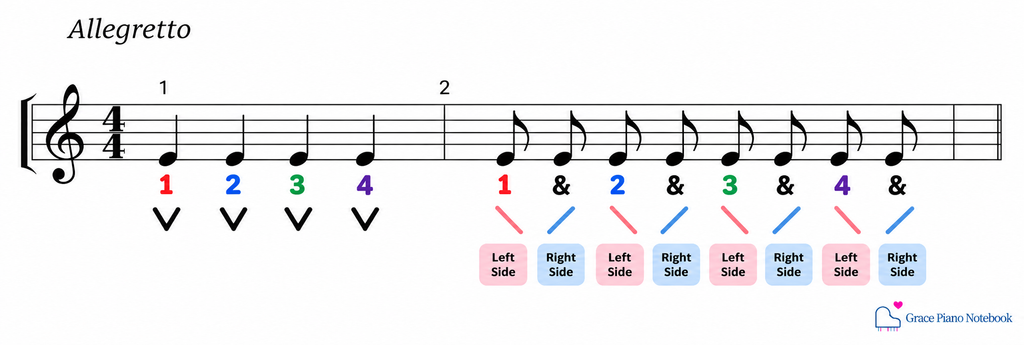
I also use a simple V shape to help my students physically understand the beat.
Think of one complete V as one beat.
With a quarter note, the whole V represents one complete beat.
When that beat is divided into two eighth notes, we divide the V into two sides.
The Left Side Is the Number
The left side of the V represents:
1
The Right Side Is “&”
The right side of the V represents:
&
Together, the two sides make one complete beat:
1 &
The next V becomes:
2 &
Then:
3 &
And:
4 &
So one measure can be counted:
1 & | 2 & | 3 & | 4 &
The V does not create extra beats.
It helps students see and feel how one beat can be divided into two equal parts.
How to Count Rhythm in Piano Music With Quarter Notes and Eighth Notes
Understanding quarter notes and eighth notes together is an important part of learning how to count rhythm in piano music.
Real music does not always contain only quarter notes or only eighth notes.
Very often, they appear together.
The most important thing is to keep the underlying beat steady.
You can continue feeling:
1 & 2 & 3 & 4 &
even when you do not play a new note on every &.
A quarter note takes the entire beat.
Two eighth notes divide that same beat into two equal parts.
Understanding this relationship is much more useful than simply memorizing note values separately.
Do Not Play Faster Just Because You See Eighth Notes
One common beginner mistake is seeing eighth notes and suddenly speeding up the entire piece.
But the main beat does not become faster.
Think about our four donuts again.
Cutting each donut in half did not suddenly give us eight whole donuts.
We still have the same amount of food. We simply divided it into smaller pieces.
Rhythm works the same way.
In 4/4 time, we still have:
4 beats per measure.
The eighth notes simply divide those beats into smaller parts.
Clap the Rhythm Before Playing
If a rhythm is difficult, you do not always need to start at the piano.
First, clap the rhythm and count out loud.
For quarter notes:
1 – 2 – 3 – 4
For eighth notes:
1 & 2 & 3 & 4 &
Students can also use the V motion while counting to physically feel the two sides of each beat.
Once the rhythm feels steady, try playing it on the piano.
This removes the extra difficulty of reading notes and finding keys while you are still learning the rhythm.
Practice One Small Section at a Time
If one measure keeps causing mistakes, do not keep going back to the beginning of the entire piece.
Stop at that measure.
Remember our room idea.
Look only at that room and ask:
How many beats are in this measure?
Then identify the quarter notes and eighth notes.
Count slowly:
1 & 2 & 3 & 4 &
Find exactly where each note belongs.
Once that measure feels comfortable, put it back into the piece.
Count Piano Rhythm Before You Play
A good way to learn how to count rhythm in piano music is to understand the rhythm before you start playing.
Do not immediately put your hands on the piano and start.
First, look at the time signature.
Then ask:
How many beats are in each measure?
What kind of note receives one beat?
Do I see quarter notes?
Do I see eighth notes?
Where does the rhythm change?
Understanding these things before you play can prevent a lot of guessing later.
Slow and Steady Is Better Than Fast and Uneven
Beginning students sometimes think playing faster means playing better.
It does not.
If you can play slowly with a steady beat, you are building a strong foundation.
If you play quickly but constantly change the tempo, the rhythm has not been learned correctly yet.
Start slowly.
Count carefully.
Keep the beat steady.
Speed can come later.
If you are also learning how to read notes, see my How to Read Sheet Music for Beginners guide for a simple step-by-step introduction.
Final Thoughts
Learning how to count rhythm in piano music becomes much easier when students can see, hear and physically feel how the beats are divided.
Start with the time signature.
In 4/4 time, remember:
4 beats per measure.
A quarter note receives 1 beat.
Think of each measure as a room that needs four beats.
Then think about our donuts.
Four whole donuts can be divided into eight half-donuts, but we still started with four whole donuts.
In the same way:
1 – 2 – 3 – 4
can be divided into:
1 & 2 & 3 & 4 &
The measure still has four beats. We have simply divided each beat into two equal parts.
Once students understand this idea instead of simply memorizing numbers, counting quarter notes and eighth notes becomes much easier—and they begin to understand how rhythm actually works.