What is crescendo and diminuendo in music, and how can beginners play these dynamic markings correctly on the piano?
Crescendo means gradually getting louder, while diminuendo means gradually getting softer. Both are important dynamic markings that help musicians create expression, contrast, and emotion.
Although these markings are easy to recognize, playing them correctly can be challenging for beginning piano students.
After teaching piano since 2001, I have noticed that students often understand what crescendo and diminuendo mean but struggle to control the gradual changes in volume.
Some students begin a crescendo too loudly and have no room to increase their volume. Others start a diminuendo too softly and cannot make the sound any quieter.
Another common mistake is changing the tempo instead of the volume.
In my piano lessons, I use visual explanations, train imagery, television volume comparisons, and simple practice exercises to help students understand these musical concepts.
In this guide, I will share seven practical teaching tips for understanding and playing crescendo and diminuendo in music.
What Are Crescendo and Diminuendo in Music?
Crescendo and diminuendo are musical terms that describe gradual changes in dynamics.
Dynamics refer to how loudly or softly music is performed.
What Does Crescendo Mean in Music?
Crescendo is an Italian musical term meaning to gradually increase the volume.
It is commonly abbreviated as cresc.
When musicians see a crescendo marking, they should make the music progressively louder over the indicated passage.
The important word is gradually.
A crescendo is not simply one loud note. It is a developing increase in sound.
What Does Diminuendo Mean in Music?
Diminuendo is an Italian musical term meaning to gradually decrease the volume.
It is commonly abbreviated as dim.
When musicians see a diminuendo marking, they should make the music progressively softer.
The volume decreases over time rather than changing suddenly.
Is Diminuendo the Same as Decrescendo?
Yes. Diminuendo and decrescendo are generally used to indicate the same musical instruction: gradually becoming softer.
Decrescendo is commonly abbreviated as decresc.
Some piano method books use diminuendo more frequently, while others use decrescendo.
In the piano books I teach from, I frequently encounter the term diminuendo, so that is the word I often introduce to my students.
Both terms are correct.
How to Recognize Crescendo and Diminuendo Symbols in Music
Crescendo and diminuendo can be written as words or shown through symbols called hairpins.
The Crescendo Symbol
Crescendo: <
The crescendo hairpin begins with a narrow opening and gradually becomes wider.
I ask my students to look carefully at its shape.
The opening becomes larger, just as the musical volume becomes louder.
The Diminuendo Symbol
Diminuendo: >
The diminuendo hairpin begins wide and gradually becomes narrower.
As the opening becomes smaller, the music becomes softer.
A Simple Way to Remember Both Dynamic Symbols
I explain to my students:
“Look at the opening. When it gets bigger, the sound gets louder. When it gets smaller, the sound gets softer.”
This visual explanation helps beginners recognize the meaning without constantly memorizing definitions.
The hairpin indicates a change in volume over the notes it covers.
It does not tell the performer to change the speed.
1. Crescendo and Diminuendo in Music Tip #1: Understand Gradually Louder and Gradually Softer
The first concept I teach is the difference between a fixed dynamic level and a gradual dynamic change.
Crescendo Means Gradually Louder
When students see crescendo, I explain:
“Don’t suddenly play loudly. Get louder little by little.”
For example, imagine playing four notes.
The first note is relatively soft.
The second note is slightly louder.
The third note is louder again.
The fourth note reaches the intended louder dynamic.
The goal is to create a smooth increase rather than an abrupt jump.
Diminuendo Means Gradually Softer
For diminuendo, I use the opposite explanation:
“Don’t suddenly play softly. Get softer little by little.”
Each successive note or musical phrase should contribute to the gradual decrease in volume.
The change should sound natural and controlled.
Why the Word Gradually Matters
Many beginners understand the words loud and soft but overlook the gradual change.
I remind them that crescendo and diminuendo are not simply instructions to play loudly or softly.
They describe how the volume changes over time.
2. Crescendo and Diminuendo in Music Tip #2: Teach the Difference Between Soft and Softer
One of the most important details I emphasize in my piano lessons is the difference between soft and softer.
I tell my students:
“Don’t forget the -er!”
Soft Means Playing Quietly
The word soft describes a dynamic level.
For example:
“Play this passage softly.”
This means to perform the passage at a quiet volume.
It does not necessarily mean that the volume must continue decreasing.
Softer Means More Quietly Than Before
The word softer is the comparative form of soft.
It means quieter than a previous dynamic level.
The ending -er indicates a comparison.
I often emphasize this small difference because it helps students understand what they are trying to accomplish.
Gradually Softer Means a Continuous Change
The word gradually adds another important meaning.
It tells us that the change happens progressively over time.
Therefore:
- Soft = quiet.
- Softer = more quiet than before.
- Gradually softer = becoming progressively quieter over time.
The same principle applies to loud and louder.
Loud describes a volume level, while louder describes an increase compared with an earlier level.
I tell my students:
“Crescendo means louder and louder. Diminuendo means softer and softer.”
This simple language lesson helps students understand the musical instruction more precisely.
3. Crescendo and Diminuendo in Music Tip #3: Use My Approaching and Departing Train Example
One of my favorite ways to teach crescendo and diminuendo is through the image of a moving train.
Children can easily imagine how the sound changes as a train approaches or moves away.
Crescendo: Imagine a Train Coming Toward You
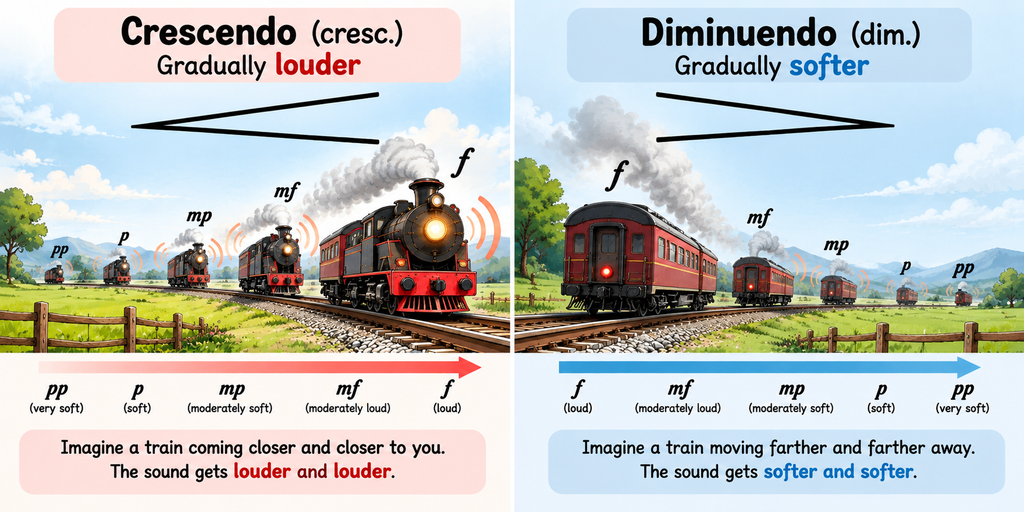
I ask my students:
“Imagine a train far away. At first, you can barely hear it. What happens as the train gets closer?”
The students usually answer:
“It gets louder!”
Exactly.
As the train approaches, its sound becomes louder and louder.
I demonstrate the effect on the piano by playing a short pattern with gradually increasing volume.
Then I explain:
“Imagine the train coming closer and closer to you. Make your piano sound louder and louder.”
This gives students a familiar image they can connect to the musical marking.
Diminuendo: Imagine a Train Moving Away
For diminuendo, I reverse the example.
The train is now nearby, and its sound is relatively loud.
As it travels farther away, the sound becomes quieter.
Eventually, it fades into the distance.
I tell my students:
“Imagine the train moving farther and farther away. Let the sound become softer and softer until it fades away.”
Why the Train Example Works
The train example makes an abstract musical instruction easier to understand.
Students are no longer thinking only about an unfamiliar Italian word.
They are imagining something moving closer or farther away and translating that experience into musical expression.
The train is a listening analogy for changing volume. Students should still maintain the written tempo unless the music also includes a separate tempo instruction.
4. Crescendo and Diminuendo in Music Tip #4: Choose the Right Starting Volume
This is one of the most important lessons I teach about dynamics.
The starting volume determines how much room a student has to increase or decrease the sound.
Crescendo: Don’t Start Too Loudly
Sometimes students see a crescendo and immediately begin playing very loudly.
When this happens, I stop them and say:
“You’ve already reached your maximum volume! You have nowhere to go!”
If students begin at their loudest comfortable dynamic, they cannot create a meaningful increase.
I explain:
“Start softer so you have room to get louder and louder.”
For example, if the music begins at piano and gradually moves toward forte, the student should preserve enough dynamic range to make the increase noticeable.
Diminuendo: Don’t Start Too Softly
The opposite problem happens with diminuendo.
Some students begin playing so softly that they have almost no room to decrease the volume.
I tell them:
“If you start too softly, you have nowhere to go!”
Instead, students need an appropriate starting volume that allows them to become progressively softer.
The Starting Dynamic Depends on the Music
A crescendo does not always have to begin extremely softly.
Likewise, a diminuendo does not always have to begin extremely loudly.
The correct starting level depends on the dynamic markings and musical context.
For example, a crescendo might begin at mezzo forte and build toward fortissimo.
A diminuendo might begin at mezzo piano and become pianissimo.
The important principle is to preserve enough dynamic range for the intended change.
My Starting Volume Reminder
I often summarize this idea with one sentence:
“Leave yourself room to grow or fade.”
This helps students plan their dynamic changes before they begin playing.
5. Crescendo and Diminuendo in Music Tip #5: Don’t Confuse Dynamics With Tempo
One of the most common mistakes I hear from beginning piano students is changing the tempo when they should be changing the dynamics.
This distinction is essential.
Crescendo Is Not Accelerando
Crescendo means gradually louder.
Accelerando means gradually faster.
These instructions affect different musical elements.
Some students begin playing faster when they see a crescendo because they associate increasing excitement with increasing speed.
I stop them and explain:
“You’re getting faster, but crescendo means getting louder!”
Unless the score also indicates a tempo change, the beat should remain steady.
Diminuendo Is Not Ritardando
Diminuendo means gradually softer.
Ritardando means gradually slower.
Some students naturally slow down when they play more softly.
However, diminuendo alone does not instruct them to decrease the tempo.
I explain:
“Make the sound softer, not slower.”
Dynamics vs. Tempo: The Important Difference
| Musical Term | Meaning | Changes |
|---|---|---|
| Crescendo | Gradually louder | Volume |
| Diminuendo | Gradually softer | Volume |
| Accelerando | Gradually faster | Tempo |
| Ritardando | Gradually slower | Tempo |
Practice With a Steady Beat
I ask students to play four or eight notes while counting aloud.
First, they play the notes at an even volume.
Next, they repeat the notes with a crescendo while keeping the same beat.
Finally, they practice a diminuendo without slowing down.
For students who struggle with steady counting, my article How to Count Rhythm in 4/4 Time is another helpful starting point.
My favorite reminder is:
“Change the volume, not the speed!”
Of course, composers can combine crescendo with accelerando or diminuendo with ritardando. When both instructions appear, students should follow both.
But one marking does not automatically imply the other.
6. Crescendo and Diminuendo in Music Tip #6: Use the Television Volume Example
Another simple teaching example I use is the volume control on a television.
Most students understand how a television becomes louder or softer when someone changes its volume.
Imagine Turning Up the Television Volume
I ask:
“What happens when you turn up the TV volume little by little?”
The answer is simple.
The sound becomes louder.
I explain that this is similar to a crescendo.
The television program does not have to play faster just because the volume increases.
Imagine Turning Down the Television Volume
Next, I ask:
“What happens when you gradually turn down the television volume?”
The sound becomes softer.
But the people on television do not automatically begin speaking more slowly.
This is similar to diminuendo.
The volume changes, but the timing stays the same.
Why This Example Helps Beginners
The television example separates volume from speed.
Students can understand that changing the loudness of a sound does not necessarily change its timing.
This makes it easier for them to maintain a steady tempo while performing dynamic changes on the piano.
7. Crescendo and Diminuendo in Music Tip #7: Practice Smooth Dynamic Changes on the Piano
Understanding the definitions is only the beginning.
Students also need to develop physical control so that they can produce gradual dynamic changes.
Exercise 1: Four-Note Crescendo
Play four repeated notes using the same finger or a comfortable fingering.
Count steadily:
1 – 2 – 3 – 4
Begin at a comfortable soft dynamic.
Increase the volume slightly with each note.
The final note should be noticeably louder than the first.
Avoid striking the last note suddenly or forcefully.
Exercise 2: Four-Note Diminuendo
Play the same four-note pattern.
This time, begin at a comfortable louder dynamic.
Make each successive note slightly softer.
The final note should be the softest.
Maintain the same rhythm throughout the exercise.
Exercise 3: Eight-Note Crescendo and Diminuendo
Play eight notes at a steady tempo.
Use the first four notes to build a crescendo.
Use the next four notes to create a diminuendo.
The pattern should feel like one smooth musical shape:
Soft → Louder → Loudest → Softer → Soft
This exercise helps students develop dynamic control in both directions.
Exercise 4: Practice With Both Hands
Once the student can control dynamics with one hand, introduce both hands.
I encourage students to listen carefully to the melody.
When the melody is in the right hand, it should remain clearly audible while the left hand supports it.
Both hands do not always need to play at the same volume.
A well-controlled crescendo or diminuendo should preserve the musical balance between the melody and accompaniment.
Exercise 5: Record and Listen
Ask students to record a short practice passage.
Then listen together.
Can they hear the gradual increase or decrease in volume?
Did the tempo remain steady?
Was the starting volume appropriate?
Listening to a recording often helps students notice details they missed while playing.
Common Mistakes With Crescendo and Diminuendo in Music
Even after students understand the symbols, several mistakes may continue to appear.
Mistake 1: Starting a Crescendo Too Loudly
Students begin near their maximum volume and have no room to increase.
Solution: Choose a starting volume that allows a noticeable gradual increase.
Mistake 2: Starting a Diminuendo Too Softly
Students begin so quietly that they cannot decrease the sound further.
Solution: Begin at an appropriate dynamic level and leave room to become softer.
Mistake 3: Playing Crescendo Too Suddenly
Instead of gradually increasing the volume, students make one note dramatically louder.
Solution: Practice the change over several notes and listen for a smooth progression.
Mistake 4: Speeding Up During Crescendo
Students confuse louder with faster.
Solution: Count aloud or practice with a metronome to maintain a steady pulse.
Mistake 5: Slowing Down During Diminuendo
Students confuse softer with slower.
Solution: Keep the beat steady while decreasing the volume.
Mistake 6: Using Too Much Force
Some students believe that crescendo requires pressing the piano keys as hard as possible.
However, controlled dynamics do not require excessive tension.
Encourage relaxed hands, comfortable wrists, and controlled key attacks.
For more information about emphasizing individual notes without unnecessary force, read What Is an Accent in Music? 7 Tips From a Piano Teacher.
Mistake 7: Ignoring the End of the Hairpin
Students sometimes begin a crescendo or diminuendo correctly but reach their final volume too early.
Solution: Look at the entire length of the marking and plan the dynamic change across the passage.
Crescendo and Diminuendo vs. Accent in Music
Students sometimes confuse crescendo with an accent because both can involve an increase in loudness.
However, they are different musical instructions.
An Accent Emphasizes a Particular Note
An accent generally tells the performer to emphasize an individual note.
The emphasis occurs at that note rather than developing gradually across a passage.
Crescendo Changes the Volume Over Time
Crescendo creates a gradual increase in loudness across a series of notes or a musical passage.
Diminuendo creates a gradual decrease.
These markings help shape longer musical phrases.
For additional information about articulation, read What Is Tenuto in Music? 7 Tips From a Piano Teacher.
You can also explore What Is Staccato in Music? 7 Tips From a Piano Teacher to understand how note length and separation differ from dynamic changes.
Why Crescendo and Diminuendo Matter in Musical Expression
Music is not only about playing the correct notes and rhythms.
Dynamics help create emotion, movement, and contrast.
Crescendo Can Build Excitement or Intensity
A crescendo can make a musical phrase feel as though it is growing in strength.
It may create anticipation, excitement, or dramatic tension.
The effect depends on the musical context.
Diminuendo Can Create Calmness or a Sense of Distance
A diminuendo can make a musical phrase feel as though it is becoming calmer, more distant, or more delicate.
Sometimes the music seems to fade away.
This is why the image of a departing train can be so effective for beginners.
Dynamics Help Shape Musical Phrases
Crescendo and diminuendo can also work together.
A phrase may begin softly, grow toward an important melodic point, and then gradually become softer.
This creates a natural musical shape.
For further reading about dynamics and notation, visit Open Music Theory: Other Aspects of Notation.
The Open University’s Guide to Musical Performance Directions also explains common dynamic and tempo markings.
Frequently Asked Questions About Crescendo and Diminuendo in Music
What Does Crescendo Mean in Music?
Crescendo means gradually increasing the volume of the music.
It is commonly abbreviated as cresc. and can also be represented by a widening hairpin symbol.
What Does Diminuendo Mean in Music?
Diminuendo means gradually decreasing the volume of the music.
It is commonly abbreviated as dim. and can also be represented by a narrowing hairpin symbol.
Are Diminuendo and Decrescendo the Same?
Yes. Both terms generally indicate a gradual decrease in volume.
Different method books and musical scores may prefer one term over the other.
What Is the Difference Between Soft and Softer in Music?
Soft describes a quiet dynamic level.
Softer means quieter than before.
Gradually softer means the volume continues decreasing over time.
Does Crescendo Mean Playing Faster?
No.
Crescendo means gradually louder.
Accelerando means gradually faster.
These are separate musical instructions.
Does Diminuendo Mean Playing Slower?
No.
Diminuendo means gradually softer.
Ritardando means gradually slower.
A diminuendo should not automatically cause the tempo to decrease.
How Do Beginners Practice Crescendo and Diminuendo?
Beginners can practice four-note and eight-note patterns while maintaining a steady beat.
They should focus on choosing an appropriate starting volume and changing the sound smoothly.
Why Is the Starting Volume Important?
The starting volume determines how much room remains for a gradual dynamic change.
Starting a crescendo too loudly or a diminuendo too softly can make the intended effect difficult to achieve.
Final Thoughts: How to Play Crescendo and Diminuendo in Music
Learning crescendo and diminuendo in music is about much more than recognizing two dynamic symbols.
Students need to understand how to control volume gradually, choose an appropriate starting dynamic, and maintain a steady tempo.
After 25 years of teaching piano, I have found that familiar examples often help students understand these concepts more easily.
An approaching train illustrates a crescendo.
A departing train illustrates a diminuendo.
A television volume control helps explain why changing loudness does not necessarily change speed.
Most importantly, I encourage students to think about their starting volume before playing.
If they begin too loudly during a crescendo, they may have nowhere to go.
If they begin too softly during a diminuendo, they may have no room to become quieter.
I remind my students:
“Start at the right volume, leave room for the change, and remember: change the volume, not the speed!”
With careful listening, steady counting, and consistent practice, students can learn to perform crescendo and diminuendo naturally and expressively.
Happy practicing!
Grace Piano Notebook
Piano Teaching Since 2001