What is a fermata in music, and how long should you hold a note when you see this symbol?
A fermata in music is a symbol that tells musicians to hold a note or rest longer than its written value. However, unlike regular note values, a fermata does not specify an exact number of beats.
After teaching piano since 2001, I have noticed that many beginning students understand the basic definition of a fermata but struggle with one important question: How much longer should I hold the note?
This is a question I hear frequently during piano lessons.
When I introduce a fermata, I explain its meaning, show students how to recognize its shape, and use simple counting exercises to help them understand how it works.
I also teach an important distinction between playing alone and performing with other musicians. A fermata allows musical expression, but when playing with a singer, choir, orchestra, or ensemble, musicians must learn to listen and follow the musical leader.
In this guide, I will share seven practical teaching tips that I use to help piano students understand and perform a fermata in music with confidence.
1. What Is a Fermata in Music?
A fermata is a musical symbol that instructs the performer to extend a note or rest beyond its normal written duration.
It is sometimes called a hold or pause.
For example, a quarter note normally receives one beat in 4/4 time. When a fermata appears above that quarter note, the performer holds it longer than one beat.
However, the exact duration is not written into the symbol.
What Does a Fermata Mean for Piano Beginners?
When introducing this musical term, I use a simple definition:
“Hold the note longer than its written value.”
Then I ask my students a question:
“If this quarter note normally receives one beat, what should you do when you see a fermata?”
Most students understand that they should hold the note longer.
But the next question is usually more challenging.
“How much longer?”
This is where I begin teaching them how to interpret a fermata rather than simply memorize its definition.
2. Fermata in Music Tip #1: Remember the Rainbow Shape
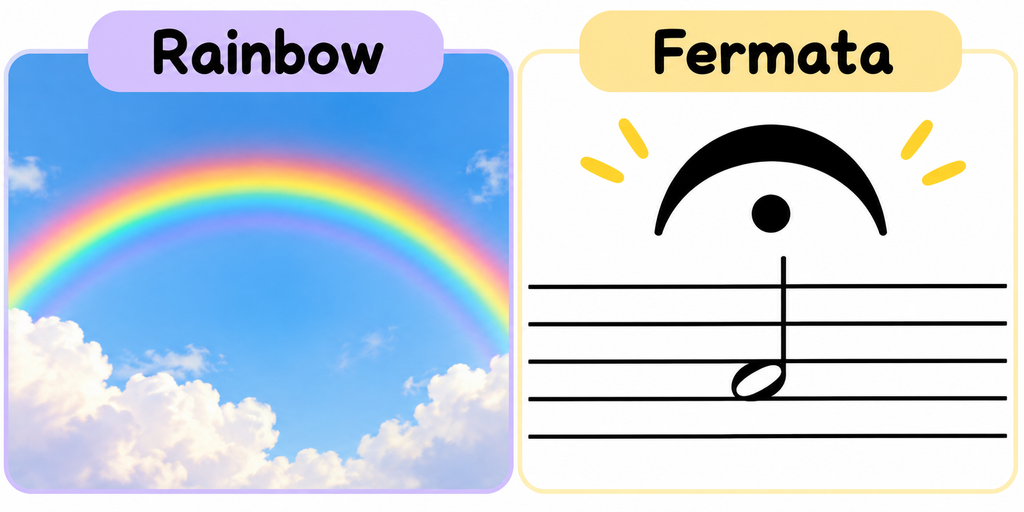
One of the easiest ways to teach a fermata in music is to help students recognize its appearance.
The traditional fermata symbol looks like a curved arch with a dot underneath it.
It is often written above a note or rest, although it can also appear below the staff in an inverted position.
My Rainbow Teaching Method
When I introduce the symbol to young piano students, I often call it a rainbow.
The curved line looks like a little rainbow, with a dot underneath.
This visual comparison helps students remember the symbol more easily.
I might say:
“Look for the little rainbow with a dot. When you see it, remember to hold the note longer!”
Young beginners often remember familiar shapes more easily than unfamiliar musical terminology.
Once they recognize the symbol, I introduce its proper musical name: fermata.
Why Recognizing the Fermata Symbol Matters
Recognizing the symbol quickly helps students prepare for a change in musical timing.
Instead of continuing through the music automatically, they learn to notice that the composer wants something expressive to happen.
A fermata is not simply another note value. It is a musical instruction that asks the performer to make a deliberate choice.
3. Fermata in Music Tip #2: Teach Two or Three Times the Written Value
One of the biggest challenges for beginning piano students is understanding how long to hold a fermata.
The definition says to hold the note longer than its written value.
But how much longer?
My Two-or-Three-Times Teaching Method

In my piano lessons, I often teach beginners to start by holding a fermata approximately two or three times the original note value.
For example:
- A quarter note normally receives 1 beat.
- Holding it twice as long gives approximately 2 beats.
- Holding it three times as long gives approximately 3 beats.
I explain this using simple multiplication:
1 × 2 = 2 beats
1 × 3 = 3 beats
This gives students a practical starting point.
Instead of guessing, they can understand the relationship between the original note value and the extended duration.
Is a Fermata Always Two or Three Times Longer?
No.
There is no universal rule requiring a fermata to last exactly twice or three times the written value.
Its duration depends on the musical context, the style of the piece, the composer’s intentions, and the performer’s interpretation.
My two-or-three-times method is a beginner-friendly teaching guideline, not a fixed musical rule.
I use it because young students often need a concrete example before they can understand a more flexible musical concept.
Why I Discourage Excessively Long Holds During Beginner Practice
When students first learn about a fermata, some assume that holding a note longer means they can hold it for almost any length of time.
For example, they might turn a one-beat quarter note into seven or eight beats without considering the musical phrase.
I explain that a fermata should have a musical purpose.
Holding a note longer does not automatically make the performance more expressive.
The extended duration should make sense within the piece.
As students become more experienced, I gradually encourage them to move beyond numerical counting and develop their own musical judgment.
4. Fermata in Music Tip #3: Practice With Different Note Values
Once students understand the basic idea, I introduce fermatas on different note values.
This helps them connect the symbol to the rhythm they already know.
Quarter Note With a Fermata
A quarter note normally receives one beat in 4/4 time.
For beginner practice, I might ask students to hold it for approximately two or three beats.
Half Note With a Fermata
A half note normally receives two beats.
Using my beginner counting method:
- 2 × 2 = 4 beats
- 2 × 3 = 6 beats
These are practice examples, not required performance durations.
Whole Note With a Fermata
A whole note normally receives four beats in 4/4 time.
Students can experiment with extending the sound beyond those four beats.
However, I remind them that musical expression is more important than simply multiplying numbers.
Fermata on a Rest
A fermata can also appear above a rest.
In this situation, the performer extends the silence rather than sustaining a sound.
This is especially important because beginners sometimes assume that a fermata only applies to notes.
A fermata over a rest creates a longer pause.
That silence can add suspense, emphasize a musical ending, or prepare listeners for the next phrase.
If you are still learning basic note values, read my guide Quarter Notes, Half Notes, and Whole Notes.
You may also find my article What Is a Rest in Music? helpful for understanding how silence works in music.
5. Fermata in Music Tip #4: Understand Solo Piano Freedom
One of the most important things I teach about a fermata in music is that its interpretation changes depending on the performance situation.
When a pianist performs alone, there is usually more freedom to decide how long to hold a fermata.
Follow Your Musical Expression
During a solo piano performance, a musician can consider the mood, character, and emotional direction of the piece.
For example, a fermata at the end of a gentle, expressive phrase might invite the performer to let the sound linger.
A dramatic fermata might create tension before the next musical idea begins.
The pianist can listen carefully and decide when the moment feels complete.
Musical Freedom Still Requires Judgment
Although solo performers have interpretive freedom, they should not ignore the musical structure.
The length of a fermata should support the phrase rather than interrupt it unnecessarily.
I encourage my students to ask themselves:
“Does this hold make the music sound more expressive?”
“Am I listening to the sound?”
“Does the next phrase begin naturally after I release the note?”
These questions help students develop musical sensitivity instead of relying entirely on counting.
6. Fermata in Music Tip #5: Follow the Leader When Playing With Others
A fermata in music becomes especially important when musicians perform together.
This is one of the most valuable lessons I teach because solo performance and ensemble performance require different responsibilities.
Solo Playing vs. Ensemble Playing
When playing alone, pianists have greater freedom to interpret the length of a fermata.
However, when performing with a choir, orchestra, band, singer, or another instrumentalist, musicians cannot simply follow their own individual timing.
Everyone must coordinate the hold and release.
Otherwise, one musician may continue holding the note while another has already moved forward.
My Experience as a Piano Accompanist
As a piano teacher and accompanist, I understand how important it is to follow the musical leader.
For example, when I accompany a soprano soloist, my responsibility is not to impose my own interpretation of the fermata.
Instead, I listen carefully to the singer’s phrasing, pay attention to breathing, and follow the musical direction established during rehearsal.
The singer may need additional time to complete an expressive phrase.
As the accompanist, I must remain flexible and responsive.
An accompanist should support the soloist rather than compete for musical leadership.
Of course, successful accompaniment is a partnership. In some passages, the pianist may provide an important musical cue, and both performers should agree on the interpretation beforehand.
Following a Conductor During a Fermata
When performing with a choir or orchestra under a conductor, musicians should watch the conductor’s gestures.
The conductor communicates when to sustain the fermata, when to release it, and when to continue.
This coordination is especially important when many performers are playing or singing together.
A clear release cue prevents musicians from ending the note at different times.
What If There Is No Conductor?
In a small ensemble without a conductor, musicians should establish who will give the cue.
They can communicate through eye contact, breathing, and subtle body movements.
The goal is not for every musician to make an independent decision.
The goal is to create one unified musical expression.
I always remind my students:
“When you play alone, you have more freedom. When you play together, you must listen, watch, and communicate.”
This is an essential musical skill that extends far beyond learning the definition of a fermata.
7. Fermata in Music Tip #6: Learn When to Release the Note
Many beginners focus entirely on how long to hold a fermata.
However, knowing when and how to release the note is equally important.
Holding and Releasing Are Both Musical Decisions
A fermata creates a temporary suspension of the normal rhythmic flow.
But the music eventually needs to continue.
When teaching this concept, I ask students to practice three steps:
- Play the note and begin the fermata.
- Listen carefully while sustaining the sound.
- Release the note deliberately and prepare for the next phrase.
Students should avoid rushing immediately into the following note.
They should also avoid creating an unnecessary extra pause if the music calls for a smooth continuation.
Practice the Release With a Partner
A simple exercise is to have one student play a note with a fermata while the teacher gives a visual cue for the release.
At first, the student may release too early or too late.
With repetition, the student learns to watch, listen, and respond.
This exercise introduces an important ensemble skill in a beginner-friendly way.
A fermata is not just about holding a note longer. It is also about knowing when to release it together.
8. Fermata in Music Tip #7: Make the Fermata Sound Musical
The final step is helping students understand why composers use fermatas.
A fermata is not simply a symbol that adds extra beats.
It is an expressive musical marking.
Why Composers Use Fermatas
Composers may use fermatas to:
- Create suspense or anticipation.
- Emphasize an important musical moment.
- Allow a phrase to feel complete.
- Add dramatic expression.
- Create space before the next musical section.
- Give performers time to breathe or prepare.
The meaning depends on the musical context.
Listen Before Moving Forward
When my students practice a fermata, I encourage them to listen to the sound instead of focusing only on counting.
For example, after practicing a two-beat or three-beat hold, I may ask them to play the same passage again without counting aloud.
Then we compare the musical results.
Does the phrase sound natural?
Is the pause appropriate for the mood?
Am I beginning the next phrase at the right moment?
This approach helps students move from mechanical counting toward expressive playing.
Connect the Fermata to Other Musical Markings
Students should also understand how a fermata interacts with dynamics, articulation, and phrasing.
For example, a fermata at the end of a crescendo may create a dramatic climax, while one at the end of a soft phrase may produce a gentle sense of closure.
For more information about musical expression, explore my guide What Is an Accent in Music?.
You can also read What Is a Slur in Music? to learn how musical phrasing affects piano performance.
Common Mistakes When Playing a Fermata in Music
Even after learning the definition, beginners often make several common mistakes.
Mistake #1: Holding Every Fermata for Exactly the Same Number of Beats
Not every fermata requires the same duration.
The appropriate length depends on the musical phrase and performance context.
Mistake #2: Holding a Fermata Too Long Without Musical Purpose
An excessively long hold can interrupt the natural flow of a piece.
Beginners should first develop a sense of proportion before experimenting with more dramatic interpretations.
Mistake #3: Ignoring the Conductor or Soloist
During ensemble performance, musicians must coordinate their timing.
An accompanist should not independently extend a fermata when the musical leader is ready to continue.
Mistake #4: Forgetting to Prepare the Next Phrase
Releasing the fermata is only part of the process.
Students must also prepare to resume playing with the appropriate timing and musical character.
Frequently Asked Questions About Fermata in Music
What Does a Fermata Mean in Music?
A fermata tells a musician to hold a note or rest longer than its written value. The exact duration is usually determined by musical interpretation.
How Long Should You Hold a Fermata in Music?
There is no fixed number of beats.
For beginner piano lessons, I often teach students to begin by holding the note approximately two or three times its written value.
As students develop, they learn to adjust the duration according to the musical context.
Can a Fermata Be Placed Over a Rest?
Yes. A fermata over a rest means that the silence should be extended.
Who Decides How Long a Fermata Lasts in an Orchestra?
In an orchestra with a conductor, the conductor generally determines the timing and communicates when musicians should release the fermata and continue.
Can You Hold a Fermata as Long as You Want?
A solo performer may have considerable freedom, but the duration should still make musical sense.
When playing with others, the performers must coordinate the timing rather than making independent decisions.
Is a Fermata the Same as a Tie?
No.
A tie connects notes of the same pitch so their written durations are combined.
A fermata asks the performer to extend a note or rest beyond its normal duration.
For a more detailed explanation, read What Is a Tie in Music?.
Final Thoughts: Understanding Fermata in Music
Learning what a fermata means is an important step toward becoming a more expressive musician.
For beginners, I recommend starting with three simple ideas:
First, recognize the rainbow-shaped symbol with the dot.
Second, understand that a fermata means holding a note or rest longer than its written value. Using approximately two or three times the original duration can be a helpful starting point during beginner practice.
Third, remember that musical interpretation changes depending on whether you are playing alone or performing with others.
After more than 25 years of teaching piano, I believe students benefit most when musical symbols are connected to practical playing experiences.
A fermata teaches much more than counting.
It encourages students to listen carefully, understand musical phrasing, express emotion, and communicate with other performers.
The goal is not simply to hold a note longer. The goal is to make that extra time meaningful.
Additional Music Theory Resource
For another explanation of fermata markings and their interpretation, visit the OnMusic Dictionary’s guide to pause markings.
This resource discusses how fermatas affect musical timing and how performers and conductors interpret pauses in music.