What do repeat signs in music mean, and how do you know which measures to play again?
When beginning piano students first see repeat signs in their sheet music, they often understand one simple idea: repeat means play something again.
But then the questions begin.
Where should I go back?
Do I start from the beginning of the piece?
What if there is another repeat sign earlier in the music?
And what happens when I see a first ending and a second ending?
After teaching piano for 25 years, I have noticed that recognizing repeat signs in music is usually easier than remembering how to follow them correctly.
Students need to understand not only where to return but also whether they are playing a section for the first or second time.
Let’s explore how repeat signs work, how to follow first and second endings, and how to avoid common mistakes.
What Are Repeat Signs in Music?
Repeat signs in music are symbols that tell musicians to play a particular section again.
Instead of writing the same musical passage twice, composers can use repeat signs to show which measures should be repeated.
A basic repeat sign looks like a double bar line with two dots.
The two dots are placed in the middle spaces of the staff, one above the other.
There are two main types of repeat signs:
- Forward Repeat Sign (Start Repeat)
- Backward Repeat Sign (End Repeat)
These symbols help musicians understand where a repeated section begins and ends.
In most beginner piano music, a repeated section is played twice in total unless another instruction is given.
Understanding Bar Lines Before Learning Repeat Signs
Before explaining repeat signs in music, I want my students to understand the different types of bar lines.
A regular bar line is a single vertical line that separates one measure from another.
A double bar line consists of two thin vertical lines. It often marks the end of a musical section or a change in the music.
A final bar line has one thin line followed by one thick line. It indicates the end of a piece.
Repeat signs are different because they include two dots that tell the performer to return to an earlier part of the music.
Recognizing these differences helps students avoid confusing the end of a musical section with an instruction to repeat.
For a more detailed explanation, read my article What Is a Measure in Music? Bar Lines Explained for Piano Beginners.
What Is a Backward Repeat Sign?
A backward repeat sign appears at the end of a section that needs to be repeated.
It has two dots on the left side of the double bar line.
When you reach this sign, you must return to an earlier point in the music.
But where exactly should you go?
That depends on whether there is a forward repeat sign earlier in the piece.
When There Is No Forward Repeat Sign
Imagine you are playing a piano piece.
You begin at measure 1 and continue playing until you reach a backward repeat sign at the end.
You look back through the music, but there is no forward repeat sign.
What should you do?
Return to the very beginning of the piece and play the section again.
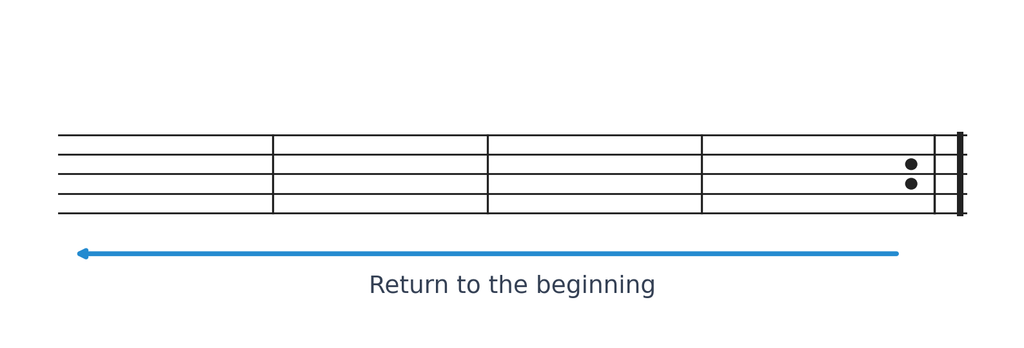
For example:
Measures 1 → 2 → 3 → 4 → Repeat
Then return to measure 1.
The complete playing order is:
1 → 2 → 3 → 4 → 1 → 2 → 3 → 4
You have now played the entire section twice.
This is one of the most common ways repeat signs in music are used in beginner piano pieces.
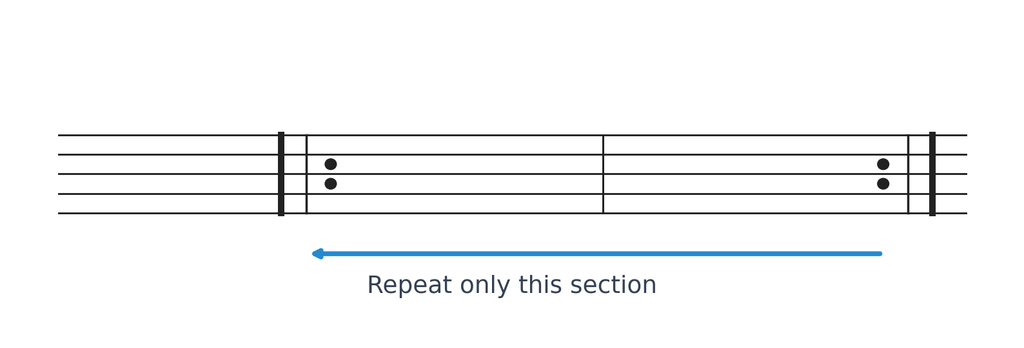
What Is a Forward Repeat Sign?
A forward repeat sign marks the beginning of a section that will be repeated.
Unlike a backward repeat sign, its two dots appear on the right side of the double bar line.
When you see a forward repeat sign while playing, you do not immediately go backward.
Instead, continue playing until you reach the matching backward repeat sign.
Then return to the forward repeat sign.
How to Follow Two Repeat Signs in Music
Imagine a piece with eight measures.
The forward repeat sign appears before measure 3, and the backward repeat sign appears after measure 6.
You play:
1 → 2 → 3 → 4 → 5 → 6
Then return to measure 3.
Play:
3 → 4 → 5 → 6
Then continue:
7 → 8
The complete order is:
1 → 2 → 3 → 4 → 5 → 6 → 3 → 4 → 5 → 6 → 7 → 8
Notice that measures 1 and 2 are not repeated.
Only the measures between the two repeat signs are played again.
This is why I encourage students to look carefully at both repeat signs before they begin playing.
What Are First and Second Endings in Music?
Sometimes repeat signs in music are combined with first and second endings.
These endings are marked with numbered brackets above the staff.
You may see:
- First Ending
- Second Ending
The first ending is played the first time through the repeated section.
The second ending is played the second time through.
The important difference is that you do not play both endings each time.
How to Play the First Ending
When you reach the first ending for the first time, play all the measures underneath the bracket marked 1.
The first ending might contain only one measure.
However, it can also contain two or more measures.
At the end of the first ending, you will usually find a backward repeat sign.
Follow that sign and return to the beginning of the repeated section.
How to Play the Second Ending
After returning to the beginning of the repeated section, play the music again.
But this time, something changes.
When you approach the first ending, do not play it again.
Instead, skip every measure under the first-ending bracket and move directly to the second ending.
The first ending is for the first time only. The second ending is for the second time.
This is especially important when the first ending contains several measures.
You must skip the entire first ending, not just the measure with the backward repeat sign.
First and Second Endings: A Simple Playing Order
Let’s use four sections labeled A, B, C, and D.
A and B represent the main musical passage.
C represents the first ending.
D represents the second ending.
The first time, play:
A → B → C
Then follow the backward repeat sign.
The second time, play:
A → B → D
The complete playing order is:
A → B → C → A → B → D
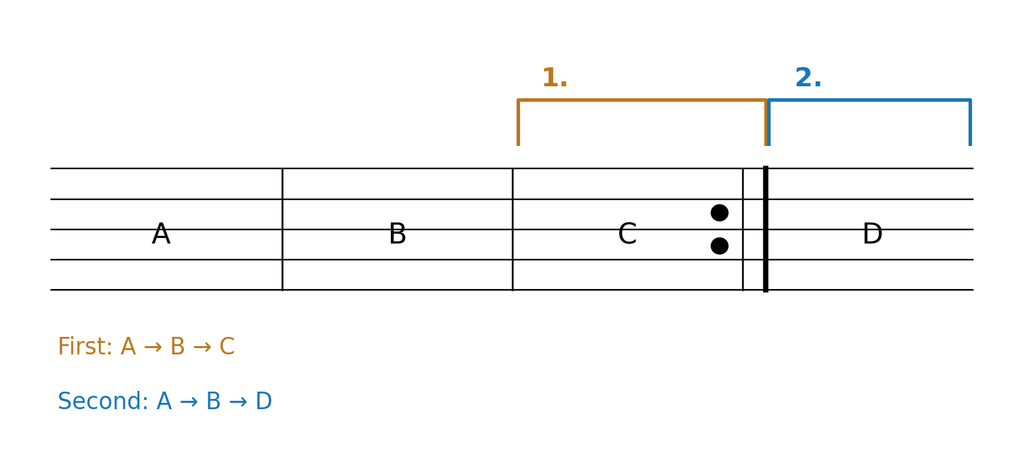
Notice that C is played only once.
When you reach that location for the second time, you skip C and move directly to D.
I find that showing students the playing order with arrows helps them understand how first and second endings work.
Why Students Get Confused by Repeat Signs in Music
One of the most common mistakes I see is that students understand the repeat sign when I explain it, but forget what to do while they are actually playing.
They may reach a backward repeat sign and suddenly stop.
Then they ask:
“Where do I go?”
Sometimes they remember where to return but forget whether they are playing the section for the first or second time.
As a result, they might accidentally play the first ending twice.
Other students skip the first ending too early.
The problem is not always that they do not understand the musical symbols.
Sometimes they simply lose track of where they are in the music.
Learning to follow repeat signs requires attention and memory as well as note-reading skills.
My Piano Teacher Tip: Look for Repeat Signs Before Playing
One of the most important habits I teach my students is to examine the music before playing the first note.
Do not wait until you reach a repeat sign to figure out where you should go.
Before beginning a new piece, look through the entire page.
Ask yourself:
- Where is the backward repeat sign?
- Is there a forward repeat sign?
- Where should I return?
- Are there first and second endings?
- Which measures should I skip the second time?
Taking a few seconds to understand the structure of the music can prevent confusion later.
I always encourage my students to think ahead rather than react at the last second.
This habit is also useful when learning other music-reading skills.
If you are still developing your note-reading skills, see my How to Read Sheet Music for Beginners: A Simple Step-by-Step Guide.
Remember Whether You Are Playing the First or Second Time
Understanding repeat signs in music is only the beginning.
Students also need to remember which time through the repeated section they are playing.
For example, after following a backward repeat sign, a student should think:
“This is my second time.”
When approaching the first ending again, the student should remember:
“I already played the first ending. Now I need to skip it and go to the second ending.”
During piano lessons, I often remind my students what to do.
However, when students practice independently at home, I am not sitting next to them.
They must learn to remember the playing order on their own.
If they play without paying attention, they may become confused and lose track of where they are in the music.
Good piano playing requires more than playing the correct notes. It also requires knowing where you are and what comes next.
Why Repeat Signs Matter When Playing With Other Musicians
Following repeat signs correctly becomes especially important when performing with other musicians.
This includes:
- Playing with an orchestra
- Accompanying a choir
- Performing in a piano ensemble
- Playing with another instrumentalist
When you practice alone, you may be able to stop and figure out where to go if you become confused.
But when you perform with other musicians, everyone must follow the same musical structure.
Imagine accompanying a choir.
The singers have already moved to the second ending, but you accidentally return to the first ending.
Suddenly, you are playing different music from everyone else.
The choir continues singing, but you may struggle to find your place again.
This is why I emphasize remembering whether you are playing a repeated section for the first or second time.
When playing with others, you must stay aware of the repeat signs and follow the same musical path as the rest of the group.
Common Mistakes When Reading Repeat Signs
Here are several mistakes beginning piano students should avoid.
Mistake 1: Returning to the Beginning Every Time
Not every backward repeat sign means returning to measure 1.
If there is a forward repeat sign earlier in the music, return to that sign instead.
Mistake 2: Playing the First Ending Twice
The first ending should normally be played only on the first pass.
On the second pass, skip it and move to the second ending.
Mistake 3: Forgetting Which Time You Are Playing
Students sometimes become so focused on individual notes that they forget whether they have already repeated a section.
Practice keeping track of the first and second passes.
Mistake 4: Stopping at Every Repeat Sign
A repeat sign tells you where to go in the music.
It does not automatically mean you should pause or interrupt the rhythm.
Keep the beat steady as you move through the repeated passage.
For additional help with keeping a steady beat, read How to Count Rhythm in Piano Music: Quarter Notes and Eighth Notes for Beginners.
How to Practice Repeat Signs in Music Correctly
When a student has trouble following repeat signs, I recommend practicing the musical structure separately from the difficult notes.
First, identify the beginning and end of the repeated section.
Next, trace the playing order with your finger.
If the piece has first and second endings, point to each ending as you explain when it should be played.
Then try playing the section slowly.
You can even say the instructions out loud:
“First time.”
“Go back.”
“Second time.”
“Skip the first ending.”
“Play the second ending.”
Once the playing order feels comfortable, practice the entire passage without stopping.
The goal is to understand the structure so well that following the repeat signs becomes a natural part of playing.
For another explanation of repeat signs and numbered endings, you can explore the free Introduction to Music Theory and Rudiments: Repeats resource from MacEwan University.
Frequently Asked Questions About Repeat Signs in Music
Do You Always Play Repeat Signs Twice?
In most beginner piano music, a basic repeated section is played twice in total.
However, some pieces include instructions such as “3 times” or other markings that change the number of repetitions.
Always follow the specific instructions written in the music.
What Happens If There Is Only One Repeat Sign?
If the only repeat sign is a backward repeat sign, return to the beginning of the piece and play the section again.
Can the First Ending Contain More Than One Measure?
Yes.
A first ending may contain one measure or several measures.
On the second pass, skip every measure included under the first-ending bracket.
What Is the Difference Between a Repeat Sign and a Final Bar Line?
A final bar line tells you that the piece has ended.
A backward repeat sign tells you to return to an earlier section and play it again.
The two dots help distinguish the repeat sign from an ordinary final bar line.
What Should I Learn After Repeat Signs?
Once you understand basic repeat signs and first and second endings, you can begin learning more advanced musical navigation markings.
These include D.C. al Fine, D.S. al Fine, and Coda signs.
These markings help musicians navigate longer pieces with more complicated musical structures.
Final Thoughts: Understanding Repeat Signs in Music
Repeat signs in music may look simple, but playing them correctly requires careful attention.
Remember these important ideas:
A backward repeat sign tells you to return to an earlier part of the music.
If there is no forward repeat sign, return to the beginning.
If there is a forward repeat sign, return to that marked location.
When you see first and second endings, play the first ending on the first pass and the second ending on the second pass.
Most importantly, always remember whether you are playing a repeated section for the first or second time.
After 25 years of teaching piano, I believe one of the most valuable skills students can develop is learning to think independently while they play.
Do not wait until you reach a repeat sign and suddenly wonder where to go.
Look ahead, understand the musical structure, and keep track of your place.
The better you understand the music before you play, the more confidently you can perform it.